Showing posts with label A.I.. Show all posts

Friday, 16 October 2015

Hannu Rajaniemi's "Quantum Thief" Trilogy


Review:

The pinnacle of high-concept, hard sci-fi, space opera cyberpunk, seemingly packed with every single concept the author could find, and he's a very smart guy: physicist, mathematician, cosmologist, recently launched a synthetic DNA start-up (via his TEDx talk). Finnish, but writing while in Edinburgh, literally hanging out with Charlie Stross, it's no coincidence that he's taken up the baton of writing the most futurism-idea dense, fast-paced (show don't tell) space-romp fun. Think "Accelerando" with the breakneck pace of "Singularity Sky". Stross surpassed I.M.Banks for this crown (in my mind), with stories that made traditional (mainstream) spaceship fiction look like quaint period dramas, pootling about in sail ships.

Mind uploads, planet scale computronium and all types of Singularity as obvious givens for Hannu Rajaniemi. He imagines the consequences of massively duplicated and branched individuals, in a complex future where identity and memory are slippery constructs and inequality has been inflated to vertiginous levels. It is cyberpunk, spun out, with contemporary nationality wiped away by subcultural identities flung across the entire solar system.

References are littered everywhere, at every scale of the telling, from throw-away pop-culture name drops (of famous games, anime series, etc), to terms for Ukrainian governance sub-divisions, to politics, philosophy and the (centuries old) historical origins of transhumanism. The books are so thick with meaning that they're far bigger than themselves; overloaded; virtually all the names and terminology (while sounding awesomely fitting, also) link the reader out to explore countless Wikipedia articles and culture.

Each of the three books has it's own distinct flavour, thematic reflections: personal, social (structure), philosophical and particular literary influences. Each also converges on a different planet, so their sub-arks cohere well as separate books. But they undeniably form a very carefully pre-planned and crafted whole. Densely plotted, too: subtle elements of the very first chapter of the first book become key through to the last. So, although Rajaniemi weaves in little reminder snippets here and there, it's highly advisory to read these books consecutively, and even then it may be worth checking out glossaries and/or synopsis in between.

If you are reading my blog, then you may well be within the core audience for this story, too. It fits perfectly with everything I've aimed to write about here myself. Other reviewers have complained of these books flying over their heads. Certainly I've been compelled to re-read sections, research meaning, etc, and am still not certain of precisely what happens in the conclusion. It is, however, definitely wrapped up properly. And I've had a virtually parallel (although even less than mediocre) academic path through physics and computer science, with strikingly overlapping cultural influences to the author (being, myself, only a little younger).

So perched atop the shoulders of high-concept sci-fi past, I'd definitely not recommend this series to the genre naive! Something to build up to, even more so than advice for readers to get a feel for Culture novels before embarking upon "Excession" or "Use of Weapons". Even then, you'll probably have to just roll with punches and maybe go back to pick out more of the details later. But  worth the effort and it works on multiple levels anyway!

[1] Quantum Thief (332 pages):

The first and best of the three. There is just no way that the others could ever have competed with the addictive rush from the tidal wall of novelty this installment hits you with! Also, with so much still a mystery, the fictional solar system feels bigger and far more real; a story in a crazy place, rather than about the place itself (which is more the case as the books progress).

The main setting here is also the most compelling in its familiarity, being structured around extreme technologically enabled privacy, with surveillance and control through information, all pressing issues (much like our present). The morally ambiguous gentleman thief character archetype drops perfectly into this setting, initiating the serie's liet motif of examining imprisonment, imposed control, security, enforced uniqueness, versus theft, liberation, diversity, etc.

[2] Fractal Prince (331 pages):

Feels the most out of place with the city of "Sirr"; it's characters didn't quite fit for me, or at least they are less knotted up with the plot than most of the others (arbitrary and single use by comparison). Twaddud felt stilted. Also, my disbelief was stretched thinnest here, with a core plot mechanism that could be a satire of Hofstadter's "Strange Loop" concept.

It's probably the easiest book to get lost in, which is saying something, since there are glimpses of deeper meaning secreted in plain sight throughout the trilogy, like fractal detail to gaze upon during re-reading. But this novel's "Arabian Nights", story(s) within story(s), "Inception" like structure doesn't help, and the intermingled interludes and flashbacks gain more concrete context from reading the next installment.


[3] Causal Angel (303 pages):

Neatly ties together all the pieces, places and people previous covered. Yet it is slightly shorter than the previous two books and feels shorter still. The plot is more linear, like it is following the ballistic trajectory that was set in motion.

Perhaps it could have dwelt a little longer on certain places and people; maybe some of the developments risked feeling a little too emotionally gymnastic, or unremarked upon. Although the core characters were developed across the entire length of the ark.


Discussion (SPOILERS Ahead!):

Wednesday, 25 April 2012

MASS EFFECT 3

In Summary (read-me for those yet to play):

It feels like this game is a pared down hybrid of it's predecessors; all extraneous features lopped off to make room for multiplayer mode to be sutured cleanly into place. The result is an even less bona fide RPG, however, the tweaks to the fighting mechanics that make ME3's co-op mode so very viable also raise the single player experience as far above ME2 as it was, in turn, beyond ME1.

ME3's rich inheritance of narrative, established in ME1, and vivid characters, developed in ME2, allows the single player game to easily get away with lacking the ingenuity of either of it's parents. This is a BIG GAME by most standards, yielding over 30 hours for one play through (excluding multiplayer). Story progression is smooth, more organic than ME2's shopping list of missions, but simultaneously more constrained and shorter (by raw single player mission count). Matters are somewhat more impersonal in their larger scope: your attentions are drawn outwards and upwards, vying for the loyalty of entire civilisations instead of squad mates. Gratifyingly though, romance options also extend beyond your personal involvement.

There are hilarious lines (though less frequent than in it's predecessor) and some brilliant moments, especially during the mid game section. However, in addition to the aforementioned cut corners, the game's concluding mission(s) did start to feel like a triumph of project management crushing creativity that would have further delayed the release date. Setting the specifics of the ending controversy aside, I still can not help but feel that a opportunity for monumental greatness was casually shrugged aside at the last minute. Thus, rather than earnestly shouting it's praises, I am now hesitant to recommend that any new comers play this series.

If you are the type who is intending to replay the previous game(s) first, aiming to cover every side quest and/or spend a couple of hours thinking about/reading up on the game afterwards, then the ending will probably be somewhat of an issue. For those just wanting something to fill 30 hours of spare time, or are more interested in multiplayer action, the 'controversy' will just be a bunch of gibber-jabber.

Contents:
  • Summary
  • Contents
  • Quick opinions:
    • Liked
    • Ambivalent
    • Disliked
  • Extended Critique
    • EMS
    • Superior Gameplay
    • Multiplayer
    • Diversity
    • Difficulty
    • Graphical Quibbles
    • Money
  • Discussion of Concepts Raised
    • Ethics
    • AI Treatment
    • Religion
    • Racism
    • Feminism
  • My Predictions Reviewed
  • To The End
    • Overview
    • The Ending that I Loved
    • Major Flaws and Nit Picking
    • Clarification
  • Indoctrination Theory
    • Supporting Evidence
    • Implications of Indoctrination
  • My Ending(s)
    • London Game Play
    • Final Explanation
    • Perspective

Sunday, 6 September 2009

Last Month in New Scientist (The Best of August 2009)

For all the articles in the magazine that I've found interesting but not thought worthy of an entire blog entry devoted to them. I was aiming to mention about 4 articles per issue, with a paragraph each. Naturally, I've elaborate significantly in places (the Noel Sharkey interview became a full blown piece on it's own), and there were 5 magazine issues this month (opposed to the more usual 4). I'd say that it is, at the least, worth a scan through the article titles listed below, in case anything jumps out at you too.

I've not provided links to individual articles online, just the issue's index page, seeing as most people won't have full access to many of the articles anyway.


** 29 Aug:

+ "It's a small world - in a healthy brain" p14 -
The neuronal structures (in human cortices) display behaviour consistent with their connectivity being finely configured to a state of 'self organised criticality'. Basically that means cascades of activity are as unpredictable as earthquakes and the neurons form a structure more like human society (where one's only ever 6 degrees of separation from anyone else on the planet), rather than merely relying on neighbouring cells to pass signals on to their neighbours, etc. This comes as no surprise to anyone who's up to speed with the revolution of network theory from the beginning of this decade. And it doesn't elucidate much further as to how we think, let alone what makes us conscious/sentient.

The sited study looked at brains with Alzheimer's (which were seen to have long distance connections that were too random) and Frontal Temporal Lobe Dementia (which had too few long distance connections).

So I now wonder if something similar might be the cause of dyslexia (rather than macro-scale variations, like a particular brain region being smaller). For me dyslexia has meant: very slow reading speed in particular (even more prominently than blindness to certain spelling transliterations). What if my current condition also represents a structural deviation in my brain?; A decline in cognitive ability, particularly higher order (conscious) thought that, presumably, requires the most widespread cortical co-ordination, making it most susceptible to such faults.

Of course, even in an optimally order brain, each cell's activation threshold has to be carefully tuned, so that the network operates in a region of chaos, rather than epileptic fit or coma (too low threshold & too high threshold, respectively). Neuromodulation (by serotonin, melatonin, dopamine, adrenaline, etc) and variations in oxygen and glucose concentration can also be responsible for moving the brain away from it's optimal operating range.

+ "Air travellers get a robot chauffeur" p19 -
I (and some of my friends) have thought for a while that we could have entirely 'self driven' cars on the roads by now, from a technical stand point. The (good) reason why we actually have none, is that

Saturday, 5 September 2009

On: "The revolution will not be robotised" NewSci 29Aug09

p28 - Two page interview with Noel Sharkey (perhaps most famous for being a judge on BBC's "Robot Wars"). Or "Why AI is a dangerous dream" (online).

- Basically, he's sitting on the fence, saying that he needs to see proof of artificial sentience before he'll concede it's possible. He does at least give fair mention to the opposite side of the debate (Hans Moravec and Ray Kurzweil).

"The mind could be a type of physical system that cannot be recreated by a computer"

His sentence should use "in" in place of "by": A computer can no more create or be sentient(s), than can a calculator understand mathematics. It's a category error; computers are merely calculators by design. Artificial Sentience would come in the form of software running on a *very* powerful computer, or a radically different electronic architecture.

But he doesn't give any examples of systems than are fundamentally impossible to emulate on computers, or why they be so. Given the amazing accuracy of physics simulations (able now to simulate entire viruses from quantum mechanical subatomic upward), I think the burden of proof should be on the other foot. But proving that a real world system can never be simulated accurately would appear to be equivalent to proving it could never be scientifically defined or understood. Quite possibly a paradox; thus everything is computable (eventually).

He admits that his own work is on problems immediately solvable with AI; these systems truly are tailor made by clever humans to solve simple problems as reliably and predictably as possible. Hence they are brute force and dumb as possible. To attribute any/all successes of a creation to it's creator is clearly flawed though: The inventor or an electronic calculator can not claim to be able to immediate find the square root of any 12 digit number. Genetic algorithms, today, are consistently finding designs (for RF aerials, F1 car aerodynamics, traffic light systems) that their human creators would *never* have come up with (often utterly weird and counter-intuitive). I'm not saying, therefore, that a piece of code should be attributed the status previous granted to the human expert it has replaced. I'm saying that intelligence has never been what it's cracked up to be. I like the his quote from Marvin Minsky:

"AI [is] the science of making machines do things that would require intelligence if done by humans."

Much of the progress in 'AI' to date has been through reducing our over-estimation of the mental abilities of humans, rather than attaining this mythical quality we call "sentience".

- This is all fine if he's taking this standpoint purely as a means to an end: getting policy makers to treat the current generation of robots correctly. In my experience there is a lot of anthropomorphising of very dumb machines (even by roboticists/computer scientists, who should know better). This is merely evidence of humans' lack of intelligence, rather than any limitations on future machine intelligence, as Sharky would have it. People expect too much too soon, then too little further in the future (after short term over-optimism falls flat), because people have little/no intuitive understanding of the experiential nature of technological progress.

The experts may just be using language loosely or hyping up their creations, but this could lead to a climate of misunderstanding in those outside the domain of expertise. A strong sceptical voice might well be beneficial here, to help avoid detriment to humanity. Warfare is the most pressing issue:

Last millennium, the ethics of tactics in armed interventions (e.g. US's various wars: Vietnam, Iraq 1, etc) there has been a balancing act between minimising foreign civilian casualties, and minimising troop casualties. Shelling from a distance, of dropping bombs from on high keep your boys safe, but are significantly less discriminatory as to whom they kill. Homeland public opinion is naturally biased towards it's soldier's safe return, but there are also limits to how many collateral deaths are acceptable.

Contemporary military automation seems to be forging ahead towards zero coffins being flown home, but on the flip side is only aiming (at best) to be equally as competent as human soldiers are currently. It shouldn't be a question of whether a robotic sniper cut distinguish civilians for militants as capably as a trained person can?; we should be asking: is it really necessary to use deadly force at all, when it doesn't even keep our military personnel safer? It's no longer 1 life vs. X number of civilian casualties; with robotic troops, it's human casualties now have a direct market valuation ($X). This kind of thinking doesn't seem to factor into the arms industry's thinking enough yet. It may take a massive humanitarian outcry (from a home population) before policy makers take note.

- Elder care won't be a significant issue until anthropomorphised robots become a reality (decades off for many reasons). If the Elderly miss out on genuine human contact as a result of carer's jobs being taken over by robots, this is more likely to be a result of necessity; the 'baby boomers' will soon be reaching that age range, adding greatly to the growing burden of an ageing society.

- He has the “Robocup” example the wrong way around: robotics is utterly failing to match the coordination and finesse of human movement; kicking a ball accurately is a long way off (the latest Asimo can barely run on a perfectly flat surface). Strength and endurance are also major deficits of, would be, artificial players: there just aren't the materials technologies to match the combination of human muscles and biochemical energy reserves, honed over billions of years of evolution.

On the flip side, tactics are easier to define. Leaving aside the 'computer vision' systems necessary to operate a stand alone robot soccer player, I don't see any reason that an AI system could not soon obtain optimal tactics (player positioning wise) within the next 10 years, or less. This might well be achieved through a 'brute force' technique, i.e. evaluating the positions of players in every recorded football match available. More examples and detail than any human player or manager could ever hope to scrutinise. But why should this be assumed to be cheating?; in a person it would just be considered the advantage of experience.

Wednesday, 6 December 2006

Energy for free?

New Scientist (02/12/06):

Understanding the swing of things
: "By engineering such variations, Peyrard has shown, you could make heat flow 10 times more easily in one direction than its opposite."! If this can be applied in a real world aplication, surely it would mean rewritting the 2nd law of thermodynamics for starters!

There are multiple ways of extracting useful (work) energy from a temperature difference. Generally a system that does this is called a '
Heat Engine'. Therefore, combining a brand new, state of the art, physics violating heat pump and a thermoelectric generator (using the Seebeck effect) or even a good, old fashioned, Stirling Engine, you can use any heat reservoir (i.e. any matter or radiation with a temperature, i.e. anything!) and extract *all* it's heat (within the operating temperature of this new device) into useful energy.

The article doesn't say anything of the possible uses of a real device (perhaps a conjecture too far considering the massive potential), and as always there are skeptics saying that the 1D computer model of the 'Breather' effect, slowing thermal conduction, is not applicable to the 3D world. Though, carbon nanotubes are practically 1 dimensional creations.

...D'oh!...Hang on, just figured out why my free energy idea is folly: selective resistance to heat flow can no more 'pump' heat, than a diode can pump electicity! (so the answer is a resounding NO...for now) However, you could make digital electronic circuits out of such components that use pure temperature to operate them instead of voltage. Possibly very useful, if components can be realised at a tiny scale.


Also pointed to by this edition is the Pentagon
buying 1 Petaflop (10^15 calculations per second) machines off IBM/Cray, to be built in the next few years. Though they'll probably just be used to calculate simulations of nuclear weapons in excruciating detail (seeing as live tests are frowned upon these days... yes france i'm looking at you! I know Pakistan and India have been naughty too, and North Korea would like us to think the have, but you should know better!), the raw computational power available in such a machine is approximately equivalent to that of all the neurones in a human brain...... which might make for a truely interesting application, if we had more than the fintest clue how the human brain is structured! Hopefully by the time the price of a 1 Petaflop device has fallen from a state budget busting $1/4 Billion to the price of an off the shelf PC (about 2025), we'll have figured out the missing details.


Monday, 4 December 2006

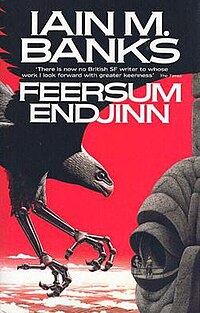
Book discussion of Feersum Endjinn (Iain M. Banks)

Having read all the other sci-fi novels by Banks, I'd originally been put off this one since it wasn't a Culture novel and was supposed to be written largely in a strange phonetics. I'm very glad I finally got around to reading it (after picking up several of his books cheap, second hand) because it's a beautifully crafted, complex piece that has clearly influenced the likes of 'the Matrix' massively and is still relevant today, despite being written over 12 years ago.


The setting of the story is utterly unparalleled in anything else i've heard off: a post singularity earth inhabited by the descendants of technology and strong A.I. refusonists who still utilise some of the handy benefits the pro-advancement (humans) presumably left for them. [tangent: though Banks has never referred in any way to a singularity as such, and generally alludes to a pretty slow pace of change of the societies in his books. Though this is justified because each culture (including the Culture itself) is stuck at it's current level of advancement for a reason: ethics in the case of the Culture, considering it irresponsible to just up and transcend, leaving the universe in a mess] The venue for most of the story is a an oddly scaled castle and bailey with floors 1 kilometre high (seemingly an OTT artwork created by those who left), now infested by normal sized people.

One such benefit being 7 lives (a somewhat arbitrary number, but it's traditional it seems); an implant scans the state of a person's brain at the moment of death and squirts the data off to mould the brain of a replacement body; your last death is not entirely final either, as your mind/soul is then left running in the Crypt where it has a further 7 'lives'.

The Crypt(osphere) is a giant, multi-level virtual reality, where the top-most environment is pretty much a copy of real world earth, with lower levels becoming increasingly bizarre and uninterruptible ('chaotic'). When you die in the Crypt (or wander too deep out of boredom) you are absorbed into the sea of all possible knowledge/experience of the lower levels. The Crypt is obviously the repository of countless millions of souls, therefore to maintain any kind of individual identity, you must be diverse/unique/smart. The souls attached to the crypt are not just human either; some animal minds seem to be linked up directly. A skilled Cryptographer (here meaning person who interfaces with the crypt, probably as a profession) can hack his way into an animals brain and control them, though the book is somewhat vague about the specifics, sometimes it seems they are in the real world and others in the simulated.

Banks imbues the Crypt with a vague, slightly mystical format, which contrast with current day ideas to a similar (though lesser) degree as William Gibson’s ‘Neuromancer’ (the difference being that Gibson’s world is a direct extension of our own, mere decades down the line, while Banks’ is distantly removed and carefully set). Something he does nicely is the massive speed difference between ‘Crypt time’ and normal time. With your mind temporarily uploaded you experience time at about 10’000 times the normal rate, able to have a fairly sizable adventure in the blink of an eye, gain lifetimes of experiences in days, or, in the instance where a story strand’s main character (Gadfium) is nearly assassinated while having her mind duplicated to the Crypt, use the vital seconds while the killer is distracted killing a bystander to: do some background research, hack the controls of the building, do some extensive image processing and analysis on her real life counterpart’s vision and plot the exact muscle movements needed to disable the attacker effortlessly. A very cool escape scene there.

Banks often makes use of characters with different perception rates: human Culture members could chemically stimulate their brains to think/react very fast to kick arse in combat (as if in a different time frame), and more substantially, the Culture Minds were capable of giving human level intelligences entire lifetimes in microseconds (see the end of Look to Windward). This brave ‘relativistic’ time use is something I’ve not really come across much, and only in more recent novels: the ‘Conjoiners’ can think up to 10 times faster than normal due to nanotech crammed skulls (almost trivial really, in Alastair Reynolds’ Redemption Ark), then very recently in Accelerando (Charles Stross) where spawning agents to lives alternative lives is standard practice in the later half of the 21st century.

It turns out that the hardware running the crypt simulations is the Serehfa Fastness itself (the castle building) - it’s made of a self healing computronium. The physical structure of the Crypt has a large influence on the internal environment of the simulation world; Sessine (a main character that dies for the last time in his first chapter) has to actually dodge past big, writhing, tubey things before wondering off around the (unreal) globe. This is a real last millennium conception…but I’ll let Banks off.

The culmination of the plot is complex: it turns out that the unhackable, anonymous, amnesiac, known as Asura (an accurate name for her) is in fact an real world incarnation of an instance of Count Sessine that was left to run in the Crypt independently for years of real time, thus acquiring intimate knowledge of the Crypt and pretty much all significant goings on. She reveals to *everyone* that the chaos in the crypt that the humans have been ‘fighting’ off, presuming it to be viral corruption, is actually an ecosystem of A.I. (artificial life forms) that are not hostile by intent.


Buscule, who falls (often literally) though a long series of semi-fortunate fantasy-cyber-adventure, after being manipulated into investigation by the faked abduction of his new telepathic ant friend (actually a Culture-esc nanotech A.I.) by a large bird, turns out only to be needed to scale the oxygen depleted heights of the Fast Tower to open a door that Ergates (the ant/key) was frustratingly too feeble to open itself. This mundane outcome in itself is a charmingly ‘down to earth’ twist, contrasting the Ant’s extensive capabilities in manipulation (presumably working in the background continuously to get Bascule out of all kinds of scrapes with the opposing military, etc) with it’s basic physical failings. They both achieve their destiny, activating the tower’s secret lift system and equipment, allowing Asura, Gadfium and some assorted refugee Chimerics (human level intelligence animals) to ascend the 10 vertical miles to the secured controls for the Feersum Endjinn, the solution to life on Earth’s biggest threat…

…Oh! Had I not mentioned yet that all the upset is due to a ‘molecular cloud’ ‘Encroaching’ into the solar system, blocking out sunlight so badly it’s going to kill all life, if not the sun itself. This machine is clearly something with capabilities equivalent to a Culture ship, but Banks neatly goes into no details to specify this, using only the title of the book to attach to it’s capabilities, leaving this reader happily satisfied with the title finally being explained as the last event, and leaving the novel as a stand alone artefact, as timeless as sci-fi can ever hope to be.

Through the story, the ‘King’ had been waging a secret ‘war’ against the splinter Clan: Engineers, for their access to a wormhole hidden in the lower part of the ‘Fast Tower’. The dilemma is that at the time it seems like the only escape route from the doomed earth and the governmental folks are keen to get out while they can! However, being rejectionists of high technology (the ‘privileged’ in their society are the few reserved for the high flying life, free of the distasteful chore of having Crypt communication implants) they’d rather save they arses in the full flesh rather than use an optimised approach that would allow everyone to be transmitted safely as digital uploads. This is Banks once again really romping home the point that discrimination against digital copies of people or strong A.I.s is just as bad as the racism of old, and perhaps could lead to atrocities even worst that those of the past! This is a recurring theme in all of his sci-fi, with the hopeless world of Against a Dark Background being a stark warning of a hypothetical result of absolute rejection/suppression of A.I.

Finally, the ‘original’ version of Sessine (with no lives to spare) sacrifices his soul in a Jesus like gesture of enlightened selflessness to become one with the Crypt A.I. in the hopes of giving it conscious form, with no guarantees there will be anything recognisable of himself left to reflect upon this thereafter. I would like to liken myself to Sessine, in that I’d consider my main strengths of intellect to be strong ethical/moral/logical reason (i.e. wisdom). Pompous of me, I know, but it’s a bit of an ambition of mine to take the cream of my human experience to temper the near infinite capabilities of a transcendent mind. I anticipate my fond smile as I briefly recall my human existence, like someone else’s faded dream, happy that it is now barely a fraction of what I’ve become. But then that’s just like growing up anyway (except without being able to casually prove the Riemann Hypothesis in an idle moment, etc).


Tuesday, 24 October 2006

A world-brain called Google

"Assuming that you keep your schedule in Google Calendar (and really, who doesn't these days?)" from an article on Engadget brought to my attention a feature of the ever diversifying Google that i'd failed to notice and may now use!


Then this BBC article pointed me to an even more significant development: customised Google Search. Provided i can login easily on remote machines this could be particularly handy, as it incorporates a whole shed load of customizable content: GMail inbox, to-do lists, local weather, RSS news feeds from my favourite sites + quick search boxes for Wikipedia and so on.... I've not even made any new searches to test out main feature of this new service!


At first glance this service appears altruistically helpful, though i'm sure the profit will continue to pour in as usual back at Google headquarters. I'd guess the service is mostly to encourage use of the custom search facilities that will allow higher paying, even more directed ads. However, Google’s expansionist efforts have been touted as being far less successful than it's root interest. Add to this the much squawked about $1.6B for YouTube, that seems a little puzzling in itself (given the potential copyright issues), and it looks a little like the big G's vying for a monopoly on the worlds information! (though this is Google’s first big purchase, and take-overs have been rife in big business for ages. Any hot new company with a new hold on a service gets snapped up, probably by a bigger fish that came to popularity in a previous wave of success).

Which brings me to an article by George Dyson (Son of physicist/intellectual/extraordinaire Freeman Dyson, whose books have been a big influence for me) on the Edge that i've been meaning to blog for a little while:

TURING'S CATHEDRAL (by George Dyson):

The main meme of the feature is speculation on the possibility of strong A.I. having been created and already
existing in some form within the Google computer equipment. Naturally this sounds entirely fanciful at first, given that the limited power of computers, for the moment, inhibits the simulating/emulating anything nearly as complicated as a human brain. Then again, if anywhere was able to support a true A.I. it would be within those estimated 450,000 servers spread around the world potentially using some of the masses of dark fibre bandwidth it wanted to/did purchase some time ago (Link 1 | 2).

Here are a selection of quotes from the article (higlighted in red) that i think are enlightening, starting with a little mitigation against those who may think creating artificial consiousness would be as good as trying to steal God's powers:

Alan Turing - Computing Machinery and Intelligence: "In attempting to construct such machines we should not be irreverently usurping His power of creating souls, any more than we are in the procreation of children...Rather we are, in either case, instruments of His will providing mansions for the souls that He creates."

Google Employee: "We are not scanning all those books to be read by people," explained one of my hosts after my talk. "We are scanning them to be read by an AI."
A pretty direct statement! One that does make me excited like the little child that i am. Of course, having that vast amount of accumulated information is one thing, processing and 'understanding' it is another! Then there's the question: in what way is this potential intelligence observable? What capabilities will it control? Mearly a textual input/output on a secret terminal screen somewhere?

H. G. Wells - World Brain (1938 ); "The whole human memory can be, and probably in a short time will be, made accessible to every individual...This new all-human cerebrum need not be concentrated in any one single place. It can be reproduced exactly and fully, in Peru, China, Iceland, Central Africa, or wherever else seems to afford an insurance against danger and interruption. It can have at once, the concentration of a craniate animal and the diffused vitality of an amoeba."
Google is perhaps already doing a fair approximation of a 'world brain', even bowing to censorship demands to ensure it's pressence in china. A search engine accessible by practically the globe in any language, that can understand and answer all requests is almost explicitly the goal of Google, so it seems, and is almost exactly the description of a 'Hub/orbital/rock mind' from Ian M Banks. Read "Look to Windward" for a detailed description of a hub mind within a brilliant story!

I'm going to finish on this thought provoking note:

Anomalous accumulation or creation of wealth might be a sign, or an unquenchable thirst for raw information, storage space, and processing cycles, or a concerted attempt to secure an uninterrupted, autonomous power supply. But the real sign, I suspect, would be a circle of cheerful, contented, intellectually and physically well-nourished people surrounding the AI.