Showing posts with label prediction. Show all posts

Wednesday, 5 October 2011

Kondratieff Waves... Crashed Our Economy!

This article presents a divergent hypothesis from Tyler Cowen's lack of 'low hanging fruit' hypothesis for the current Stagnation (discussed in my previous post).

I was going to make one quick mention of a pure economics based thought that might have contributed to our current depression but it was based on an understanding inversion (see tiny writing below):

The 1970s switch of Government policy away from Keynesian practises towards monetary policies that buffered the economy from depressions and recessions may have precipitated the financial crisis by their very success: economic fluctuations shake the wastage out of the system, forcing inefficient businesses to shut down, reform or lay off unproductive staff. Keeping things steady just allowed more detritus to accumulate on the buckaroo donkey, saving all the pain for one big, inevitable mess... Well, actually that's complete nonsense!; It was *Keynesianism* that involved strong state intervention (like The New Deal). The 70s and 80s saw the rise of neo-liberalist policies promoting deregulated, free markets and privatisation. So, if anything one would have to blame *over* optimisation for the crash. 


+ Introducing Kondratieff waves:

To say that (inter)national economies are complex things is a blatant understatement. Many factors can effect a short term change in GDP growth rate; changes in: money supply, taxation, national interest rate, financial/business regulations (or removal of), public sector redundancies, etcetera. These have each caused quick and apparently large fluctuations in the past, but ultimately such disturbances only manifest for a couple of years at most before return to equilibrium. No amount of fiddling with these factors can stimulate sustained economic growth. Period. Yet on aggregate, since records began, the world GDP has *always* grown, year on year, even during the great depression, world wars and right now.
US GDP per person - "The Singularity is Near"
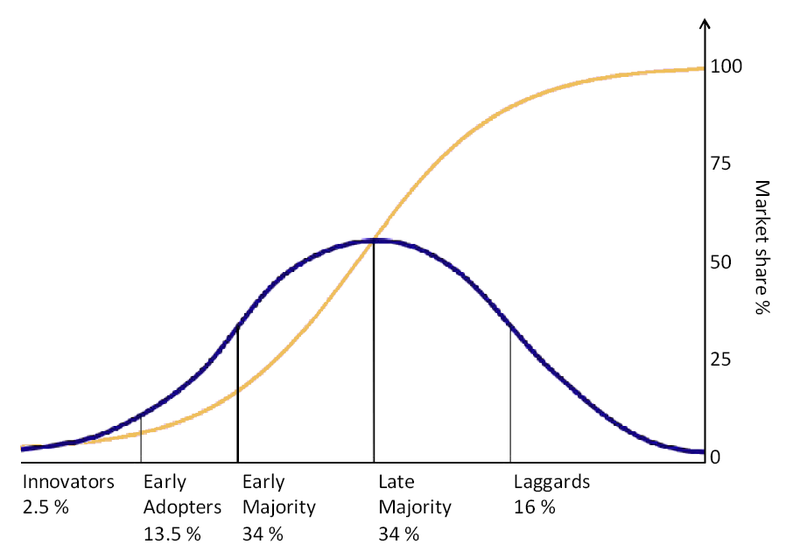
This continual rise in per-person wealth, standard of living and productivity has come from a succession of  technological innovations that have permeated society. Although, from an historical distance, the long term growth trend of a country looks pretty smooth, innovation uptake by members of a society tends to following a wave of adoption. Very gradual at first, rapid as it gains widespread popularity, but then perhaps never quite reaching *everyone*.
Wikipedia - Diffusion of innovations
There are only a discrete few innovations that are such majorly influential improvements to life as to have become ubiquitous (for example: mains electricity, automobiles, the internet), so they are spaced along our past. Each major innovation stimulated frenzied economic activity, indeed much employment was necessary to build, from nothing, massive infrastructure or industry (e.g. the railway/motorway network, industrial revolution). Lulls occur after each wave of innovation (because science takes time and) because the start of a wave is dependant on the new environment created by the previous one. So one should expect GDP growth history to be a little lumpy; a series of economic revolutions.

Nikolai Kondratieff wrote of his observation of a long wave economic cycle, back in 1925. It earned him Soviet Gulag, death by Stalin, and title to this theory (respectively). He estimated a fixed period of 50-60 years per cycle of: expansion, stagnation, recession. Since then it has been more commonly split into 4 seasons or irruption, frenzy, synergy, maturity (or such like).

Tuesday, 30 March 2010

China's Geely buys Volvo for $1.8bn

So why does an automotive acquisition pique my interest? (on BBC or Telegraph)

Well, anyone who follows this blog shouldn't have failed to notice me preaching about how revolutionary PML's Quad Electric Mini is/was. PML (a small Hampshire based company) got caught in the recession, November 2008, and was split asunder. Now one company ("Printed Motor Works") continues their old line of "Printed Armature/Pancake" electric motors and another: "Protean Electric" (that employs 60, mainly engineering, staff). Protean Electric continue to develop the "Hi-Pa Drive" system, of in-wheel car motors and all electric drive train, working closely with Volvo. There's the link.

Volvo's been developing this technology in it's C30 ReCharge plug in hybrid (video below), though it has been dubious that it would actually feature in their forthcoming 2012 models. Development and testing costs are likely the issue here, as it represents a paradigm shift in car propulsion, and Volvo (car division) has been consistently loss making since it was bought by Ford in 1999 for almost 4 times the current valuation.


There's no question in my mind that regenerative hub motors will be the automotive norm by 2030, it's just a matter of how long is spent 'umming and ahhing' over them before they're accepted. The longer it takes for proper electrics/hybrids to take off, the longer it is before we start reducing environmental damage and the deeper we'll get into ugly realms of oil scarcity. Of course, it would also be nice to see the British company, that first developed this ingenious system, profit from it before everyone else rips it off.

Consumer nervousness over using regenerative breaking as the main/sole way of stopping a car will be a major challenge (perhaps the biggest), a conundrum perfectly suited to Volvo, with it's reputation for unimpeachable safety standards.

Hopefully Geely's cash injection will secure the research partnership with Protean. But I suspect Geely will end up being more closely involved in crafting an affordable product. Geely started in refrigeration in 1986 and has worked it's (his) way through motorcycles to being the premier Chinese owned car manufacturer, the only one that has managed to successfully produce it's own fully automatic transmission system.

I imagine that gaining ownership of all Volvo's intellectual property was more than just a bonus for Geely; hopefully they've recognised the particular potential there. They have already signed an R&D agreement with Tanfield Group (presumably to utilise the experience of Smith Electric Vehicles) to work on converting London's black cabs, thanks to co-owning Manganese Bronze. At the very least Geely comes replete with a cheap manufacturing base: China. (Though, oddly Geely's workforce is currently half that of Volvo's)

There is of course a 4th piece of the (successful, next generation, plug-in/series-hybrid car) puzzle still to fall into place: the battery technology. Lighting GT has a Hi-Pa Drive based product available for order right now, considered the Aston martin of electric cars (I'm still dying to see it on the Top Gear track). But the Altairnano lithium-ion battery it packs costs $70k alone. Fine for a ground breaking, limited production, high end, luxury sports car, but not for a family hatchback. However, there is already a huge amount of competition in the lithium battery research field; all car manufacturers are having to push this tech along as fast as possible. So Geely may not even need to bag an exclusive, battery producing, partner. Also, the HI-Pa drive system has an advantage here because of it's inherent efficiency: no transmission loss to lay down power, no transmission loss regenerating (10%-20% each way, repeatedly). If anything the system needs batteries with faster discharge times, rather than greater capacity.