Showing posts with label infrastructure. Show all posts

Wednesday, 5 October 2011

Kondratieff Waves... Crashed Our Economy!

This article presents a divergent hypothesis from Tyler Cowen's lack of 'low hanging fruit' hypothesis for the current Stagnation (discussed in my previous post).

I was going to make one quick mention of a pure economics based thought that might have contributed to our current depression but it was based on an understanding inversion (see tiny writing below):

The 1970s switch of Government policy away from Keynesian practises towards monetary policies that buffered the economy from depressions and recessions may have precipitated the financial crisis by their very success: economic fluctuations shake the wastage out of the system, forcing inefficient businesses to shut down, reform or lay off unproductive staff. Keeping things steady just allowed more detritus to accumulate on the buckaroo donkey, saving all the pain for one big, inevitable mess... Well, actually that's complete nonsense!; It was *Keynesianism* that involved strong state intervention (like The New Deal). The 70s and 80s saw the rise of neo-liberalist policies promoting deregulated, free markets and privatisation. So, if anything one would have to blame *over* optimisation for the crash. 


+ Introducing Kondratieff waves:

To say that (inter)national economies are complex things is a blatant understatement. Many factors can effect a short term change in GDP growth rate; changes in: money supply, taxation, national interest rate, financial/business regulations (or removal of), public sector redundancies, etcetera. These have each caused quick and apparently large fluctuations in the past, but ultimately such disturbances only manifest for a couple of years at most before return to equilibrium. No amount of fiddling with these factors can stimulate sustained economic growth. Period. Yet on aggregate, since records began, the world GDP has *always* grown, year on year, even during the great depression, world wars and right now.
US GDP per person - "The Singularity is Near"
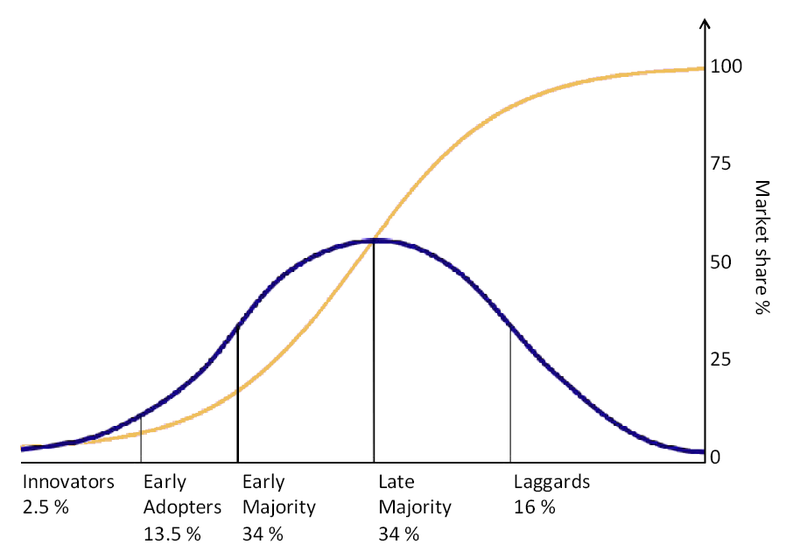
This continual rise in per-person wealth, standard of living and productivity has come from a succession of  technological innovations that have permeated society. Although, from an historical distance, the long term growth trend of a country looks pretty smooth, innovation uptake by members of a society tends to following a wave of adoption. Very gradual at first, rapid as it gains widespread popularity, but then perhaps never quite reaching *everyone*.
Wikipedia - Diffusion of innovations
There are only a discrete few innovations that are such majorly influential improvements to life as to have become ubiquitous (for example: mains electricity, automobiles, the internet), so they are spaced along our past. Each major innovation stimulated frenzied economic activity, indeed much employment was necessary to build, from nothing, massive infrastructure or industry (e.g. the railway/motorway network, industrial revolution). Lulls occur after each wave of innovation (because science takes time and) because the start of a wave is dependant on the new environment created by the previous one. So one should expect GDP growth history to be a little lumpy; a series of economic revolutions.

Nikolai Kondratieff wrote of his observation of a long wave economic cycle, back in 1925. It earned him Soviet Gulag, death by Stalin, and title to this theory (respectively). He estimated a fixed period of 50-60 years per cycle of: expansion, stagnation, recession. Since then it has been more commonly split into 4 seasons or irruption, frenzy, synergy, maturity (or such like).

Tuesday, 7 December 2010

Physical Interweb Pipes for Produce; "FoodTubes"

* From this article on ilookforwardto.com.

Initially this reminded me of a system I envisioned a few years ago. That was more for of a local loop thing: store to household delivery of groceries, post & small parcels or restaurant food. Self powered bogies, the size of supermarket home delivery crates/boxes, that run through rectangular cross-sectioned conduits under roads/pavements, finding their destination by being forwarded like packets of data on the internet.

[ XKCD - http://xkcd.com/827/ ]
I thought my idea would be unlikely to make wide scale implementation, given the massive investment required merely for wiring up households with new data/communications lines. It seems more likely that automated intelligence will solve the problem by utilising existing infrastructure: an extension of driverless cars. Either the recipient of a delivery walks out to collect the package from said robot car (that would not complain about unsociable hours) or, some years later, properly smart humanoid delivery bots could be deployed from the cars for the last 10 meters.

* However, this FoodTubes concept has more fundamental benefits:
+ Energy efficiency - "1/5th of current freight prices" when HGVs/vans/trains use 92% of their energy to move purely the vehicle.
  - These are based on current scenariors, which is fine for now, and as long as the scheme can recoupe it's cos before the advent of 100% electric lorries, charged of solar PV, AI drivers.

+ Food security (independent of roads and severe congestion or temporary fuel shortages).
     - Though (with a single main loop) I would worry about it's reliability (resistance to natural structure failures, capsule collisions, or even sabotage) and repairability (possible methods to clear out or even replace tunnels that where bored underground.

+ Boon for car drivers; fewer HGVs means:
     - Less getting stuck behind slow or overtaking lorries.
     - Significantly less wear on the roads.
[ Top - Capsule (2m long, 1m diameter). Bellow - conduit construction illustration. ]
* Will it happen?
The FoodTubes website looks very 90s at the moment, and designs are all vague concepts, so a 10 year minimum time-frame might be par. It's basically a set of case study documents that did well in this "St Andrews Prize" competition (ideas for reducing environmental impact or something). Although, there are some pretty high brow members of the team (professors, industry experts, prominent layers). Not sure what type of company would be able to spawn a division capable of this flavour of (inter)national scale undertaking...

As an 'internet for goods' there needs to be common standards, like the shipping container system currently used worldwide on ocean vessels and lorries. Island UK could get away with a bespoke system, but Europe would require more consensus, for example. Having cylindrical capsules rules out direct compatibility with containers, and possibly even pallets, so massive repacking operations will be necessary at ports or other distribution centres.

With China looking set to use our currency from their trade surplus to finance rail links to us, this kind of scheme would make even more sense: as the last leg of a faster, more reliable (than ships and lorries) delivery system for manufactured goods,  which will be increasingly customised, in smaller batches, with ever more desire for shorter lead in times from manufacture to receipt.