Showing posts with label critique. Show all posts

Sunday, 14 April 2024

3 Body Problem - Series Review vs Book 1

I read the first book of Liu Cixin's trilogy (translated from Chinese by Ken Liu) in 2016. So, fittingly, just about enough time has passed for a radio transmission to reach and return from the Proxima Centauri system... Also, more than enough time for me to forget many of the details! So I was not overly focused on expected plot waypoints, or any finer details, in the new Netflix series.

This streaming adaptation is by Benioff & Weiss, of Game of Thrones infamy, plus Alexander Woo (True Blood writer, apparently). Thankfully, they won't have to make up their own ending from scratch, this time. But given that the books reportedly get increasingly grand in cosmological scope and concept, we'll have to see what they make of the rest, come season 2. Hopefully not too far off!
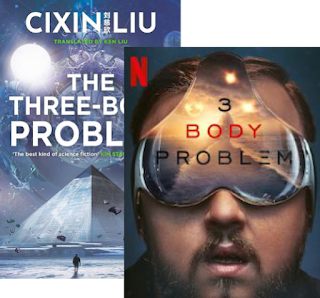
Book 1 (left). Netflix series thumbnail (right).

► My Initial Impressions of the Show [Low Spoiler]: the pacing was good and quick, despite the 1 hour episodes. So some of the many hard sci-fi concepts were shaved down to "blink and you'll miss it". Some things maybe discarded from the plot a little too soon. There was a frustrating lack of discussion of major events, following on from the big dramatic episode endings. 

But they managed to include a surprisingly large amount of the original material and feel, while finding a better compromise for retaining audience attention. Better than the somewhat laboured tour of scientific history, etc, in the first book. I was still surprised to see the show reach the main plot culmination of book one by the end of of the Ep 5. With 3 left to go! Apparently, they linearized the trilogy timeline, including a lot from Dark Forest and even some from Death's End.

I was a little disappointed how almost all the contemporary (2024) setting of the show was plonked down in London. Deploying a distracting remobilisation of GoT resources, with a far more 'international' cast than the books. White-washed vs the novels? Perhaps. But it worked well; the main characters were utterly remixed into an original ensemble, with more compelling personalities and social relationships. 

And there's already been a 30 episode (!) Chinese TV series adaptation, released in early 2023, with all Chinese cast. Apparently it drags badly, literally converting almost everything from the books. *Except* for the Netflix series' brutal opening scene, in the Chinese Cultural Revolution. The Chinese audience gets historical censorship, while we get soft power propaganda, only seeing the horribly outdated worse of China's tumultuous political neurosis and industrial devastation of nature.

Monday, 17 July 2023

"Scale" by Greg Egan - review and critique

► Review: I struggled to complete Scale; not up to the standard I expected from reading Schild's Ladder and Permutation City.

The concept is cool, if ambitious to reconcile in the messy details. But I was continually frustrated that Egan gave so few descriptive details of the different perspectives of physics, in daily life experience for the smaller scales. He glossed over a very major plot detail and entirely ignored the issues of eg shared air. I think because it (and other things) were too implausible.

Scale on Greg Egan's website.

It's mostly written as a straight detective mystery, from 3 main character perspectives. Which plays to his weakness of flat characters. Then, as politics becomes a major theme, that feels naïve, as if seen from space. And the bits of action aren't very thrilling.

I'd have preferred to see more of his usual trick, of skipping ahead through time periods and settings. Thus exploring more of the technological changes, and timescale divergence, in this wild little civilisation. Perhaps he knew it couldn't hold together.

Overall, I think this concept could have worked as a cheeky short story. Padding it out with human intrigue didn't work for me. I didn't care about Cara.

Sunday, 19 June 2022

"Ra" by qntm - Book Review

I enjoyed this book. It had immediate personal relevance, kicking off in my old-university city of Nottingham! In the 90s, a little while before the time I was there studying physics. With its central female protagonist called Laura (weirdly also the name of a girlfriend I had there), its brief summary of her mundanely relatable romance spoke truth to me, too. Anyway... 

"Ra" initially presents as a kind of alternate history, where magic exists as a new kind of science. Only recently taught to undergraduates, in either applied or theoretical courses. Described as esoteric and remote, for the majority of the population. Much like quantum physics in the real world. In both cases, they've been quietly revolutionary for civilisation. 


Our protagonist makes the exception to this, with ostentatious, hyper-competent implementation of its possibilities. Magic is cast by speaking a kind of programmer pseudo-code, with an ancient Samarian (or some such) flavour. While simultaneously holding complex concepts in mind.


It's no coincidence there's an echo of "The Laundry Files" mathematical demonology, here; qntm has clearly been strongly influenced by several of my favourite sci-fi authors, including Charles Stross, who's tweet put me onto them in the first place.

Tuesday, 10 May 2022

"Left Hand of Darkness" by Ursula K. Le Guin - A Tepid Review

I picked up this novel because Ursula K Le Guin is often cited as an underappreciated sci-fi master and I've not read anything of hers. I started with Left Hand of Darkness because it was one of the top recommended, e.g. on the printSF Reddit.

I skipped over the two(!) additional introductions by contemporary authors, for fear of major spoilers I’ve had in the past. In her intro, she states: "Science fiction is not predictive; it is descriptive." Which is always somewhat true; dressing up contemporary issues in strange clothes to better understand them. 


Just as much a fantasy writer, apparently, this perspective makes sense. But not entirely so, to me. No prediction at all, would fly in the face of what I like most about my go-to fiction genre: exploring possible effects of future technological change.


She also seemed to say there was an unreliable narrator, telling some of this story..? But, even primed, I spotted no contradictory versions of events. [Edit: I don't know where I got this idea from, after re-reading her (1976) foreword. Kindle UK version.]


For a book published in 1969, it has largely dodged feeling entirely dated, courtesy of mostly avoiding high technology. The plot is grounded entirely on a somewhat backwards world (or at least, one that’s in no hurry to fully modernise). So the setting is very vaguely reminiscent, for me, of say "Inversions" by Iain M Banks.


Non-plot spoilers - In the rare appearance of a spaceship, it does sound like a stereotypically antiquated shiny silver rocket. While their FTL communications are basically a pager. Which, I guess, is still ahead of her time…? They have universally electric vehicles too. (I guess that transition is long overdue, for us.)

Sunday, 8 May 2022

"Raised by Wolves" Seasons 1 & 2 Reviewed

Season 1 [Adapted from these Tweets] - was more watchable than expected, knowing very little before hand, other than people thinking it a bit odd. I felt it was a decent, slow-burn sci-fi. It definitely has Ridley Scott flavours: grey-blue colour pallet of Prometheus [2012]; various visual details, from android blood down to hats; the horror-spun theme of birthing/raising children, intersecting with brooding alien mysteries.

Raised by Wolves was not at all as sci-fi silly/tacky as some of its initial appearances.

There really are some seriously dark themes (trigger warning). Including a teenage girl coming to terms with being coerced into carrying a pregnancy following rape (while unconscious). Then dealing with meeting the perpetrator (whose made theatrically monstrous). Attempted suicide. The grief of loosing several children (pictured right) and self blame for that. Mass murder. Loss of bodily autonomy. Orphan child soldiers. Child abduction, etc. But I guess its all softened the surrealness of a sci-fi setting. Anyway...

Much is lost...

The season had enough time to develop its main characters, particularly heroine/antagonist android "Mother". She took an opposed arc to Travis Fimmel, who was apparently reprising his King Ragnar roll (from Vikings). Military genius, usurps power, undergoes religious conversion, hobbles about injured with a staff, etc. 

Friday, 6 May 2022

Why "Matrix Resurrections" is so terrible...

This new Matrix film is less a resurrection, more intellectual property necrophilia. It doesn't just break the fourth wall, it bursts through the screen and slaps you around the face with franchise merchandise! While a boardroom montage gibbers about how mind blowing a 4th instalment would need to be...

I'm gonna stop you right there; don't watch this!
My expectations were very low; movie sequels selling out is par for course, and Revolutions was already a disappointment. But this new piece had failed to recapture any of the magic.

A major reason the first film seemed so creative is the Wachowski's cobbled it together from a lot of pieces of other great sci-fi works, which most views won't have known: anime, e.g. Ghost in the Shell (1995) lent much cyberpunk look and feel, with small sequences recreated shot-for-shot.


A shocking amount of concepts, plot arc and specific terms (e.g. "Matrix" and "Squidies") came from Dan Simmon's 1989 novel "Hyperion" and its sequel "Fall of Hyperion". Which I read recently and think still stands up OK today. Recommended, for historical genre significance.


But in Resurrections, they seem to be feeding, ouroboros-like, exclusively on their *own* works. Thematically, the result is mediocre fan fiction, vomiting up clips of the original's more memorable (and more inspired) bits.

Tuesday, 6 July 2021

"Bobiverse" trilogy by Dennis E. Taylor - Criticisms

We are Legion (book 1), For We Are Many (book 2), All The Worlds (book 3).

► Overview Review:

These were easy reading sci-fi and they can't have been that bad, given that I read all three consecutively. I know there's now a forth book in the series, "Heaven's River". But I'm going to treat the first 3 as a stand alone trilogy, seeing as they round off the plot arcs at the end of the third. Also, I don't have the interest to read any more, for the reasons below...

Sunday, 11 September 2016

On: Stephen Baxter's "Raft"

Trying to branch out to new authors, and potentially new series, Stephen Baxter was a name that has come up a fair bit and particularly his "Xeelee" universe novels. I took a chance, aiming to start back at the beginning, with "Raft", from 1991.

A quarter century old now, it shows it. Not so much via obsolete direct technological references, which are ducked via context. (Although there is one to a large IBM computer, which stood out). It's more the immaturity of the writing.

The setting is ludicrous in the details of it's physical infeasibility, but a fairly novel premise: what if the gravitational constant, in a parallel universe, was crazy strong, such that cosmology scaled right down to human sizes? Stars the width of towns, 'planets' a few dozen 'yards' across (not sure why he chooses imperial here). Throw a bunch of (former) space faring humans into the mix and what weird, appalling, structures might their descendants inhabit there...?

Tuesday, 20 August 2013

The non-paradox of "The non-paradox of choice".

About this article: "More Is More: Why the Paradox of Choice Might Be a Myth" on The Atlantic.

I don't see the contradiction here between:
  • Too many choices being bad - overwhelming customers.
  • And too few choices being bad - choice always needs to be discernibly relative. 
Most of the time, those doing the 'choosing' are actually just searching for what they already had in mind: there's not time in the world to analyse the relative merits of each type of milk, butter, bread, jam, etc, for each range of items in your grocery shop, every time you shop (even if you could erase your memories and start from scratch each time). There seems to have been a pretty strong evolutionary bias against such strategies, hinting at the expense of this type of critical thinking.

Scheibehenne, et-al
2010
So there should be a bell curve, with an optimum number of product options peaking in the middle somewhere. Exactly where that sweet spot lies will depend on each individual: domain naive persons benefit from simplicity, while connoisseurs generally think at a finer level of specificity, dependant upon past explorations.

The meta-study (Scheibehenne, et-al - 2010), to which the article presumably refers, appears to have been rather dumb: simply averaging the outcomes of the ~60 studies done in this area, selected from the previous decade, so that the two separate effects cancel each other out. In fact, the spread of study results lean pretty equally in either direction (picture, right). So the Atlantic article misleads by pitting a single, famous (Jam) study against "...10 different experiments... finding very little evidence that variety caused any problems,..".

Of course I didn't read the whole study paper, and might well not appreciate the intricacies of statistical significance, even if I had. But then I've not read Barry Schwart's book either, so this is just the ignorant rumblings of some guy on the internet who's read an article and watched a snack-sized pop-lecture (quite a while ago):


Conclusion: there's probably no marketing research shortcut here; you need to understand your customer's motivations, and the demographics there-of, to provide the optimum dispersal of product options for their satisfaction, and your sales.

What's doesn't seem to have been studied is the cultural phenomenon of spawning entirely new product markets, by gradually expanding established ranges. I strongly suspect that new economic ecosystems will monopolise a greater percentage of customer's attention and therefore spending resources. Promoting choice inflation (via biased reporting, for example) could be seen as a kind of capitalist control conspiracy: keeping a populace busy working all hours to buy more s...stuff, they don't really need. But I'd lay the blame squarely at the door of humanities's slavery to memes.