Showing posts with label Tyler Cowen. Show all posts

Wednesday, 5 October 2011

Kondratieff Waves... Crashed Our Economy!

This article presents a divergent hypothesis from Tyler Cowen's lack of 'low hanging fruit' hypothesis for the current Stagnation (discussed in my previous post).

I was going to make one quick mention of a pure economics based thought that might have contributed to our current depression but it was based on an understanding inversion (see tiny writing below):

The 1970s switch of Government policy away from Keynesian practises towards monetary policies that buffered the economy from depressions and recessions may have precipitated the financial crisis by their very success: economic fluctuations shake the wastage out of the system, forcing inefficient businesses to shut down, reform or lay off unproductive staff. Keeping things steady just allowed more detritus to accumulate on the buckaroo donkey, saving all the pain for one big, inevitable mess... Well, actually that's complete nonsense!; It was *Keynesianism* that involved strong state intervention (like The New Deal). The 70s and 80s saw the rise of neo-liberalist policies promoting deregulated, free markets and privatisation. So, if anything one would have to blame *over* optimisation for the crash. 


+ Introducing Kondratieff waves:

To say that (inter)national economies are complex things is a blatant understatement. Many factors can effect a short term change in GDP growth rate; changes in: money supply, taxation, national interest rate, financial/business regulations (or removal of), public sector redundancies, etcetera. These have each caused quick and apparently large fluctuations in the past, but ultimately such disturbances only manifest for a couple of years at most before return to equilibrium. No amount of fiddling with these factors can stimulate sustained economic growth. Period. Yet on aggregate, since records began, the world GDP has *always* grown, year on year, even during the great depression, world wars and right now.
US GDP per person - "The Singularity is Near"
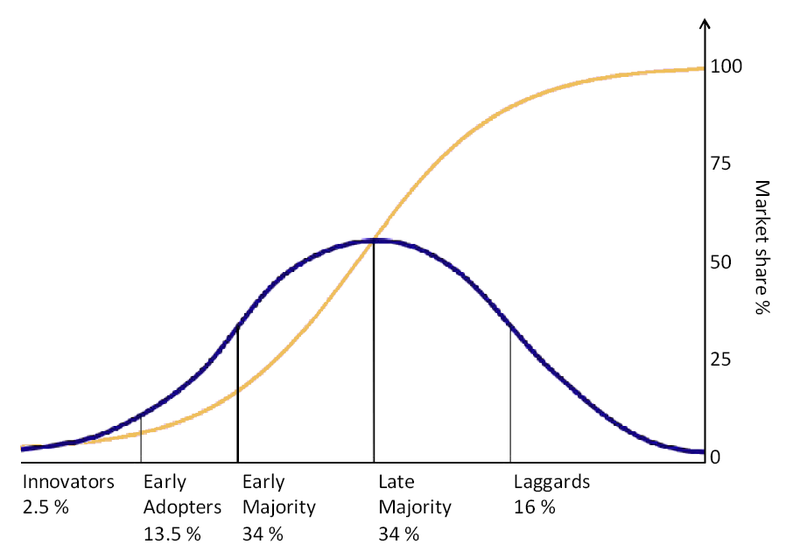
This continual rise in per-person wealth, standard of living and productivity has come from a succession of  technological innovations that have permeated society. Although, from an historical distance, the long term growth trend of a country looks pretty smooth, innovation uptake by members of a society tends to following a wave of adoption. Very gradual at first, rapid as it gains widespread popularity, but then perhaps never quite reaching *everyone*.
Wikipedia - Diffusion of innovations
There are only a discrete few innovations that are such majorly influential improvements to life as to have become ubiquitous (for example: mains electricity, automobiles, the internet), so they are spaced along our past. Each major innovation stimulated frenzied economic activity, indeed much employment was necessary to build, from nothing, massive infrastructure or industry (e.g. the railway/motorway network, industrial revolution). Lulls occur after each wave of innovation (because science takes time and) because the start of a wave is dependant on the new environment created by the previous one. So one should expect GDP growth history to be a little lumpy; a series of economic revolutions.

Nikolai Kondratieff wrote of his observation of a long wave economic cycle, back in 1925. It earned him Soviet Gulag, death by Stalin, and title to this theory (respectively). He estimated a fixed period of 50-60 years per cycle of: expansion, stagnation, recession. Since then it has been more commonly split into 4 seasons or irruption, frenzy, synergy, maturity (or such like).

Saturday, 1 October 2011

The Great Stagnation(?) by Tyler Cowen:

This mini-book appeals to me because it talks about economic progress/stagnation/crisis as primarily attributable to innovations. However, his surprisingly compelling idea, to account for our global economic finance bubble, seems to clash directly with Kurzweil's portrayal of miraculously smooth technological advance. (Although Ray does talk about an overall exponential composed from S-curves through successive paradigms.)

I came upon this (£2 Kindle app special) book via a link to this blog post considering stagnation vs relocation (of the world's economic centre to China).

* The Book's Central Thesis in A Nutshell Painted by Me:

The natural course of technological innovation, following the tree of scientific discovery, yielded many 'low hanging fruit' from 1870-1970 that greatly benefited the whole of western society. Transport, communications, home conveniences, mass production, free fertile land for US settlers and perhaps cheap fossil fuels. These rapidly raised the standard of living for just about everyone (in America), doubling it ~ every 25 years, also creating universal employment.

However, in the the last 40 years there have been no innovations with the same level of wide ranging public utility. We, in the developed world reached a plateau of of technological productivity gains in the 1970s. Advances since then have been *marginal improvements* that have mostly benefited private consumers (to an extent dependant on wealth). The lack true economic growth was hidden by the uncertain value of growing government expenditure. [Perhaps outright "Pollyanna Creep" too (my thought, or rather Douglas Rushcoff's from "Life Inc.").] Markets and individuals, caught up in the endemic false expectation of continuously strong growth (from the previous period of reaping 'low hanging fruit') all simultaneously overstretched to the point of buckling.

The Internet is a sole exception of innovation, in that it has had a great qualitative benefit to peoples lives, for that part of society sufficiently educated to enjoy it's many wonders. However, it has not yet raised standards of living as ubiquitously as did electricity in homes. Furthermore, it contributes very scantly to employment and GDP. Computers do almost all the hard work, so massive companies (Google, Facebook) have few employees, hence (in part) the 'jobless recoveries' of the last 2 decades. Also, it's very difficult (or just plain unnecessary), to monetise most internet content. Time well spent on-line, for the individual, may well decrease spending elsewhere, hence reduce GDP and government tax income. The net is just too damn efficient!