Showing posts with label internet. Show all posts

Saturday, 8 August 2009

The Audacity of Spotify

In response to a Facebook post: I think Spotify is a pretty impressive offering. I've been wondering for a while why no one had made something like this. Finally 'they' have. Think I'll be sticking to using my enormous mp3 collection most of the time still.

+ What's hot:
  • Very immediate playback (far quicker than torrenting mp3s)
  • Full quality sound (as good as 160kbit/s mp3 imho).
  • Good buffering (track will finish playing even if connection is entirely lost).
  • Plenty of information on albums and artists (like a sleek version of AMG/IMDB); intuitive and highly functional interface.
  • Good as a music discovery tool (with links to buying too).

+ What's not so good:
  • It lacks similar artist links or a recommended artists/customised radio channel functionality like Last.fm or Pandora.... Oh, hang on! I just found them! But the “Artist Radio” doesn't play similar songs, it just links to the other artists. Wait, it does that too! Wow.
  • The search function is simplistic, requiring exact spelling.
  • You never own your music, but that's all right because it never tries to pretend that u do (unlike DRM locked downloads).
  • The ads are unavoidable on the free version; it knows if u mute your sound or turn it right down, or if u move the banner ad off the screen it moves to a different part of the window, which is fair enough and besides, the adverts are mostly targeted and the audible ads are quite brief (but fairly frequent).
  • No internet connection means no music, even though it stores content locally, presumably because it can't show adverts (does the pro version work fully off-line?).
  • No track numbers shown in play list; clearly it's intended for use as an iTunes substitute, used mainly by people who want to cherry pick favourite tracks rather than listening to entire albums.
  • Some big name material is unavailable, e.g. no “In Rainbows” as yet (though the ad banners seem to suggest it's coming to spotify premium). But there is a lot of my slightly obscure artists on there and they are still in Beta so I'll give them some leeway.

+ The artist biography information is the same exactly the same blurb that can be found on any site pertaining to music, so I wonder where it originally comes from, and whether Spotify pay for it? The only place I found it attributed to a specific person was “All Music Guide”.

+ I'm curious what licensing arrangements they have, that they can allow people to listen to an unlimited amount of music for only £10/month... could it be too good to last? It must certainly be an enormous headache for them to negotiate with the different labels with content only being made available in certain countries and being able to be withdrawn at any time.

+ It would be cool for small artists if it included geographical information too: local live performances. This could form the perfect basis for a micro-royalties system (paying money to artists only for songs that were actually listened to), perhaps enabling tiny artists to bypass record labels. However, if they only get as much per play as the biggest artists, they're probably going to get very little money. I think there should be a principle of diminishing returns applied (e.g. An artist with 1 million plays only gets twice as much money as an artist with 100k plays, etc). So there's still incentive to create the best music, and one could certainly make a living from it, but at the same time many more artists could also afford to go full time, leading to an explosion in the number of creative minds at work in the 'industry'.

+ Why didn't (doesn't) Kindle take this approach too? (or at least have it as an optional package): unlimited book access for a flat monthly cost? I expect it's because publishers (or publishing laws) are *even less* reasonable than record companies.

+ If Spotify can be kept alive with it's content collection continuing to grow, and later versions incorporate fully featured music discovery, it could become the perfect music tool for desktop PCs.

+ As to reaching mobile platforms, that's a different matter. In principle they could start giving away (high speed) wireless handsets with a minimum Spotify subscription: a flat rate Kindle for music. Of course, mobile operators/makers cold take the initiative too and bundle Spotify with contracts. Given Apple's record so far, with 3rd party iStore apps, this does not yet look likely.

Monday, 20 August 2007

IT Trends

Vista sucks!: http://slashdot.org/articles/07/08/18/1512243.shtml. and is it surprising that Microsoft’s dropping the ball here? It knows it’s OS glory days are over; computer use is becoming almost entirely internet centred. I mean, what good would a computer be today if u couldn't check talk, message, email, or even Facebook (god forbid)?! Why, it'd just be an electronic typewrite/DVD player combo basically. Not too useful when the latter can be bough separately for £20 and using the former would involve doing something far too like old fashioned work!

Anyhoo! Point is, who’s going to want to pay for a £300 operating system, when there’s so many flavours of Linux distribution waiting to be lapped up for free? The only thing holding Linux back in the consumer market thus far is that it’s not Windows (basically). So when ppl are only concerned with what’s up inside their web browsers, they’re barely even going to notice whether the lonely little button in the bottom left of the screen says “Start” or not…

So with society transitioning to a comprehensively online computing paradigm, and with broad band speeds broaching the point where viable streaming TV has reached a reasonable quality, thus beckoning a flurry of demand, is the strain on bandwidth going to mean trouble for the internet itself?!: http://slashdot.org/articles/07/08/19/133241.shtml

It doesn’t seem at all far fetched to me after spending a month trying to get Virgin to turn up our signal at the grossly oversubscribed curb-side box, where we were originally on an unboosted 2 way splitter between us and the normal rows of 60 or so ports. Virgin Media’s pushing hard for more business too: it seems to be sponsoring everything at the moment. I can only hope they’re investing as much upgrading their backbone as on advertising!


With fibre network to the curb across most of the country, and pre dug conduits to all previous customer’s front doors, they’re in a brilliant position to follow the trend in many other countries and roll out fibre optic coble to the home. BT and ADSL services appear to be screwed!: the antiquated copper lines are already pushed beyond their information carrying capacity anywhere more that a stone’s throw from a telephone exchange. So to compete with Virgin they’ll either have to get digging up country anew or begging infrastructure access from Virgin!? Perhaps they’ll be forced to ‘unbundle’ their services by OFCOM in the same way ole BT was.

But it’s not just the national ISP that need to pull their fingers out. The massive international connections and such need to do more than keep pace; internet traffic has doubled every year it’s existed (that’s even faster than Moore’s law!) and only looks set to double more rapidly in the future, for the applications above to start with, but there’s always going to be a new and bigger bandwidth hogging service on the horizon, set to dwarf all previous use, ever! So pre-emptive upgrading would seem to be the only way to even vaguely satisfy demand (not that I’m a network expert or anything).

I seriously worry that insufficient bandwidth could soon cause a global recession or such like. I expect if you looked at nation’s economic bottom lines you could already see that those with loitering ISPs (like the UK) are falling behind in terms of growth compared to those with more prepared infrastructure…at what point might governments intervene and assist/force ISPs to invest more heavily? Probably not soon enough, if at all, given governance already trails industry on pretty much all avenues.

Sigh... It’ll all work itself out one way or another.

Saturday, 2 December 2006

[Imported from "LewyLife"] A 3rd blog for the personal and mundane:

Hey, so I've been feeling particularly tired and rubbish of late, but never mind. I've still been able to finish reading Accelerando (by Charles Stross - basically a dramatization of "The Singularity is Near" by Ray Kurzweil) and check out some new software/services:

Since previously trusty Firefox went to pieces on my 64bit computer for no apparent reason, I've been needing an alternative. Eventually i got around to trying Opera (which I'm using right now). It has tabbed browsing and some useful features Firefox doesn't have, so I recommend it.

This groovy picture by Eboy inspired me to check out a few other things:

Last.fm - a custom internet radio player, equivalent to Pandora, arguably better.

Well, err, actually that's all the new stuff I'll be using from there for a bit, but i did also just get on Facebook which had been coming for a while. Well… gotta try and stay in touch with the youth, you know, even if i am just an old fart at heart!

2023-11-29 Addendum: I've imported the few posts from my old LewyLife blog to this less defunct blog, and deleted that to tidy up. Images missing that were presumably embedded via URL links only.


Tuesday, 24 October 2006

A world-brain called Google

"Assuming that you keep your schedule in Google Calendar (and really, who doesn't these days?)" from an article on Engadget brought to my attention a feature of the ever diversifying Google that i'd failed to notice and may now use!


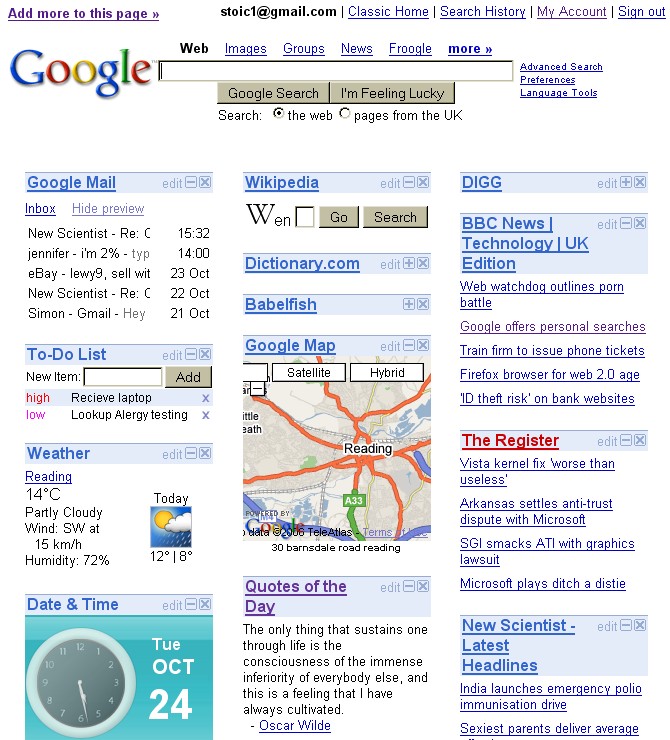
Then this BBC article pointed me to an even more significant development: customised Google Search. Provided i can login easily on remote machines this could be particularly handy, as it incorporates a whole shed load of customizable content: GMail inbox, to-do lists, local weather, RSS news feeds from my favourite sites + quick search boxes for Wikipedia and so on.... I've not even made any new searches to test out main feature of this new service!


At first glance this service appears altruistically helpful, though i'm sure the profit will continue to pour in as usual back at Google headquarters. I'd guess the service is mostly to encourage use of the custom search facilities that will allow higher paying, even more directed ads. However, Google’s expansionist efforts have been touted as being far less successful than it's root interest. Add to this the much squawked about $1.6B for YouTube, that seems a little puzzling in itself (given the potential copyright issues), and it looks a little like the big G's vying for a monopoly on the worlds information! (though this is Google’s first big purchase, and take-overs have been rife in big business for ages. Any hot new company with a new hold on a service gets snapped up, probably by a bigger fish that came to popularity in a previous wave of success).

Which brings me to an article by George Dyson (Son of physicist/intellectual/extraordinaire Freeman Dyson, whose books have been a big influence for me) on the Edge that i've been meaning to blog for a little while:

TURING'S CATHEDRAL (by George Dyson):

The main meme of the feature is speculation on the possibility of strong A.I. having been created and already
existing in some form within the Google computer equipment. Naturally this sounds entirely fanciful at first, given that the limited power of computers, for the moment, inhibits the simulating/emulating anything nearly as complicated as a human brain. Then again, if anywhere was able to support a true A.I. it would be within those estimated 450,000 servers spread around the world potentially using some of the masses of dark fibre bandwidth it wanted to/did purchase some time ago (Link 1 | 2).

Here are a selection of quotes from the article (higlighted in red) that i think are enlightening, starting with a little mitigation against those who may think creating artificial consiousness would be as good as trying to steal God's powers:

Alan Turing - Computing Machinery and Intelligence: "In attempting to construct such machines we should not be irreverently usurping His power of creating souls, any more than we are in the procreation of children...Rather we are, in either case, instruments of His will providing mansions for the souls that He creates."

Google Employee: "We are not scanning all those books to be read by people," explained one of my hosts after my talk. "We are scanning them to be read by an AI."
A pretty direct statement! One that does make me excited like the little child that i am. Of course, having that vast amount of accumulated information is one thing, processing and 'understanding' it is another! Then there's the question: in what way is this potential intelligence observable? What capabilities will it control? Mearly a textual input/output on a secret terminal screen somewhere?

H. G. Wells - World Brain (1938 ); "The whole human memory can be, and probably in a short time will be, made accessible to every individual...This new all-human cerebrum need not be concentrated in any one single place. It can be reproduced exactly and fully, in Peru, China, Iceland, Central Africa, or wherever else seems to afford an insurance against danger and interruption. It can have at once, the concentration of a craniate animal and the diffused vitality of an amoeba."
Google is perhaps already doing a fair approximation of a 'world brain', even bowing to censorship demands to ensure it's pressence in china. A search engine accessible by practically the globe in any language, that can understand and answer all requests is almost explicitly the goal of Google, so it seems, and is almost exactly the description of a 'Hub/orbital/rock mind' from Ian M Banks. Read "Look to Windward" for a detailed description of a hub mind within a brilliant story!

I'm going to finish on this thought provoking note:

Anomalous accumulation or creation of wealth might be a sign, or an unquenchable thirst for raw information, storage space, and processing cycles, or a concerted attempt to secure an uninterrupted, autonomous power supply. But the real sign, I suspect, would be a circle of cheerful, contented, intellectually and physically well-nourished people surrounding the AI.