Showing posts with label sci-fi. Show all posts

Monday, 27 October 2025

GenV - a frustrating second season (review)

Extended review to link from this tweet. GenV S1 previously covered much more briefly, here. Maybe I've been unreasonable, levelling so much criticism at a show that's a spin off of another that was always a little throw-away in terms of overall plot and production (more making pithy points, initially). But this showed promise that it squandered...

+ Tragedy: the actor playing Andre died in a motorbike crash, paid tribute throughout the season, following rushed rewrites. But, as far as I can see (having done little digging) the father character may have been given a bigger role to cover the same abilities. And I didn't feel like this could totally excuse the mess of continuity and pacing. Perhaps production timelines and financial pressure preventing sufficient delays to recalibrate..?

+ Plot hole [major spoilers]: Mid episode 4, Marie clocks Dean Cipher as *definitely* non-supe (just human) and tells the others. This key fact is inexplicably not mentioned in later episodes; the cast totally buys the bizarre explanation Stan pulls out of his arse about Godolkin being Cipher's 'trophy'. Mentioning, but ignoring, the fact he'd be too old at >100, especially for a burnt husk of a human. (Whether Stan deliberately deceived them is beside the point, but I didn't see reason he would help Godolkin, even if he could should have known, as former Vought intel.)

All a bit awkward and lost...

+ Unbelievably dumb!: So, Marie rushing to heal Godolkin (end of Ep7) without hesitation is ridiculous. For what? So he can quickly divulge Cipher's weak spot..? How about punching him in the head real hard?! If Polarity (now at full strength) can block his mind control, then he's a squishy target, as far as they know. Why over-complicate things?

Even when the ensemble cast stupidly pile in, giving Cipher bodies they *know* he can control (eg Jordan), the obvious move was to just rush Cipher (well, his main puppet, Doug) all at once. Instead they stand about like NPCs so we can watch him play whack-a-mole.

Tuesday, 22 April 2025

Black Mirror Season 7 review - Good to excellent Sci-fi TV!

These are very quickly bashed out over/reviews. Please excuse missed details, etc. But new Black Mirror is something specially to be noted down! The episode order was certainly cathartic, making us work through the rough to finish with the fun...

1 - Common People - Depressing satire of predatory subscription models. Like, "Brain River" maybe a reference to Microsoft's digital river (torrenting Windows updates between users to save on server cost, etc). Also degenerate live streaming taken to a depressing low of basically crowd sourcing self torture porn. Talking to extreme the unhealthy practices of being a 'channel', eg multi-day 'subathons' that Twitch game streamers run, at the shallow end.

Some on r/cfs (Reddit) said they were somewhat triggered by the portrayal of the wife, choosing to end her life due to being exhausted all the time, with long unrefreshing sleep and continually loosing bodily control (with forced adverts channelled *through* her). Given that this depressing quality-of-life is still better than theirs, with this living torture disease.

2 - Beté Noir - A dark side of multiverse transitioning, a bit like "Everything Everywhere All at Once". The ultimate for revenge manipulation and gaslighting. Of course, they transition through a lot of impossible universe spaces and make no attempt to explain why their minds transfer over. 'Quantum Compiler' magic.

Saturday, 12 April 2025

Pantheon - Underated Show of the Year?

Season 1 tweet review:

#Pantheon S1 on #Netflix - anachronistic near futurism based on Ken Liu stories. Ignores AI (v hard to do now IRL!) so human uploads can prat about in fantasy VR battles representing hacking. Meh. Social upheaval gets marginally interesting; will watch S2.


Watched on Netflix, but previously released elsewhere a couple years ago. Maybe a part of why it feels so dated (by the generative AI boom). Opening exposition on "The Singularity" is almost 2 decades into being cringe (for me). But maybe it brings along some general audience, from under rocks.


For demographic pleasing: high-schooler protagonist opening. Very blatant GITS references and Motoko Kusanagi character. Young parents split by death/upload (for middle-aging anime fans?)...

The whole refusal to accept husband is not dead gets tiresome. Maybe realistic. But doesn't depict him as being partly lobotomised, per plot. Or any of the uploads as being meaningfully transhuman...

Beyond time dilation, which makes no sense, because it would require exponentially more processing hardware. But instead they have arbitrary mind degradation limitation ('the flaw'). Bleh.

I was surprised that the human cloning aspect was historically plausible. But Steve Jobs dude wouldn't have had computer hardware to grapple with uploads 20 years earlier. 🤷

Season 2 tweet review:

#Pantheon S2 on #Netflix ramped up exponentially into space opera, last 2 ep's largely remix of @cstross's Accelerando!😍

Carefully constructed conclusion revised S1 mediocrity..: https://x.com/Z3R0Gravitas/status/1884676773008306303

... To fav show of year I keep talking about: [search link to my comments in the show's subreddit].

Sunday, 14 April 2024

3 Body Problem - Series Review vs Book 1

I read the first book of Liu Cixin's trilogy (translated from Chinese by Ken Liu) in 2016. So, fittingly, just about enough time has passed for a radio transmission to reach and return from the Proxima Centauri system... Also, more than enough time for me to forget many of the details! So I was not overly focused on expected plot waypoints, or any finer details, in the new Netflix series.

This streaming adaptation is by Benioff & Weiss, of Game of Thrones infamy, plus Alexander Woo (True Blood writer, apparently). Thankfully, they won't have to make up their own ending from scratch, this time. But given that the books reportedly get increasingly grand in cosmological scope and concept, we'll have to see what they make of the rest, come season 2. Hopefully not too far off!

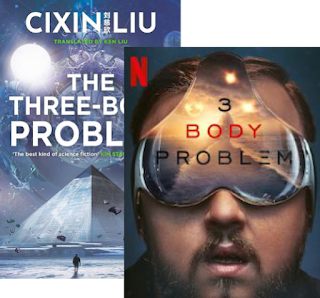
Book 1 (left). Netflix series thumbnail (right).

► My Initial Impressions of the Show [Low Spoiler]: the pacing was good and quick, despite the 1 hour episodes. So some of the many hard sci-fi concepts were shaved down to "blink and you'll miss it". Some things maybe discarded from the plot a little too soon. There was a frustrating lack of discussion of major events, following on from the big dramatic episode endings. 

But they managed to include a surprisingly large amount of the original material and feel, while finding a better compromise for retaining audience attention. Better than the somewhat laboured tour of scientific history, etc, in the first book. I was still surprised to see the show reach the main plot culmination of book one by the end of of the Ep 5. With 3 left to go! Apparently, they linearized the trilogy timeline, including a lot from Dark Forest and even some from Death's End.

I was a little disappointed how almost all the contemporary (2024) setting of the show was plonked down in London. Deploying a distracting remobilisation of GoT resources, with a far more 'international' cast than the books. White-washed vs the novels? Perhaps. But it worked well; the main characters were utterly remixed into an original ensemble, with more compelling personalities and social relationships. 

And there's already been a 30 episode (!) Chinese TV series adaptation, released in early 2023, with all Chinese cast. Apparently it drags badly, literally converting almost everything from the books. *Except* for the Netflix series' brutal opening scene, in the Chinese Cultural Revolution. The Chinese audience gets historical censorship, while we get soft power propaganda, only seeing the horribly outdated worse of China's tumultuous political neurosis and industrial devastation of nature.

Monday, 17 July 2023

"Scale" by Greg Egan - review and critique

► Review: I struggled to complete Scale; not up to the standard I expected from reading Schild's Ladder and Permutation City.

The concept is cool, if ambitious to reconcile in the messy details. But I was continually frustrated that Egan gave so few descriptive details of the different perspectives of physics, in daily life experience for the smaller scales. He glossed over a very major plot detail and entirely ignored the issues of eg shared air. I think because it (and other things) were too implausible.

Scale on Greg Egan's website.

It's mostly written as a straight detective mystery, from 3 main character perspectives. Which plays to his weakness of flat characters. Then, as politics becomes a major theme, that feels naïve, as if seen from space. And the bits of action aren't very thrilling.

I'd have preferred to see more of his usual trick, of skipping ahead through time periods and settings. Thus exploring more of the technological changes, and timescale divergence, in this wild little civilisation. Perhaps he knew it couldn't hold together.

Overall, I think this concept could have worked as a cheeky short story. Padding it out with human intrigue didn't work for me. I didn't care about Cara.

Tuesday, 28 February 2023

"Valuable Humans in Transit" by Qntm - short story anthology summary and review

Having read all commercially published works by this relatively new author, of hard sci-fi on stilts, I felt I can to snaffle up this collection of short stories too. Bite size, even for me, so I read and summarised one per day, between dinners. Keeping the old noggin active.

They are all revisions of existing short stories he previous posted for free on his website, which are linked here, as well as purchase options. 

Lena - Cautionary tale of the first human brain upload being duplicated, incidentally tortured (for compliance) hundreds of millions of times in increasingly numerous parallel simulations, to use him as a cheap information processing commodity.

Qntm preciously threw this into Fine Structure Constant, in passing. It's a sobering thought for extropians like myself, intent on digital reincarnation with indefinite lifespan. But, I feel like ChatGPT and other generative AI are already making redundant this idea of simulating brain Uploads for such utilitarian purposes. It's gonna be many orders of magnitude less efficient and probably less reliable.

Thursday, 16 February 2023

"Blindsight" & "Echopraxia" by Peter Watts - a qualified positive review, discussion and questions

 ► Review (light contextual & thematic spoilers):

"Firefall" omnibus edition of both novels
These two hard sci-fi novels are ostensibly space operas, set near the end of this century. They depart from a world where base humanity is struggling for relevance, half choosing to live in virtual reality heaven. While technology has resurrected once extinct vampires.

But the author also uses the context and diverse assortment of transhuman characters, in each book respectively, to explore themes of, first: neuroscience, abnormal psychology and consciousness. Then: genetic engineering, augmented intelligence, belief, identity, culpability and free will (or lack of).

Both books have an explicit discussion of concepts at the end, with over 100 references to science papers and other books, in each. This comprises a full 10% of Echopraxia's total length! In case readers had any doubts about just how thoroughly researched and insightful these works are.

There are certainly spaceships, action and a novel first contact situation. But the plot arks were somewhat arduous through long mid-sections, with lots of dialogue that dragged a little. Brooding suspense and flashbacks, in one. Voyage with sometimes grating protagonist interactions, in two.

Echopraxia doesn't really continue on from Blindsight directly. For me, it had somewhat of a feel like, for example, Prometheus (2012) continuing the Alien (1979) franchise. Although there is technically one recurring character. Book two reframes the first a little and is mostly a chance to explore additional futurism and dig more into his conception of a hyper-intelligent vampire.

Despite a promising first book opening, that name checked the (technological) singularity and Ray Kurzweil explicit, I never quite meshed with the feel of Peter Watts' philosophising. Throughout either book. I think, in part, he deliberately writes to make things uncomfortable. There's certainly no heart warming romance or nice happy endings.

But, more fundamentally, in the afterword of Echopraxia, he explicitly states that he doesn't support/believe in the concept of digital physics. I.e. the leitmotif of most of Greg Egan's works, and (implicitly) many works by other authors, which have sat more squarely with my own core beliefs and understanding of the universe.

The character arcs conclude properly, in my opinion. Although there seems to be deliberate ambiguity left for interpretation as to exactly what and why various things happened, big and small.

Tuesday, 18 October 2022

"Cyberpunk: Edgerunners" series review

As someone naïve to the Cyberpunk universe, I found the Edgerunners series to be a colourful and interesting pastiche of various anime influences, with some flaws [SPOILERS]...

David - the school age male central protagonist, generic fan demographic foil. Who finds that he's exceptionally gifted, through no effort of his own. Thus he's able to realise his daydream ambitions.

Lucy - Motoko Kusanagi (Ghost in the Shell) hacker chick in an outfit mixing together that from Stand Alone Complex and 2045 series. Her distinctive hair design has a (Serial Experiments) Lain lopsided bang on her left and is coloured white like Benten (pretty boy) in Cyber City Oedo 808. She also has a built-in version of the nanowire weapon he uses, which I believe originates from Gibson's Neuromancer (sci-fi novel). 

Maine - Duke Nukem meets Prototype JACK (Tekken) substitute father figure. He comes complete with paternal physical abuse and a hard nosed (but soft on the inside) butch lady-friend second in command - Dorio.

Pilar - actual transhuman-looking non-normative body plan cyber punk with super-hands. He fashion a visor and mohawk like Gogou (Cyber City). The abrasive clown, he's naturally the first to go.

Rebecca - the fiery Lolli archetype, literally obligatory in all anime, now (studio refused to make the show without her). Predictably she's romantically interested in our generic protagonist, though we thankfully fall short of a full hareem. She's not particularly problematic, compared to some, and makes sense in this context. Actually she's a fairly fun character, although her Scooby Doo impression gets tiring towards the end.

Kiwi - chain smoking albino cyber-goth second fiddle hacker chick, with a more extruded frame. Like Lucy, she inexplicably *has* do her virtual reality ICE (Intrusion Countermeasures Electronics - again Neuromancer) breaking shenanigans with full frontal nudity, in a bath of icy water. Big "Hey, I don't make the rules!" feel, male gaze fanservice.


Falco
- Overwatch's McCree Cassidy Cole, complete with one robot arm and the same voice (Matthew Mercer), randomly turns up half way through, as a getaway driver.

Faraday - the ominously voiced middle-man with the triple eye, reminded me of something I couldn't put my finer on... Some 90s arcade game villain, or something.

► Other notable influences: 
  • Blade runner - city design, flying cars/billboards, chain smoking, etc.
  • Akira - motorbike gangs, neon style, ultra-violence, etc.
  • District 9 - mech's weapon grabbing magnets hands.
  • Blues Brothers - style car pile-up super-orgy.
  • Various games - including Cyberpunk (duh), with nonsense red circle impact warnings inexplicable appearing on the ground, with one fight. 
► Overview and Critique:

Part of the reason I've not been possessed to jump into the Cyberpunk PC game (besides the price and brutal hardware spec requirements) is the dystopian setting. Which is a failure as escapism, given how many aspects of this genre are becoming increasingly, depressingly, relevant here in the UK. 

Our Tory governments seem determined to break the public provision of healthcare, by any means, whatever the death toll and permanent damage. They even seem to be trying to privatise democracy and governance, itself, via sneaky charter city legislation (massively expanding freeport areas and such). 

Sunday, 19 June 2022

"Ra" by qntm - Book Review

I enjoyed this book. It had immediate personal relevance, kicking off in my old-university city of Nottingham! In the 90s, a little while before the time I was there studying physics. With its central female protagonist called Laura (weirdly also the name of a girlfriend I had there), its brief summary of her mundanely relatable romance spoke truth to me, too. Anyway... 

"Ra" initially presents as a kind of alternate history, where magic exists as a new kind of science. Only recently taught to undergraduates, in either applied or theoretical courses. Described as esoteric and remote, for the majority of the population. Much like quantum physics in the real world. In both cases, they've been quietly revolutionary for civilisation. 


Our protagonist makes the exception to this, with ostentatious, hyper-competent implementation of its possibilities. Magic is cast by speaking a kind of programmer pseudo-code, with an ancient Samarian (or some such) flavour. While simultaneously holding complex concepts in mind.


It's no coincidence there's an echo of "The Laundry Files" mathematical demonology, here; qntm has clearly been strongly influenced by several of my favourite sci-fi authors, including Charles Stross, who's tweet put me onto them in the first place.

Tuesday, 10 May 2022

"Left Hand of Darkness" by Ursula K. Le Guin - A Tepid Review

I picked up this novel because Ursula K Le Guin is often cited as an underappreciated sci-fi master and I've not read anything of hers. I started with Left Hand of Darkness because it was one of the top recommended, e.g. on the printSF Reddit.

I skipped over the two(!) additional introductions by contemporary authors, for fear of major spoilers I’ve had in the past. In her intro, she states: "Science fiction is not predictive; it is descriptive." Which is always somewhat true; dressing up contemporary issues in strange clothes to better understand them. 


Just as much a fantasy writer, apparently, this perspective makes sense. But not entirely so, to me. No prediction at all, would fly in the face of what I like most about my go-to fiction genre: exploring possible effects of future technological change.


She also seemed to say there was an unreliable narrator, telling some of this story..? But, even primed, I spotted no contradictory versions of events. [Edit: I don't know where I got this idea from, after re-reading her (1976) foreword. Kindle UK version.]


For a book published in 1969, it has largely dodged feeling entirely dated, courtesy of mostly avoiding high technology. The plot is grounded entirely on a somewhat backwards world (or at least, one that’s in no hurry to fully modernise). So the setting is very vaguely reminiscent, for me, of say "Inversions" by Iain M Banks.


Non-plot spoilers - In the rare appearance of a spaceship, it does sound like a stereotypically antiquated shiny silver rocket. While their FTL communications are basically a pager. Which, I guess, is still ahead of her time…? They have universally electric vehicles too. (I guess that transition is long overdue, for us.)

Saturday, 7 May 2022

"Kaiju Preservation Society" by John Scalzi - Review

An impulse buy, for me, when needing a new book to read on my Kindle. Kaiju Preservation Society is a quick, easy to read sci-fi novel by John Scalzi. I'd agree with his post-script, that it's the literary equivalent of a pop song.

It currently feels extra relevant, kicking off at the start of the Covid pandemic, in New York. Our protagonist's working for an UberEats competitor, seeing an uptick in demand. And there's an explicit reference to the opening of the genre cult classic "Snow Crash". Which comes up again as a bit of a running joke. So too, a couple more pop sci-fi references.


The story soon escapes miserable reality. I thought, at first, that we were going to taken on an interesting deconstruction of monster movie tropes. Focusing on more realist management banalities and such. But it only goes half way…


On one hand: the crew studying (and aiming to protect) the giant monsters are, realistically, almost all scientists with a complementary array of doctorates. They run through why such massive animals are physically impossible. Then proffer some bio-eco-physio-logical embellishments that might help realise this trope.

Sunday, 13 February 2022

"The Relentless Moon" by Mary Robinette Kowal (Lady Astronaut Universe Book 3)

Like books one and two, which I reviewed here, Kowal has very well written characters, with good narrative structure and pace. So "The Relentless Moon" is an easy reading page turner. Even though it's not my typical cup of tea: it is rigorously well researched hard sci-fi, but relatively low concept, big picture wise. 

Set in an alternative 1960s where severe climates change, caused by a large asteroid a decade hence, is spurring a much more ambitious manned (and womanned!) space exploration and colonisation program. To escape the inevitable runaway greenhouse effect.

[Goodreads]

We ride inside the mind of Nicole Wargin, while our previous protagonist, Elmer York, is on her way to Mars; this is a spin-off plot, running in parallel to the second half of book 2. We met Wargin before: one of the first batch of (lady) astronauts. The wife of a senator, who is now angling to run for president of the US.

Saturday, 17 July 2021

"Permutation City" by Greg Egan - Review & Discussion

Egan is famous for his very high concept hard sci-fi fiction that leverages his academic background in mathematics plus deep knowledge of quantum physics and computer science. Permutation City is no exception, exploring an even broader scope of fascinating concepts than Schild's Ladder, which I'd read years ago.

It's one in a set of 3 novels, by him, grouped together as "subjective cosmology". But they're not linked in any way besides this categorisation of theme.

It pushes far beyond hand waving philosophy, weaving in some solid technical references, as it explores concepts of: continuity of identity, simulation of consciousness, extreme transhumanist mind modification, subjective reality, artificial life within deterministic systems, computability, parasitic computation and "dust theory". Many ideas I consider important to at least be vaguely aware of.

His characters are adequately believable and his writing style reasonably sophisticated. Although my attention/motivation struggles a little, these days, with this kind of classic novel structure: alternating chapters between several characters, telling a story largely in parallel.

Tuesday, 13 July 2021

"Ancillary Justice" trilogy by Ann Leckie - positive review and discussion

"Ancillary Justice" (book 1 - 2013), "Ancillary Sword" (book 2 - 2014), "Ancillary Mercy" (book 3 -2015).

►Review:

"Ancillary Justice" is the first in the highly acclaimed, multi-award winning "Imperial Radch" series, from a debut female author [Wikipedia, Goodreads]. It felt very different from most of the sci-fi that I've read and loved, in not being primarily about a technologically exciting setting, cosmologically consequential events, or near future insights. It's overwhelmingly character driven, with an extreme focus on their development and back story.

Consequently, I was not utterly riveted by the first book, coming to it a couple years late, with a gap of a few more years before recently returning to finish the arc. But the story really grew on me; I can understand why this caused a splash.

I'd describe the core (feel good) hook of these books as ethics competency porn. The central character, Breq, always seems to hit the nail on the head, in terms of picking the most righteous course of action. Even in thorny situations, sticking it to the callous powers that be, etc. In a similar way to how Iain M Bank's Culture novels have a kind of ship mind competency porn, where it may come down to the last breath, but they clutch it out somehow, against all odds. More on the link between these authors, later.

Much has been made of Leckie's unique take on gender [e.g. Slate]. With Breq's biological sex never explicitly confirmed. Equality and gender neutral pronouns are one progressive aspect of the deeply flawed Imperial Radch empire. Feminine pronouns are always the default: she/her. Breq struggling to accurately gender some of the people they meet is certainly a cute device to accentuate this point. But it made less sense to me by the end of the series; when she was the troop carrying spaceship "Justice of Torren", she will have been intimately involved in matchmaking and interpersonal harmony between the many officers of her crew.

See, Breq is the last surviving fragment of a millennia old ship AI. Out, from the start, for revenge against the tyrant who murdered the rest of her. In the first novel, the story and meaning behind that unfolds in flashbacks interwoven with her travails on this quest. It's built up in a way to really put the reader into the shoes of this perpetually angry but compassionate intellect. Dealing with loss of function, identity and purpose. Redefining herself as she unexpectedly builds up a new life, sweeping through the whole arc to a satisfying conclusion.

The prose is well written and paced, with the occasional song lyric snippets included, that didn't make me turn off or really cringe; songs and their collection is a core personality trait of our protagonist. The latter two books are essentially linear, by comparison. And set in roughly the same place; this isn't a romp around the galaxy. Instead we explore in more depth, as events develop and unlock new possibilities.

There's certainly exciting build-ups and some interesting action. But generally it's more low key and human scale - tactical and psychological. Perhaps more of a stereotypically female thinking approach to things, overall, with tensions bubbling under the surface of outward civility. A lot of weight placed into subtle details and even menial activities, that, on paper I wouldn't have expected to get on board with. But fell into an easy rhythm.

I was really glad I read the whole of this trilogy, by the end. Hitting a very satisfactory conclusions via an often unexpectedly understated route. Although I wonder if it will be less memorable for me, in not hitting the more physical/technological notes that usually excite my interest. This trilogy might be good for fiction readers who don't normally go for sci-fi; maybe genre gateway books. 


► Discussion with SPOILERS!: much of the text below is content summary, as I struggled a little to pick many outright faults or failings. Nor interpret meanings too far beyond some fairly direct, probable and some (perhaps) wishful thinking references.

Tuesday, 6 July 2021

"Bobiverse" trilogy by Dennis E. Taylor - Criticisms

We are Legion (book 1), For We Are Many (book 2), All The Worlds (book 3).

Overview Review:

These were easy reading sci-fi and they can't have been that bad, given that I read all three consecutively. I know there's now a forth book in the series, "Heaven's River". But I'm going to treat the first 3 as a stand alone trilogy, seeing as they round off the plot arcs at the end of the third. Also, I don't have the interest to read any more, for the reasons below...

Thursday, 16 January 2020

"Autonomous" by Annalee Newitz

Review:

A pretty straight forwards and compelling sci-fi read that I liked. I enjoyed the female central protagonist - James Bond age, scarred and entering a tryst with a hapless but permissive younger man, along the way. And the high (i.e. balanced) number of other strong female characters. Perhaps merely realistic, given the bio-science setting.

Its 2144 setting seems extremely conservative, to someone like myself. Quite possibly aimed at a more mainstream audience - it was, indeed optioned by AMC for a TV adaptation (admittedly what brought it to be on my read list). In terms of personal freedoms and distopia it even seems a little quaint, naive, compared to the (rapidly deteriorating) contemporary political situations in many countries.

I didn't really feel like the cover tag-line was justified, calling it the Neuromancer of biotech and AI. But that William Gibbson story is a little over-hyped itself (and outdated, now). The fictional science and technology felt pretty prosaic - under-ambitious in scope and impact. Except for a use of viruses (at the end) that seemed to jump the shark in implausibility. The AI are all human equivalent robots, with no hint at the influence of trans-(or even sub-)human AI. Let alone why there's been no Singularity, etc.

Specifics [SPOILERS]:

Sunday, 12 January 2020

"The Calculating Stars" & "The Fated Sky" by Mary Robinette Kowal

Review:

Two fairly short, well paced sci-fi novels that tell of an an alternate history branching from 1952, when the Eastern seaboard of the USA is hit by a large meteorite.


The story follows a female protagonist who is a scientist, 'computer' and ace pilot, as she, and her refreshingly supportive lead space engineer husband, face the trials and tribulations of fast tracking a space program to ensure against the consequences of this catastrophic event.

The first novel of this duology could stand entirely on its own, but I enjoyed it enough to buy into the continuation and be entirely please I read them both. Even though it's not the kind of hard sci-fi I'd generally go for. There's great technical adherence to the practical realities of spaceflight (and American life) in that era. But no attempt at predicting on technological or societal changes in our own future. And its not really a space opera in the usual sense.

In shines in its feminist tilt, looking at struggles against counterproductive sexism, and racism, in the space program setting. From the perspective of an unlikely heroine, who's main problem is crippling physiological anxiety stemming from physiological mistreatment by the male establishment. Rather than the rigours of spaceflight itself.

The main male characters are interesting constructions, too. The husband appears to be almost an idealised reference for how a feminist might specify best practice male behaviour (towards women). Perhaps a little artificial, but refreshingly non 'rough around the edges'/interestingly imperfect. I found their, more subtly written, physical romance scenes heart warming.

The most interesting character arc is that of a more senior male antagonist. He's initially a somewhat 2D male chauvinist, borderline(?) rapist, who our protagonist is forced to deal with and get to know better, in halting steps forwards and back. Ultimately not ending up going quite where I expected.


Issues [Spoilers]:

Saturday, 29 September 2018

Why the Thanos plot is dangerous in real life (Infinity War)

Review:

I liked the movie. It did a really great job of bringing together all the accumulated characters and story arcs in a meaningful and satisfying way. Great fight scenes. Implausibility only becoming physically painful in the scene with stellar re-ignition via elbow grease.

The movie's most notable success was subverting expectations by making the genocidal big-bad into an empathetic and rational protagonist. In fact, the central protagonist of the movie.


The problem:

Thanos' plan, through the whole Avengers timeline, is to wield the combined potency of all the 'infinity stones' to wipe out half the population of the universe in an instant.

His motivation for this is to save all civilisations from implosion via resource depletion, brought on by over-population. As happened to his home world, after he personally failed to convince them to randomly cull themselves.

It doesn't really matter that this is a stupid plot mechanism, in that...

(a) Caveman or medieval civilisations, elsewhere, aren't in any danger of exhausting planetary resources. Maybe we should assume he only culled human level, globalised civilisations. (But then also, what about the various, seemingly stable societies we see in Guardians and Thor?)

(b) Clearly a one-time cull is only going to delay the inevitable by a couple of generations (if it is inevitable).

... It's made to work in the movie. There is suspension of disbelief.

The dangerous part is that the only reason this plan is presented as undesirable is the killing itself. "Murder = evil" is such a universally evocative idea that no one can avoid making that the main counter-argument.

But that's not enough in reality, where the ends tend to justify the means: we have large, expensive organisations dedicated to making and utilising weapons to kill potential threats to our civilians and nations.

When we, as humans, feel our lives are threatened, we tend to acquiesce to amoral measures. In the last decade, nationalist xenophobia has been fuelled by increasing financial and physical hardships on individuals. (Not mattering that this is primarily from unrelated, rising wealth inequality.) This collective sentiment has already enabled callous right-wing/authoritarian politicians to implement horrible policies that would normally have been seen as too inhumane.

With further, deeper economic crashes seeming ever more pressing (in the West), the tale of woe so far could easily be eclipsed, in terms of increased suffering catalysing far further reaching humanitarian disasters, even war, etc.

Add to this ferment the popular notion of global over-population, with such bastions of scientific authority as Sir David Attenborough pushing discussion of the need for population reduction.

When bellies are empty and people are terrified, maybe a little genocide can slide, if it's helpful in the grand scheme of things...


Why it's wrong headed - because it won't work!:

Morality, even in the extreme, is malleable. Practicalities, not so much.

Sunday, 5 August 2018

"Avogadro Corp" by William Hertling

From the cover's tag line "The Singularity is closer than it appears" I expected this book would be a bit pat - aimed perfectly at my interests, as per this blog's focus. It certainly was very pat. Entirely straight forwards and linear in it's plot structure, with overly plain language and cardboard characters prone to converse in totally unrealistic exposition.

This book is basically a long form best guess at how a very early technological Singularity might be kicked off, via the accidental creation of AI. "Avogadro" would probably have read "Google" if not for the trademark issue - that is literally the company described, in every detail. As such the story is unimaginative. Yet it is still unbelievable in the amount of contrivances it throws in, to start the plot rolling.

The behaviour of characters is often uncanny, too - although this may be down to writing for brevity, without the author having the deft wordsmith skills of the likes of Charles Stross (let alone Banks).

To be fair, it was easy reading, for me, with short chapters and good pacing - I actually finished it (first one this year!). I'm considering going forwards onto his sequels, except the first chapter excerpt name drops both "Gibson" and "Stross" (as future phone handset models). Ick; clearly the author's influences are near perfectly aligned with my own, here, but his hat  tips are ugly AF.

Sunday, 25 September 2016

On: "Knights of Sidonia" Anime (and Related Current Affairs)

"Knights of Sidonia" totes plenty of whizz-bang space battles with giant mecha suits piloted by teenagers repeatedly fighting incomprehensible space monstrosities that attempt to tentacle humanity to death.... But! Push past the facade of these overused anime tropes and be rewarded by a rich, engaging space opera.


Summary - Components of This Well Assembled Pastiche:

There's a strong 'hard sci-fi' undercurrent carrying the story along and underpinning a decent amount of attention to detail.

Then there's teenage awkwardness, of course, and tensions in a kind of high school-ish setting (of the pilot academy). The socially inept protagonist, chosen-one (Nagate), who alone can pull the joysticks of the legendary armour suit to it's full potential... But thankfully it's never as paralytically morose as NGE (Neon Genesis Evangelion).

It is respectably gritty, but not like the gratuitous gore of Akira. It has decent depictions of the brutal suddenness of war. This is brought home via the perspective of sympathetic characters, mostly very young, like the unlucky soldiers of real wars. But, of course, the fantastical space setting and perversely monstrous threats make it psychologically gentler (safer) for an audience to engage with emotionally.
Yuhata Midorikawa's different faces.

It also avoids being too bleak via juxtaposing the relatively low key social tribulations of the pilots, burgeoning on adulthood. Prime example of this is Yuhata. She swings between command responsibilities, gambling everyone's lives, to then be the star-struck, boy obsessed, teen girl. (Also gluing together geeky toy models kits in her spare time.)

There's a definite 'harem' sub-genre element running throughout, adding lighter notes, with support character developement and romantic intrigue. With three main contenders for Nagate's attention, there are few other females encountered who don't also make a play at some point, brood over him or have a twinkle of possible interest. These are mostly relatively subtle, making sense in context, since our protagonist is deliberately set up to be an inspirational hero who necessarily appeared mysteriously from no-where. An attractive combination, I suppose. But then this blank slate POV character with an open selection box of different flavoured lovers meshes rather neatly with the psyche of the core young-ish male demographic. Who would not love to imagine themselves as an overlooked darkhorse hero themselves? (If only they had their moment to shine or step out of themselves!)

Residential interior of Sidonia - caricature of the 
dense, hilly urbanisation of 'spaceship Japan'?
The flip side of all these female characters is that there are a whole lot of complex, strong female characters. In fact, they run the ship, from captain to XO, to commander, chief engineer, dorm mother, genius doctor/scientist. So, I suppose that even if this is basically down to the Manga artist/author enjoying drawing the female form more, then so be it. The result is good overall, although the bias towards showing only female communal 'photosynthesis' room scenes feels a little exploitative.

Also thrown into the pot are the unavoidably ubiquitous anime tropes of instant karma for (accidental) male lechery, always receiving a bloody nose, usually quite directly off a fiery female. Plus an alpha dog bully antagonist with long, grey/white hair and a massive family inheritance. But even he has an interesting story arc.

Finally, the art style is seamless 3D CGI. It's more noticeable in the space action scenes, when things look a little bit Tron - monochrome with neon highlights. But then it blends into a more rustic feel while inside sidonia's city spaces, with familiar cartoon stylings. The characters faces generally appear unnoticeably traditional. There's a retro aesthetic flavour, too, with the uniform outfits: almost storm trooper-esq, with stuffed up gear. There's some disconcertingly high flung, pointy boobage going on, but we'll put down to genetic engineering and/or reduced gravity, and move swiftly on...

The marriage of high tech space mecha, moving city(ies) of giant rusty pipes and cthulhu-ish space monsters is similar to, though far less gordy than, 2013's "Gargantia on the Verdurous Planet".


Original Manga vs Anime:

The anime appears to follow the original manga (comic) publications very closely. Almost shot for shot, with only some minor sequence juggling and tweaks here and there. So while I'm talking about the Knights of Sidonia (KoS) anime here, most comments apply to both.

Given that the manga has concluded already, it's a little tempting now, after watching season 2, to just read the final third (volumes 44-78, or thereabouts), rather than wait while the animation studio is apparently finishing up with a different project. It would save totally forgetting the plot details a second time.

But the video format is more compelling and I often struggle more to figure out what's supposed to be happening in the strips. It's a far more mentally tiring and different experience. At only 20 minutes per episode and a dozen per season, it's probably almost as quick for me to watch as read and digest the corresponding 20 odd manga volumes with 30 or so pages a piece. Plus you get to hear the cute Japanese voices and groovy theme tunes.