In Summary: I’d give Deathloop a “maybe” recommendation; I finished it and don't hate it. It’s a laudably innovative game, with mostly great elements: unique fictional setting and aesthetic, great voice acting, polish, interesting combat build variations, etc… But! I REALLY struggled with a couple of core game mechanics, which I’ll explain in more detail further down.
As someone with ADHD (and slow information processing) these issues prevented me from enjoying the good aspects; Deathloop is far less approachable than either Dishonoured (1, 2, 3, reviews on Steam) or Prey (which I loved). All made by Arkane. Deathloop was hard work to get into, with an overwhelming number of UI screens, clues, loadout settings, etc, to read tutorial notes for and then navigate. Totally breaking the flow, immersion and addictiveness, for me.
Then the unexpected multiplayer element was brave, but in practice just meant getting randomly griefed, as a new player. Unwelcome during an otherwise single player chill-out game. Together, these issues, and other smaller design choices, made it tough to explore different loadout customisations for fun. Or to find much freedom or escapism.
(1) Less accessible: The previous Arkane games quickly launch into the action and almost immediately begin to flow. While Deathloop felt like being taught an overly complex board game for hours on end.
Prey is quite reminiscent of Bioshock 1. So presumably System Shock, too? (I've never got around to it.) With a hack mini-game, for one thing. Also, the post disaster exploration of an Island of Doctor Moreau super-science setting. This time, a near future massive space station in lunar orbit. Realised due to an alternate history where President Kennedy lives to 100 and there’s cooperation with the soviet space, etc. As discovered by in-game background materials, of which there’s a good amount.
The game’s promotional material had put me off for a couple years, with an apparent emphasis on psychological and body horror (the eye injections). But I was glad that this wasn’t really representative. There were no jump scares, and none of the squalor or wildly demented characters of Bioshock.
So, does a 'game' (as in, a computer game), by definition, require a level of 'difficulty'?: Obstacles to overcome...
I think successful games are those that manage to mirror the configuration of a player's mind: An artefact image refracted through the prism of human senses and perceptions. On the finest (most literal) scale this means presenting concepts that arouse the individual's attention (i.e. interesting memes). But also, from an overarching structural viewpoint, the form of the thing (this 'game') should sync with a player's reward response. Biology...
Human physiology (like most mammals) evolved to provide a stimulus reward for achieving tasks that benefit the organism (well, more accurately the transmission of their genes, but gloss over that). A similar, smaller squirt of dopamine is also released during failure, when the goal is nearly reached (so I've read). This is why many persist at gambling, and slightly unbalanced brains can become addicted. It's also why gamers so often enjoy 'difficulty'.
DOA; addictive while it lasted, Trials 2 quickly got too hard for me!
However, frustration wins out (during failure) when the end-goal appears unattainably far. Depression probably dampens down dopamine release/transmission, thus making all goals more distant, thus a depressed individual will struggle to engage in previously fun things, and struggle to persist in general.
Adaptive difficulty attempts to milk this near miss response (re-calibrating it's obstacles to make players keep reaching, just so). The such systems risk more than distracting the player, if they notice: If the pretense of the game's scenario is lost, it's like watching a badly shot fiction movie where you keep seeing accidental glimpses of the production team and their equipment. Without that invisible 4th wall, an individual will struggle not to perceive events quite literally: moving patterns on a screen, empty of meaning and/or relevance.
In Summary (read-me for those yet to play): It feels like this game is a pared down hybrid of it's predecessors; all extraneous features lopped off to make room for multiplayer mode to be sutured cleanly into place. The result is an even less bona fide RPG, however, the tweaks to the fighting mechanics that make ME3's co-op mode so very viable also raise the single player experience as far above ME2 as it was, in turn, beyond ME1.
ME3's rich inheritance of narrative, established in ME1, and vivid characters, developed in ME2, allows the single player game to easily get away with lacking the ingenuity of either of it's parents. This is a BIG GAME by most standards, yielding over 30 hours for one play through (excluding multiplayer). Story progression is smooth, more organic than ME2's shopping list of missions, but simultaneously more constrained and shorter (by raw single player mission count). Matters are somewhat more impersonal in their larger scope: your attentions are drawn outwards and upwards, vying for the loyalty of entire civilisations instead of squad mates. Gratifyingly though, romance options also extend beyond your personal involvement.
There are hilarious lines (though less frequent than in it's predecessor) and some brilliant moments, especially during the mid game section. However, in addition to the aforementioned cut corners, the game's concluding mission(s) did start to feel like a triumph of project management crushing creativity that would have further delayed the release date. Setting the specifics of the ending controversy aside, I still can not help but feel that a opportunity for monumental greatness was casually shrugged aside at the last minute. Thus, rather than earnestly shouting it's praises, I am now hesitant to recommend that any new comers play this series.
If you are the type who is intending to replay the previous game(s) first, aiming to cover every side quest and/or spend a couple of hours thinking about/reading up on the game afterwards, then the ending will probably be somewhat of an issue. For those just wanting something to fill 30 hours of spare time, or are more interested in multiplayer action, the 'controversy' will just be a bunch of gibber-jabber.
Zeno Clash is the artistic antithesis of Arkham Asylum's purely derivative, design-by-committee, bland, sexiness: it is a celebration of ugliness and asymmetry; the stranger realms of "Heavy Metal" (1981) with the soft core nudity supplanted by the broken detritus of an steam punk brawl between H. R. Giger and Pablo Picasso (during his surrealist phase).
In the same vein, the storyline is impenetrably mysterious and schizophrenic, very much "Through the Looking-Glass". The entire game experience could well have just been the oddest dream you've ever had. Batman, on the other hand, is Batman; you're getting the whole multi-billion dollar franchise shoe-horned (very successfully) into a Bioshock meets Streets of Rage framework with a side helping of Assassins creed. It incorporates the current characterisation of the whole mythology quite nicely; an epic win for Batman fans (of which there are many, hence the guaranteed return necessary for investing the effort of a large game developer) but perhaps a pretty uninspiring prospect for some regular folk.
Admittedly Zeno Clash is a rail shooter corridor fighter, which makes it positively claustrophobic compared to some of the spaces available in Arkham Asylum's sandbox-ish environment. However, it's arguable how much all that freedom adds to the game: a lack of location discontinuities does make the story more immersive, but this was balanced (for me) by constantly wondering if I was pointed in vaguely the right direction, or if I had understood correctly which part of the shopping centre island I should be rendezvousing at next. Of course, Zeno Clash is very low budget in comparison, it's creators having had to scale back from a much more ambitious project to get it done at all.
So based mostly on artictic originality, we have an early leader: Zeno Clash 1-0 Arkham Asylum
I steered clear of this game for a while, mostly because of the fantasy setting gave connotations of WoW to mind, but I was totally wrong, and it's an EXCELLENT game, the most fun I've had for years!
Embark on an adventure to prevent the world from changing... Forever!
Magicka's fictional land of Midgård was conceived of by a bunch of Swedish Uni students to be vaguely Norse Mythological. But is dominated by computer game influences and popular geek culture references, from Return of the Jedi to Disc World via Monty Python and the internet. The fixed view, walk-towards-mouse-pointer format is most reminiscent of Diablo, but there's zero grind in sight; one's success in battle is determined almost entirely by raw ability and knowledge of spell combinations.
It's a game that uses boring legacy PC peripherals like a Guitar Hero controller of pure awesome: with each 'chord' one blasts out a volley of ice shards, a massive fire ball, a freezing electric death beam or random healing bombs that throw you right across the screen. [Tangential Note 1]
In terms of cultural significance, I would say it's the "Scott Pilgrim" of the games industry. The myriad hat tips to geekishness past and present are sandwiched in a satirical narrative that pokes fun at (for example) the ridiculous contrivances necessary to string such a notable story of adventure and battles together.
The overnight success of this £8 Steam wonder is probably largely to do with the multiplayer element. The trailer gave me the impression that combat would be an impenetrable clutter of mayhem; Streets of Rage and Golden Axe played concurrently in a rastafarian laundry explosion. Throw a bunch of rookie Magickians together and it's worst still. Ferment this in an alcohol fuelled LAN party for ultimate LOLZ! (And thank god for 'Revive': the first and most used multiplayer 'Magick'.)
However, multiplayer is up to 4 player co-op only, no official PvP (yet), squabbles and frequent accidents discounted. There are 2 bonus "Challenge Arenas”, but inevitably you end up only playing the campaign part multiplayer. While we're on the negatives, it has a hideous tendency not to connect. Then if you figure out a work around there were/are more bizarre coding bugs during game play than there are giant spiders, with a roughly zero percent chance you'll make it to the end of the campaign without the game fully crashing out.
In one sentence: the Bioshock 2 single player campaign has a worth while story, but the difficulty arc is very iffy.
Summary in more that one sentence:
Game play wise, innovation is comparable to Halo 2 verses it's predecessor, mostly just adding 'dual wield'. There are the same gruesome aesthetics one will have habituated to in the first title, and again they are juxtaposed with the cheery 50/60s style infomercials for deadly plasmid powers. However, the alternative game play section towards the end impressed me in that it genuinely shocked my sensibilities in a very artistic manner. I have not played, and am not commenting on, the multiplayer aspect. The ridiculous protection and Games for Windows Live situation I shall leave alone too.
"All good girls gather"...
Criticism:
Early in the game I found it very tough to successfully defend a little sister from splicers, while she harvested Adam, even on medium difficulty and after careful preparation of traps/defences. I was all out of money, heath packs, eve and trap ammo. But having struggled through, a few upgrades and various weapon acquisitions later, the same situations were far easier. Then the number and difficulty of enemies dropped right off before mid game, making my main problem having so much ammo and money I could rarely pick any up.
Mass Effect is a sci-fi space opera presented in the form of a single player, action role playing game (RPG) for XBox 360 and PC. The first instalment was released in November 2007, and May 2008 respectively (XBOX then PC), to much critical acclaim. Ridiculous overreactions to the brief (and tasteful by TV standards) sex cut-scene raised the game's media profile (and spawned the "Alien side-boob" internet meme).
Mass Effect 1 (ME1) incorporated a high quality, non-linear story line into a detailed universe with plenty of 3rd person shooter action. While plenty of first person shooters (FPSs) can claim better action, Mass Effect is somewhat unusual in that two AI controlled characters assist the player during every shooting segment. This is bold given that AI co-op has historically been a recipe for disaster.
It also brings in the option of 6 different main character classes (with different abilities in combat), male/female appearance (with facial customisations) and levelling up of various traits/skills as the game progresses, including those of the 6 squad mates you pick up. The contrasting personalities of the supporting characters ensure something for everyone, letting you chose your favourite 2 to take on missions, which one of 2 possibles to sweet talk, and even which die (permanently).
Equipment management (weapons, armour, ammunition modifiers) is a major part of ME1, as is driving around the surface of planets in an APC (the "Mako"). Both are dropped for the inevitable big budget sequel (ME2), released January 2010. ME2's increased focus on combat (with various tweaks and reduced distractions) seems to have helped it achieve an even better reception, with many perfect review scores. ME3 is now a certainty, with many fans (like myself) hoping it comes sooner rather than later.
I read somewhere that Bioware's development team had twice as many artists as programmers. At any rate, with such high artistic value, this franchise may, in future, be referred to as the turning point when single player computer games really came of age: truly occupying the same level of entertainment territory previously monopolised by TV series, movies and novels. I have
* Navigation:
If you have not played these games yet, but there is a good chance you will, I strongly suggest stopping reading here, for now, and coming back later. However, I have marked certain sub sections with {!Spoiler!} warnings to help minimise damage.
All in game screen shots were taken by me. Click pictures to view full resolution.
Given that this review turned into a 10'000 word dissertation, I have provided an mini-index:
Introduction (for those living under a rock)
Navigation
Overview (praise)
General Gripes
A Fix too Far? (Mechanistic Changes from ME1 to ME2)
Interlectualisation (Deeper Discussions)
Summary
[Navigating plot through conversation options (ME1)]
Seems that 2010 is a crossover time for both genetically modified laboratory animals (vs regular) and PC game distribution (downloads equal other sources). Personally, I'm no advocate of animal suffering, but continued increases in the volume of testing is only to be expected as the rate of scientific progress accelerates.
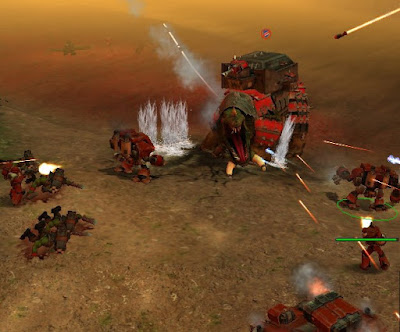
I've never owned painted or played with a Warhammer army, but I will admit to kind of liking the Aesthetic of the 'Space Marines': Fully armoured figures clomping along with their jet-packs and chainsaw swords, accompanied by those top heavy roboty things (“Dreadnoughts”) and brutally simple yet futuristicy tanks (“Land Cruisers”). I had heard DoW was a good game from a couple of people, so, with time to be killing, I just went and bought all 4 titles off the interwebs as a single package for under £15. And the DoW 2 demo came out on Steam while they were in the post. Dawn of War (1): Before playing any real people I thought it best to learn the game mechanics and the faction specifics. The Campaign seems like a good place to do this, with more advanced units being unlocked with as missions advance, giving opportunity to learn to use everything. There's a helpful tutorial that'll try to force itself on you when one first plays the game too. Unfortunately you only ever command Space Marines (with a sprinkling of imperial guard units). For Orks, Eldar or Chaos you just has to jump straight into a skirmish.
The Campaign is a nice length though, and you come up against all the factions in turn, and at some point their super unit (e.g. Avatar of War, Dark Prince) with a cut scene forewarning you of impending doom, except for the “Squigilith” which just appears out the fog and takes a scary amount of killing. The cut scenes are animated with the game engine, thus the 'acting' is the opposite of smooth (and your can forget dubbing), but it somewhat endears you to the hero units who then toddle about on your field of play. The caricatured proportions of the hero unit's faces are a lot more interesting here than the bland looks they've acquired come the better graphics of the later installations.
A general (and sizeable) criticism of all the titles is the viewing angles (in play. The full 3D camera should be a boon, but one is forced to use it continuously, rotating your viewpoint to peer around enormously tall pieces of landscape that keep filling the screen. This precipitates the annoying side effect of total disorientation, particularly as you can never zoom out far enough to get your bearings. OK, so Supreme Commander has totally spoiled me with it's “Strategic Zoom” (allowing instantaneous scroll in/out to any magnification is sooo indispensable) but, while it seems like the DoW 3D engine could have handled it, one would then spend far too much time zoomed out, not looking at the very pretty units (and they are often pretty enough to demand being seen). So I play zoomed out as far as possible, and it still feels like watching a tennis match from the front row through a telescope when I'm hopelessly casting my view about the convoluted mission maps, trying to internalise the topologies that fail to show up on the wonky mini-map, so that I won't accidentally send my minions on a casual short-cut though the middle of an enemy base.
A minor, but nifty, redeeming feature of the camera mechanics is that colour coded silhouettes of units show through buildings and obstacles, making it easier to track down that nuisance construction unit that likes playing hide and seek. There's also the way water switches from transparent to reflective when viewed past a critical angle (total internal reflection IRL) and other little pieces of attention to detail. As with the Tabletop pieces, DoW is equal parts battle porn and strategy game.
Winter Assault comes across as having the most carefully crafted of the campaigns. In some of the earlier missions it seems a little too moulded with the player just jumping though hoops on demand. The switching of command between the alternative two factions, in each the “order” or “disorder” campaigns, redeems it, really helping the narrative to flow and avoid the stiltedness that often troubles single player RTS. In contrast to the earlier simplicity, the last mission (for all factions) is incredibly challenging, even on normal difficulty: on the second attempt, as Eldar, I had to continually pause play to check on all the various quarters of attack, just to have enough time to figure out what was happening and how to spread my limited resources even thinner. Quite rewarding though.
For Chaos Marines (and Imperial Gaurd), the penultimate mission is near immpossible, while the final mission is anticlimatically easy (contrasted against Eldar) as the Necron Temples are far weaker so can easily be destroyed with regular units or a Bloodthirster. I do like the way that uber demon is summoned (with a splat and lots of blood), but using the mission mechanism of harvesting Imperial Guard infantry to fill the blood pit twice seems a bit lazy, especiallygiven how frustratingly fiddly it can be.
Oh and for this game onwards the voice of the narrator has changed from one that was comically over dramatic, like the movies advert guy's bass tones, to someone's dad doing a bad impression of that guy; rubbish.
Dark Crusade introduces the two factions that I identify with most: the Tau, because they wear state of the art cyber suits with shed loads of guns and missiles to wage war in the year 40'000, which seems a lot more sensible than swords, axes. And the Necrons, who will have nothing to do with this infeasibly ubiquitous “requisition” resource, thankyouverymuch! (well, kind of) and have very artfully minimalist buildings too.
Having covered play using the first 5 factions in previous parts of campaigns in the first 2 titles, Relic apparently gave up trying to write an involving narrative featuring the 7 now available, instead sculpting a single mission in which each race is defeated (and presumable 7 factorial end blurbs) and padding it out with a Risk board game style, world domination set up. Apart from providing an epic volume of game play, even to complete the campaign as just one of the factions, it stumbles because the, supposedly, less fortified territories are initially nearly impossible to win compared to the scripted missions with their well balanced challenges. You are basically just landed in a skirmish with an AI that has a pre built base and a tendency to rush you with everything as soon as it's built a full army; the only way to prevail is by somehow taking out their HQ first, provided there's not another 3 hidden around the corner. Then defending your territories is a choice between loosing by default with “Auto Resolve” or loosing at some length in a very unfair fight, unless u managed to fortify the entire map before winning the map the last time around. Base structures are stored for later, which is kind of cool, but leads to an obsessive behaviour of camping on the enemy's last HQ while constructing listening posts on *every single last* requisition point. Once you reach the end of the 'campaign trail' your accumulated honour guard allows you circumvent all the earlier heart-ache by going directly for HQ destruction and forgetting what all the fuss was about.
From the couple of territories I've captured in Soul Storm, I get the feeling that Relic (having decided to stick with the massive Risk campaign format) made the much needed adjustments to the AI's tactics in the unscripted 'missions'; even when I was pratting about playing Dark Eldar for the first time ever, I didn't get inundated by a massive wave of every single unit the enemy could muster. In fact, even after I provoked a counter attack they stopped short of finishing me off after ploughing though one of my bases. Conversely, an opponent that is continuously balanced to play as hard as you makes things a bit dull; a control loop designed to keep play in a nice, safe stalemate. (though I've only the observations of one match for this theory).
Frankly, I don't like the new factions. I don't know anything about the 40K universe to know whether they were conjured specifically for this game or not, but: Dark Eldar seem pretty uninspired Chaos esq derivative with a dingy purple colour scheme, lots of blades and points, the flying wing boards from Spiderman's Green Goblin and some levitating barges, complete with shackled wenches, from Gabber the Hut (in Return of the Jedi). All that's left is a camp, evil, ugly supper villain up front, giving the whole faction a (David Bowie in) Labyrinth feel.
The Sisters of Mercy Battle have a more solid leitmotif, but it is totally LOLable when they are introduced (particularly unbelievable said in the crappy new narrator's voice) as the “most feared” faction (because they're crazy religious nuts; as if the rest aren't?!). And they totally fail to sex up the game either, with the Commander's bizarrely shaped armoured brazier, making Madona's oddest fashion accessories look like well fitted M&S lingerie. Even the semi-naked woman strapped to the front of a mecha fails to titillate. Am I'm missing the point and they're just trying to reach out to female gamers...... ROFLMAO!; as if there was ever any franchise that was less appealing to the female population?! Anyway, both factions seem underpowered, particularly the Dark Eldar who have a ludicrously low unit cap (unless I was doing something very wrong).
The false promise of increased choice: if you happen to own one of the factions in lead figure form, all painted up next to a pile of books that tell their back story, then you will probably be pretty keen to play as that faction, and there's little chance you'll be disappointed here, whichever faction you covet. However, the remaining, easy-going gamer folk have a monumental decision to make as to which faction's glib characteristics to be stuck with for the next million missions. It's an example of greater choice equating to greater regret that you still (might have) picked the wrong option. That's just way too stressful for a game IMHO.
The all new Aeroplane type units suck. They're not hovercraft nor popper planes, but something in between. There's plenty of terrain they can't fly over, so they fall foul of distributed defences like an uncloaked scout and can be shot at by nearly anything as they hang in the air near their target like great big turds, slowly killing. And for all their ineffectiveness, a single enemy plane appearing in the least protected part of your base is highly inconvenient tactically, and is unsightly to boot.
Manually entering the CD key from each previous title, in order to play as any of the factions, was starting to get a bit ridiculous by the time I got to Soul Storm, but that was a more fun that transformer-kittens compared to the debacle of registering to play the DoW2 demo!: When it turns out that you *have* to have an Micro$oft Live account for the privilege of playing is offputting enough, but after downloading over 2Gb of game through Steam I persevered... and kept persevering for another half hour or so after installation.
The process of signing up is more like a test of wits and determination to weed out the unworthy. U have to sign in with your “XBox” account at one point during account creation (ironic given this title's not being released on Xbox so i'm told). This was after finally figuring out how a “Gammer Tag” related to my Live account ID (despite the provided help documentation not mentioning anything about this entity) and before the Internet Explorer Window (that it insisted on opening up despite Opera being my default browser) was crashed the CAPTHA at the bottom of my personal details form. I was forced to search the web for the account management site in a proper browser.... grrr!
This game uses 3 of the original armies, and even preserves most of the units from the first DoW, but is a massive departure when it comes to game play. It is no longer an RTS in my opinion, because it is entirely about knowing each individual unit/squad inside-out so as to micro-manage them and their unique abilities in battle; there are no buildings to be built at all. What's left is (I imagine) more directly analogous to the original, table-top game, except way faster with much prettier and more voluminous scenery.
The Trailer(s) for the game is very cool, but I found the reality of the exclusively online multi-player demo utterly frustrating. If I hadn't have had a friend to play against I don't think I would ever have been given the chance to control any tier 3 units. The auto-match system seems to enjoy setting complete novices against level 14 players and such, giving little chance to figure out what the hell's going on.
Despite all my gripes I have bought the full game, but from Amazon for £20, as opposed to the full £35 on steam, which is still more than I paid for the complete collection of all 4 previous titles. There's a lot to be said for patience when it comes to the cost of computer gaming.
My sci/tech analysis of the Dawn of War universe: There has presumably been interplanetary war for 40'000 years and the technology of the combatants is still pre-singularity, i.e. there are no superhuman intelligences knocking about and no use of self-replicating nanotechnology, etc. This is, of course, necessary to have the type of scenarios depicted, not representative of a philosophical standpoint on the advancement of technology. After all, clunky armour and chain-swords are visually appealing and fit in with gory visuals that should satisfy the like of morbid teenage gamers.
Towards integration with the real world: The whole universe could be a simulation, enabling arbitrary laws of physics, etc. Failing that, this part of the universe could be in a 'Slow Zone' (a la “A Fire on the Deep”), afterall they even have “Warp Storms” in both. But we'll leave those Deus ex machina aside for now.
There's anti-gravity, teleportation and cloaking, but these are perhaps throw-backs from a higher level of society in the hay day of the Eldar. Interplanetary travel is via something like wormholes, which have been totally acceptable as a staple of 'hard' sci-fi for some time. The Orks only steal technology, perhaps being biologically incapable of developing it themselves. The Eldar are noting but remnants of a civilisation, now too thinly spread to re-gain their previous lofty heights. The human factions are entirely caught up with religious fundamentalism, blocking scientific advance even more effectively than did Rome in the time of Galileo. The Tau are the most promising technologically, with they groovy cyber-suits the most realistically advanced fighting force. I think these guys were a jumble of species that were uplifted to consciousness relatively recently. Consider also their communist ethos and perhaps you could mumble together a partially convincing excuse for their steady state society.
Chaos heavily use magic, seemingly an insurmountable contradiction with reality. It is terribly reminiscent, to me, of Charles Stross's “The Atrocity Achieves”, the mix of contemporary war technology, sacrificially powered symbology, that can still almost fit with reality, though in a massive conspiracy theory kind of way. Anyway, this could just be a way to interface with the higher level of implementation (in an aforementioned simulation), or of communing with post-Singularity, god-like entities. Khorne (perhaps ensnared by fellow gods), is an evil genie in a bottle, somewhat like the intelligence in “Lascaille's Shroud” (of Reynold's “Revelation Space”), or the malevolence intelligence in a parallel universe revealed at the end of his “Absolution Gap”. In this analogy the Necrons would certainly fit the part of the “Wolves”: awoken by sentient life, they then seek only to purge the galaxy of it.
So in my opinion, much like the nonsensical state of interplanetary human colonisation in Stross's “Singularity Sky”, the DoW universe would be most sensibly set in a post-Singularity environment.


.jpg)