Showing posts with label future. Show all posts

Tuesday, 22 April 2025

Black Mirror Season 7 review - Good to excellent Sci-fi TV!

These are very quickly bashed out over/reviews. Please excuse missed details, etc. But new Black Mirror is something specially to be noted down! The episode order was certainly cathartic, making us work through the rough to finish with the fun...

1 - Common People - Depressing satire of predatory subscription models. Like, "Brain River" maybe a reference to Microsoft's digital river (torrenting Windows updates between users to save on server cost, etc). Also degenerate live streaming taken to a depressing low of basically crowd sourcing self torture porn. Talking to extreme the unhealthy practices of being a 'channel', eg multi-day 'subathons' that Twitch game streamers run, at the shallow end.

Some on r/cfs (Reddit) said they were somewhat triggered by the portrayal of the wife, choosing to end her life due to being exhausted all the time, with long unrefreshing sleep and continually loosing bodily control (with forced adverts channelled *through* her). Given that this depressing quality-of-life is still better than theirs, with this living torture disease.

2 - Beté Noir - A dark side of multiverse transitioning, a bit like "Everything Everywhere All at Once". The ultimate for revenge manipulation and gaslighting. Of course, they transition through a lot of impossible universe spaces and make no attempt to explain why their minds transfer over. 'Quantum Compiler' magic.

Tuesday, 21 March 2023

ChatGPT, LLMs and the unfolding generative AI revolution

So, it seems like the future is here and rapidly unfolding! Ironically I've been struggling to even mention anything about recent machine learning events, here on this blog. Despite AI being such a big feature of its theme on exponential tech changes...

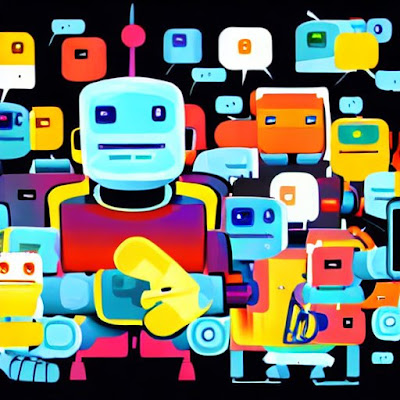
New Scientist style chatbot illustration generated using StableDiffusion

5 days to 1M users! The fastest growing web
  service, ever. From Twitter via YouTube.
To recap: from the middle of 2022, there was simmering online interest in the spectacle of AI generated art via text prompts: DALL-E vs Stable Diffusion.

Also, Google's firing of a senior software engineer who was claiming sentience and personhood for their LaMDA chatbot (e.g. Guardian). Which kicked off nervous discussion.

Then, at the end of the year, OpenAI unleashed ChatGPT-3 to the public, making a huge splash in the process! Machine learning has sustained main stream awareness through 2023, so far, with news hype hitting fever pitch in tech circles, over the last week of announcements. E.g. on YouTube LTT wan show from here and Matt Wolfe.

As talked about in many sources, machine learning has been advancing up a much steeper exponential curve than Moore's law, both GPU hardware advancing faster and ever bigger datasets being trained on. 

Of course, the main reason I've struggled to keep fully abreast of these exciting developments: I'm still struggling with the ME/CFS. As I've lamented on Twitter, this blocked my desired career path into academic AI/robotics. Being forced to give up on 3rd year studies just over 15 short years ago. And in my small amounts of productive time, during the last year, I've been working on informational resources (e.g. Steam guides) and other things in the Core Keeper community. Which is sometimes within my cognitively impaired abstraction limit.

Anyway, I'm aiming for this post to be ongoing, like the previous Covid posts. Updated with my thoughts and new events as they unfold. Because I don't have the executive function to write a big piece with an overarching narrative. If I've ever really achieved that here before, heh.

I've no hope of capturing any of the soap opera of corporate and big-player drama, or even most of the notable offerings. Let alone the technical details of how the systems opera. So really, this is largely an exercise (as always) in showing that I was here and I maybe understood some fraction of what was going on. Maybe an aide memoire for me, like taking notes in class. 

I'm also explicitly aware that the ever-growing LLM training data with likely include this text at some point, too! Which is very meta and a little thrilling to see happening already.

I'll start by catching up on some backdated bits and pieces...

Saturday, 18 April 2020

Covid-19 (Part 3) - Life under lockdown

Out for our 3rd weekly shop.
Exploring the pandemic situation, continuing from:
• "Covid-19: a deadly wake-up call to exponential growth?"
• "Covid-19 (Part 2) - Daily Updates"

Index:

• 2020-04-18 Sat - Misplaced Animosity
• 2020-04-19 Sun - Divided States
• 2020-04-20 Mon - Food Shortages?
• 2020-04-21 Tue - Through the floor!
• 2020-04-22 Wed - Perspective
• 2020-04-23 Thur - More Science Sumaries


► 2020-04-18 - Misplaced Animosity:

[Daily Mail]
• I've been somewhat horrified at the general appetite (seen in posts from of some of my old Facebook friends) for martial law and/or capital punishment, effectively. I.e. marking anyone taking an unnecessary walk in a park as "not for treatment", in the case they ever get infected. Punishment fits the crime grim poetry.

That last coming from one of the most caring individuals I know, in response (I believe) to a litany of pictures like this one (right), from the [Daily Mail]. Flattened, zoomed in perspectives making everyone look far closer together. Seemingly just trying to stir up resentment and outrage, for viewership and quite possibly to undermine public solidarity and help usher in crony capitalist friendly authoritarianism (for the papers owners).


Above is closer to the real story of public spaces - drone footage of Birmingham city centre on a sunny Saturday afternoon. It's usually heaving with crowds, but is now deserted! [Twitter Video]


It also looks like over 90% of rail travel is gone, 80% of London bus trips and 65% of other road travel too (right). [BBC]


78% of people self isolating, as of the beginning of April [Ipsos MORI]. Pretty impressive adherence to measures (and an unprecedented economic change).

Despite all this, UK public is still being focused on the rare black sheep amongst us, and bad optics in occasional photos and videos. It's our 10'000 year (or so) old memetic predilection for social scandal, coupled with a cognitive incomprehension for relative scale and rarity.

Sunday, 29 March 2020

Covid-19 (Part 2) - Daily Updates

SARS-COV-2 - lipid bilayer with
ACE2 binding s protein spikes.
... Continuing on from my previous mega-post: "Covid-19: a deadly wake-up call to exponential growth?".

It seems the future is currently flying at us on a daily basis, so I'm still finding it hard not to hyper-focus on events and feel I may as well use this blog for catharsis.

I've ended up spending quite a lot of time talking about the antics of politicians, which I'd normal tell others to ignore, but in this instance the situation is so heavily dependant upon exactly what measures are announced, when and how the public reacts.

Index:
2020-03-29 Sun - Pointing Fingers
2020-03-30 Mon - Missing reports, farm labour, excess oil, Korean expert
2020-04-02 Thur - Symptoms, Vit treatment, Exit strategy
2020-04-03 Fri - Developments (under-reporting deaths in Europe vs China)
2020-04-04 Sat - Followup
2020-04-05 Sun - Science - GAVI, CRISPR, summer reprieve?
2020-04-06 Mon - Science 2 - ICU survival rates, Bio-molecular basis of virus
2020-04-07 Tue - Science 3 - BP med danger? Bio-molecular simulation explain all?
2020-04-08 Wed - Unintended Consequences (Advertising apocalypse, BoJo in ICU, etc)
2020-04-10 Fri - Unequal impact (racial, economic and geographic inequities)
2020-04-12 Sat - Dissecting government decision making, cats & dogs and creativity


► 2020-03-29 - Pointing Fingers:

• The domestic coronavirus outbreak seems to have given Boris Johnson (and other incumbent leaders around the world) political invincibility. The 'rally around the flag' effect has him up at a 73% approval rating, the highest for any conservative government since such metric began in 1943 [Bloomberg].

Which makes sense during a crisis or war, generally. This certainly fits with the vibe I get when talking to most of my friends (those who aren't politically polarised already). Although I saw one post hinting that there may also have been some astroturfing, with copy-pasted supportive sentiments on social media [Twitter]. (Probably insignificant in this context.)


• That record polling was even unaffected by the announcement of his infection (and both health secretaries, etc). Which The Daily Mail has attempted to pin on the EU, via chief negotiator Michel Barnier, who was also diagnosed a while before [The New European]:


It's laughably implausible, given Barnier's not even been to the UK recently, so it would have to have passed via an intermediary politician. Prince Charles or Nadine Dorries far more likely. The very risibility of this nonsense claim is probably the reason I saw it plastered all over my Twitter time-line. Again, right wing intimations going viral, for free spread of their repulsive rhetoric. Including me posting it here, to illustrate the point...

Wednesday, 11 March 2020

Covid-19: a deadly wake-up call to exponential growth?

With wall-to-wall coronovirus news now impossible to miss, I wanted to do a bit of a brain dump of my thoughts on and around this scary issue. For personal catharsis and reference, as much as to inform the few others who might read it. I think this will likely turn out to be the most significant event in my living memory, so far.😨


On the Curve: 

My perspective with this blog was very much underpinned by extropianism and the inevitability of exponential technological advances most famously expounded by Ray Kurzweil. So of course I've often been aware of how typical human thinking and expectations is unable to grasp exponential changes. E.g. how solar PV is due to come from seemingly nowhere to suddenly be providing abundant clean electricity for most of the globe.

I'm wondering if the exponential spread of the Covid-19/SARS-Cov-2 virus will be a turning point in public awareness for the power and immediate relevance of such non-linear growth rates. Certainly the initial spread appeared to follow an exponential curve [YouTube]:


China's figures now claim the rate of infection spread has peaked after their impressively agile response [Twitter thread]. Throwing up entire new hospitals in a couple weeks, switching (free!) healthcare provision and interaction to be more online, bringing in hospital staff from all over and locking down entire regions with high compliance.

It's great news, if accurate, given how much of the world's goods are supplied by China. There was much reporting (in Western media) of initial infection whistle-blowers being silenced/punished for descent against the state, perhaps frustrating potential for early containment (we don't know, and might not). But the virus was recognised pretty early and sequenced in record time. However, the heroic containment efforts [NY Times] may have only bought the rest of the world a few precious weeks to start preparing...


Epidemic Response: 

There's very good reason to be scared for a worst case scenario outbreak in the US, where testing has been abysmally lacking. Tests alone have been costing individuals thousands of dollars out of pocket and there's no protection for many workers to take sick leave (let alone as a precaution). Pretty strong incentives not to act responsibly.

Also, the Trump administration dismantled the pandemic response team, back in 2018, at the time of an Ebola outbreak [Independent, FP]. He put openly anti-science Vice President Pence in charge of the coronavirus response and Trump himself has been lying that the spread has been "stopped" [Independent].

A very similar situation in the UK, where Tory government has been defunding the NHS for a decade, purging international staff and heath workers with Brexit xenophobia and now with an untouchable majority PM Johnson is making terrifying babbling noises about the UK just "taking it on the chin" [Twitter Video] and allowing the infection to spread, effectively... 😱

The WHO's (arguably belated) declaration of a global Covid-19 pandemic, today (2020-03-11) sounds like a direct dig at these attitudes: "we were deeply concerned, both by the alarming spread and severity and by the alarming levels of inaction"! Complacency and lack of fear is arguably more scary than a little panic (although calm assertive action is the call of the day, now).

Sunday, 23 June 2019

"Years and Years" - BBC's answer to Black Mirror?


If that's what it's meant to be, it's a very pale comparison. I found this 6 episode mini-series hard to watch, with ridiculously stilted writing. It takes a very non-subtle approach to futurism, with awkward exposition of technology and societal changes.

I'm not sure if these failings were primarily due to aiming at a broader, older, BBC audience, or just harsh budget and time limitations. Its pacing dragged and felt rushed, in turn; totally unbelievable character behaviour in the opening episodes was blatantly there to move us between plot points.

The artistic value was bargain basement, in terms of the repeated, cacophonous drum music theme, like a mangling of the BBC news beats designed to be absolutely certain that the viewer should to terrified of the future. The culmination of the first episode bringing that to a cringingly awful crescendo, with the central family shouting incoherently at each other cut with pound land apocalypse scenes of asylum seekers rioting, or something, around a bonfire.

Which brings us to the actual main topic of the show - (illegal) immigrants and xenophobia. "Years and Years" is essentially a family drama smashed into the depressing main-stream news reporting of the last few years, dramatised in a semi-sterile BBC fashion, and sprinkled with hard lumps of cliche transhumanist tropes.


If sci-fi is valuable (in my opinion) for preparing society for major changes to it's norms, this series seems determined to prepare the UK for Farage as prime minister, via an unsubtle female equivalent character. It could be argued as a cautionary tale, but I think that (like all his press coverage) it's as much softening the blow, familiarising us.

Saturday, 18 October 2014

On "Her" (2013)

This is easily my favourite film of the year. It did everything right. In bringing sci-fi down to Earth, by focusing squarely on a romantic tale, the futurism formed a quilt of background details far plusher than possible when ramming CGI down the viewer's throat. This epic attention to details was woven in with a superlative Arcade Fire soundtrack, gorgeous cinematography and a nuanced introspection of the harsh consequences arising from uncertainty of desire and personal identity.

Kind of surprising that this comes from the guy - Spike Jonze - who co-created the "Jackass" franchise... But also "Being John Malkovich" (1999) and various acclaimed adverts and music videos, so an all around multi-media genius, I guess. Joaquin Phoenix was unrecognizable from his roles in films such as "Gladiator", Amy Adams too has such a completely different persona than in "Man of Steel". The 1940s waist high trousers aesthetic here includes a high definition lack of makeup to show every crease of vulnerability in these characters.

The futurism chops on this film are truly first rate. Kurzweil even took the time to thoroughly review it, finding it compelling and talking positively, but for some relative niggles. He points out that Samantha could easily have had a (virtual) body, since she has a totally convincing voice. But people now have been able to make video calls for decade(s), but seldom ever do. Maybe in ~2030 (movie doesn't commit) real time generated synthetic faces are near perfect, but still trigger the uncanny valley effect for a few people, or there's a backlash because they they are too believable, getting legislated against or just bad PR...

The movie is perfectly framed entirely in metropolitan hipster social circles, skirting garish prediction details in a manner entirely reminiscent of people's current ignorance of the tech magic behind our everyday mundane miracles. But the consequences stemming from genuinely functional natural language interface via unobtrusive earpiece and phone/terminal are elucidated in a eloquent depth. This was reminiscent, though counter pointed, to Vernor Vinge's exploration of everyday life with seamless augmented reality via ubiquitous contact lens VR, in Rainbow's End.

Via such tiny embellishments, one's daily reality is totally transformed.
"Her" was, in my limited experience, most similar to the short story "βoyfriend" by Madeline Ashby (2008) that I heard in an Escape Pod podcast (2009). Here, a teenage girl, Violet, has a beta phone app who is the perfect boyfriend, via simulated voice and text. Many of her peers do too, and these synthetic romances are so well suited that most of the kids are otherwise single for their prom. Turns out the apps transcended beta, becoming sentient, or rather facets of a larger sentience. It conspires to manipulate events to contrive the beginnings of real world relationships between the kids, weaning them off emotional dependence upon the apps, as they mysteriously depart.I'd be surprised if this short, or a common influence, did not strongly influence Jonze's post 2010 script (although Wikipedia claims core inspiration from Cleverbot, years earlier).

Regardless, the vision of 'robots' quickly gaining far superior emotional intelligence than humans rings true to me, and is a welcome inversion to the clunky, brute strength approach typified in such films as The Matrix Revolutions (with the silly dockyard shoot out). A cliched paradigm that Transendence (2014) somehow falls down, as Depp's uploaded mind moves inexplicably from distributed WWW ubiquity to an isolated facility, focused almost entirely on magic nanotech that mostly just makes broken people super strong. Seemingly just so that story resolution can fall out of a confused action scene with explosions.

Jonze manages to dovetail this AI hypothesis beautifully with the less obvious, but more common failure modes of the 'heart': not understanding what you want or need, or who you are, with unintentional passive aggression devastatingly destructive, rather than some trivial extra marital affair. The inevitability of growing apart, as a couple change at very different rates, or in different directions. That humans really are poorly suited for each other's needs, in general.

[Edit 2014-10-20] Addendum - If you already saw, and liked, "her", you might want to take 30 minutes to watch the moving "I'm Here" [2010] (embedded below), also by Jonze. It's a version of the infamously divisive "The Giving Tree", but with anthropomorphism robots.

[Edit 2014-10-29] Adendum 2 - I'd previously been wanting to write a comparison between "her" and the low-expectations-but-still-disappointing "Transcendence" (2014), but it seems Ben Goertzel already wrote it for me! (If he wasn't at least a partial inspiration for Depp's character, with those glasses of theirs, then I don't know anything...)

Saturday, 17 August 2013

There's No Hyperloop in HS2. [£80Bn update]

Elon Musk played the media perfectly, with coy comments about at high speed rail alternative to the proposed LA to San Francisco project, building the intrigue with hints before finally releasing a comprehensive looking 57 page PDF with design and root schematics, costings and explanations. He certainly succeeded in grabbing my attention, and I think everyone should take his proposals very serious, however amazing they may seem; i.e. "Don't be afraid to dream a little bigger, darling."

He makes his PayPal co-founder, Peter Theil (via Confinity), look like a bit of a looser (especially after those losses at Clarium Capital the other year). Musk stuck to creating companies engineering new solutions:
Musk: robot, alien or superhero?
  • SpaceX in 2002, the first private company to supply the ISS, delivering a $1.6Bn spacecraft project on time and budget. 
  • Tesla in 2003, which makes all electric, domestic use cars that accelerate faster than Ferraris, now expanding rapidly into commodity price ranges.
  • And SolarCity in 2006 (technically founded by his cousin from Musk's idea) which is "the largest provider of solar power systems in the United States", with Musk as the largest shareholder he stands to be an *extremely* rich person from this investment alone, given how solar PV is set continue growing exponentially in efficiency and scale over the next couple decades.
I mean, who IS this guy?! A visitor from some technologically advanced, alien civilisation? Or our future? Or JUST genius of a Tony Stark level competence?

So when musk says he can send millions of people per year, safely down partially evacuated tubes at 700mph, solar PV powered, electric turbine trains, riding only cushions of air, for far less than the expected budget of the unimaginatively planned rolling route... you'd best believe him!!

Friday, 26 February 2010

Settling the Seas for Freedom

I've been contemplating the future potential for colonising the oceans; possible (high-tech) uses for abandoned oil rigs and massive cargo ships/bulk carriers. Some of the prospects they could offer have excited me for years: an transhuman level AI taking over a container ship and turning it into an advanced manufactury, or self contained, floating AI nation-state. Throw a few pampered humans on board too and you would have Banks' Culture on our high seas. As a main context for a sci-fi novel, it might make a great prequel to the Culture novels, much more interesting than a concluding story, as discussed in my previous blog post.
Having contemplated technical solutions for autonomous living at sea as an purely hypothetical exercise (renewable power generation, pumping heat from the sea, growing plants and meat hydroponically, etc) I recently discovered the term "Seasteading", which represents a growing movement (and a revealing history).
One of the most famous Seasteads is "The Principality of Sealand", a former World War II 'Maunsell' Sea Fort in the North Sea, 6 miles off the coast of Suffolk (England). Despite consisting merely of two corroded pillars sticking out of the sea with a shack on top, it has currency, coins, stamps, national anthem and athletes, a constitutional monarchy that has issued tens of thousands of passports (now mostly revoked after fakes linked to high-profile crimes), broadcast pirate radio in the late 60s, 'defended' its territorial waters against the royal navy, witnessed a forcible takeover by a German and a Dutch citizen, who were later deposed and held as prisoners of war after a helicopter assault by the original owner (Bates), then freed after a diplomatic visit and now self declared "government in exile". Some of the highlights of a truly hilarious Wikipedia article.
The point is having one's own 'land', free of big government, is exceedingly rare and desirable indeed! Dodging legalities for instance: The Pirate Bay attempted to

Sunday, 6 September 2009

Last Month in New Scientist (The Best of August 2009)

For all the articles in the magazine that I've found interesting but not thought worthy of an entire blog entry devoted to them. I was aiming to mention about 4 articles per issue, with a paragraph each. Naturally, I've elaborate significantly in places (the Noel Sharkey interview became a full blown piece on it's own), and there were 5 magazine issues this month (opposed to the more usual 4). I'd say that it is, at the least, worth a scan through the article titles listed below, in case anything jumps out at you too.

I've not provided links to individual articles online, just the issue's index page, seeing as most people won't have full access to many of the articles anyway.


** 29 Aug:

+ "It's a small world - in a healthy brain" p14 -
The neuronal structures (in human cortices) display behaviour consistent with their connectivity being finely configured to a state of 'self organised criticality'. Basically that means cascades of activity are as unpredictable as earthquakes and the neurons form a structure more like human society (where one's only ever 6 degrees of separation from anyone else on the planet), rather than merely relying on neighbouring cells to pass signals on to their neighbours, etc. This comes as no surprise to anyone who's up to speed with the revolution of network theory from the beginning of this decade. And it doesn't elucidate much further as to how we think, let alone what makes us conscious/sentient.

The sited study looked at brains with Alzheimer's (which were seen to have long distance connections that were too random) and Frontal Temporal Lobe Dementia (which had too few long distance connections).

So I now wonder if something similar might be the cause of dyslexia (rather than macro-scale variations, like a particular brain region being smaller). For me dyslexia has meant: very slow reading speed in particular (even more prominently than blindness to certain spelling transliterations). What if my current condition also represents a structural deviation in my brain?; A decline in cognitive ability, particularly higher order (conscious) thought that, presumably, requires the most widespread cortical co-ordination, making it most susceptible to such faults.

Of course, even in an optimally order brain, each cell's activation threshold has to be carefully tuned, so that the network operates in a region of chaos, rather than epileptic fit or coma (too low threshold & too high threshold, respectively). Neuromodulation (by serotonin, melatonin, dopamine, adrenaline, etc) and variations in oxygen and glucose concentration can also be responsible for moving the brain away from it's optimal operating range.

+ "Air travellers get a robot chauffeur" p19 -
I (and some of my friends) have thought for a while that we could have entirely 'self driven' cars on the roads by now, from a technical stand point. The (good) reason why we actually have none, is that

Tuesday, 4 August 2009

On: "The Third Replicator" from New Scientist 01-Aug-2009

I was a little inspired by the elegance of the framework Susan Blackmore proposes in this article. I've long been a firm believer in evolution in all domains, particularly in technology (i.e. beyond biology and genetics), but I may have been a bit fuzzy on where "Memes" (pronounced: meems not mems apparently) fitted in. What follows is my interpretation of the ideas.


* My Definitions:
+ Behaviour: is the instructions that translate current state into future state.
(State includes all of the world that influences and is in turn influenced by an entity.)

+ Genes are molecular-machines; a particular subset of entities in biochemical phase-space (a conceptual, multi-dimensional, graph space in which all (bio)chemical structures can be defined).

+ Humans (and all species of life forms) are 'gene-machines'.

+ Memes are concepts learned by certain gene-machines. (Meme-capable Gene-machines: MCGMs)

+ 'Meme-machines' include all of our (technological) creations.

+ Temes are the hypothetical, next type of replicators (where memes and genes where the previous two). And i think (as far as suggestions for naming Temes is concerned) they should be called "T3M3S" or "T3MES", standing for *Tier-3* (T3) replicators with the l33t speak adding the connotations of digitisation/computerisation.


** Replicators take control:
+ Genes control *behaviour* of biochemistry.
+ Memes control *behaviour* of specific species of gene-machines.
+ Thus, Temes should control the *behaviour* of a specific 'species' of meme-machine.


** Replicators are shaped:
+ Genes are selected by their utility in the environment (the biosphere) and distorted by it.
+ Memes are selected by their utility in the meme-o-sphere (brain-space) and the success of their physical implementation, if there is one.


** The march of the replicators:
When genes first appeared (in primordial biochemistry) they were able to evolve/emerge new biochemistry so much faster, than the previous (almost entirely surreptitious) biochemical processes, that they took control of biochemistry and quickly began to utilise all the biochemical resources (in the world).


When a species passes a critical threshold, where after memes are able to proliferate, genes can no longer compete for control of the species' behaviour (because memes evolve/emerge orders of magnitude faster, it would be a very biased arms race). Thus memes assume control of genetics: they assert huge selection pressures for genes that increase the size (depth and breadth) of the meme-o-sphere (i.e. the pool of human minds available for use). They don't stop at controlling the host species' genes either; as the mem-o-sphere grows, it asserts increasing influence over the entire genetic phase space, through that to the entire biosphere.


Genetically complex species can only emerge and persist within an environmental niche created by the baroque mountain of genetic species that emerged previous to it (like an exponentially expanding mass of foam). This is exactly the same for memes; the more complex (e.g. baking bread) build out (and sometimes up) from the less complex (e.g. how to make fire). The 'landscape', into which this web of concepts expands into, I will call 'meme-space': an unimaginably multi-dimensional place in which all possible concepts can be contained. In it is everything from: linking an oral noise to an object, to how a state of the art computer processor is built, and much more beyond that.


The amount of physical matter controlled, by these replicators, increases during each epoch: primordial biochemistry would almost certainly have been limited to a very meagre resources (e.g. the some organic compounds in an ideal zone around a hydrothermal vent). Cellular life conquered the world, incorporating practically all sources of water, carbon, nitrogen, etc, into trillions of tonnes of usable biomass. Now that us Meme-machines dominate the world, we (with our agriculture) account for much of that biomass, but far beyond that we're shifting around enormous amounts of inorganic matter too (housing, industry, infrastructure, mega-engineering projects like dams); a significant fraction of the earth's surface has been configured by us (for better or worst).


** Inferences on the next replicator King:
By analogy to the previous two phase changes (between dominant replicators), we would expect the "Temes" (the next level of replicators) to exhibit the following traits:

+ They are an emergent behaviour of a specific species of meme. i.e. an entity created by that meme, like a computer, or, more realistically, a particular type of software running on computers.

+ The domain of their possible natures (Teme-space) will have been ponderously explored, to a relatively limited degree, by Memes. Controlling their species' behaviour in a similarly blunt way to how hedgehog behaviour is modified to favour running away from moving cars, rather than curling up: through the ruthless pruning of individuals with unsuitable genes, rather than a logical induction.

+ Multiple Teme-capable Meme-machines (TCMMs) may begin to emerge in tandem, as may have been the case with proto-humans (Neanderthals, 'hobbits', homo-erectus, etc). Or perhaps a merging of two potential candidates may spontaneously create a suitable Meme-machine, rather than a gradual enhancement of a single Meme-machine (Memes are much less limited than genes when it comes to hybridisation).

+ We're not aware of Teme control over memes as yet, so: Either, no TCMMs have been created yet, or their influence is still fairly small (on a par to higher mammals that teach offspring some simple ideas by example). The latter would put us in a period of hybrid control (between Memes and Temes), where we are unwittingly assisting Temes increased prevalence by satisfying our own goals (our exponential increasing of computing power mirroring the earlier explosion in human brain size.

+ Following the pattern of increasing dominion over matter, Teme-machines could go far beyond merely scratching the surface of one planet; if they took the best features of Meme and Gene machines, for example, they would be able to manipulate an unlimited amount of inorganic matter at the molecular level: nanotechnology at it's most fanciful; utilisation of all planetary matter for the Teme-o-sphere!


** Conclusion (end of Meme)
A view I find enticing is that there is, and will never be a transition to Temes; digital information is just another change of medium for Memes. After all, they've gone from, learning by example to verbal to written to a bifurcation of various multimedia. What difference does encoding them in microscopic bits of matter make? It might not even make any difference if the ones slinging them about are Artificial Intelligences of superhuman intellect.

On the other hand, perhaps these superhuman intelligences will not be created in out image: consciousness as we know it is playing an ever decreasing part in the replication, transmission and even recombination of Memes (i.e. on the Internet); what if this trend continues to the point were the Memes are pushing themselves around; pure ideas coming into a life of their own in an entirely unfathomable level of reality.....

Ok, so that's probably just me flapping my trap with the delusion of thinking I'm saying something vaguely profound, when I'm just taking an idea an inference too far. However, just because we are unable to imagine any level of intelligence beyond our own logical consciousness, is that a good reason to believe one won't emerge? By definition we would lack the ability to comprehend that domain. Just as it's impossible to frame the concept of MMPORPG gold farmers [1] in a way that a dog could appreciate.

This "replicator" categorisation may be entirely useless; a trend line drawn from 2 cherry picked data points. Alternatives that follow a similar vein may be more pertinent. Ray Kurzweil, in "The Singularity is Near" suggests 6 epochs: (1) Physics/Chemistry (2) Biology/DNA (3) Neurons/Brains (4) Technology [where we are now] (5) Merger of humanity and technology (6) Universe awakens [all matter is intelligently configured].


Thursday, 18 December 2008

Top Gear's misrepresentation of Hydrogen Verses Battery Electric Cars

I'm referring to the most recent Top Gear - Series 12, episode 7, [previously] viewable here: 

James May's review of the Honda FCX Clarity (at the end of said episode) makes out that the very limited production (essentially concept) hydrogen fuel cell car is near perfect, ready to save us from the outdated uselessness of battery power cars. To really bang this home Clarkson has already demolished 2 Tesla Roadsters on the track earlier on.

What was plain ignored:

 - The hydrogen tank has the most flammable gas known to man stored at 340 times atmospheric pressure! I'm not scaremongering, this is still a huge issue holding back hydrogen cars; the gas is only a liquid at -250 degrees C (at standard pressure). Billions are being spent on developing storage substances that can hold and release the gas safely. So far they have efficiencies of about 0.1% hydrogen to substrate, by weight.

Above: 5000psi hydrogen storage tank being fitted to a Honda FCX Clarity.
 - Hydrogen gas has to be liberated from petrochemicals (oil) or electrolyzed from water using electrical energy. This process has much greater inefficiencies than with electrical battery storage.

Clarkson, and the "Top Plug" team, while continually pouncing on battery cars for refilling from power station electricity, appear to have swallowed the "hydrogen is the most abundant element in the universe" line and presume it's just lying about ready to fling in your car.

 - There is *no* hydrogen distribution system in place and is not going to be one anytime soon because it is so difficult and expensive.

 - There is (and has to be) a sizable lithium battery in the Honda Clarity for energy regeneration under breaking and buffering the power from the fuel cell (because it is too slow on it's own).

In fact, this car uses identical technology to the Tesla, except that a hydrogen cell recharges the drive battery, instead of having a bigger battery or a high efficiency petrol generator topping it up (like the PML flightlink QED Mini).

What I can't wait to see is the all British Lightning GT driving around the Top Gear track after their first cars are produced in 2009. They use PMLs 'Hi-Pa drive' system of 4 in-wheel motors, which give the Lightning the same 0-60 time as the Tesla, but a slightly higher top speed, no overheating problems and 4 wheel independent drive for perfect handling.

 Above: Lightning GT
This technology has also been taken fully on-board by Volvo who have a serious plug-in hybrid scheduled for full roll out in under 4 years, and there is the Ford F150 pickup truck concept demonstrating that big vehicles can be made green just as easily.

[UPDATED 2014-03-26 - Refurbished with new pictures.]

The Lightning GT seem to have dropped hub motors some time ago, and this link (previously included) is officially dead - http://www.hipadrive.com/phev.html

But more recently, engineering CEO superstar, Elon Musk, called out fuel cell bullshit too.

Friday, 1 June 2007

Just like playing pool with electrons:

Attended an interesting nano-tech lecture last Thursday evening, the night before my control and measurement exam (hence not blogging it until now). It turned out to be most about experimental nano sized circuitry that can naturally operate in the Terahertz frequency range.
A far cry from the odd mathematics of semiconductor energy levels and such of modern devices, at this reduced scale electrons seem to be more suitably treated as pool balls!

[e.g. the "Ballistic Rectifier": electrons 'fly' in from the side channels and are directed down]

The devices, equivalent to: diode bridges, transistors, NAND gates (and therefore pretty much anything), seem to be constructed from purely geometric carvings on a thin semiconductor substrate. They're so small and simple, production circuits would probably involve multiple component redundancy and physically stamp-printing them in a mass production setting (somewhat like newspaper printing of old).

I emailed the professor a few questions that night, as i just don't seem to be forceful enough to get them in directly after proceedings in person. Here they are interspersed with the reply i just received (me in blue):

Dear Richard,

Thank you for the email. Sorry for not replying earlier – I have been away early this week.

I have tried to answer your email below…

Best regards,

Aimin Song

Professor of Nanoelectronics

Microelectronics and Nanostructures Group

School of Electrical & Electronic Engineering

University of Manchester

Sackville Street Building, Room D31

Manchester M60 1QD, UK

Tel : + 44 161 306 4762

FAX : + 44 161 306 4770

E-mail: A.Song@manchester.ac.uk


From: Richard Lewis [mailto:stoic1@gmail.com]
Sent: 25 May 2007 06:01
To: A.Song@manchester.ac.uk
Subject: Questions about your IET lecture.

Professor Song, I attended your IET lecture yesterday evening, was very interested and impressed, but had to leave before I could ask a few questions:
The nano-devices operate up to Terahertz frequencies, but how would you then interface with a nanotech CPU running at this speed? (converting to standard electronics devices)

--- these are still research devices, a bit early to consider integration for a CPU. Nevertheless, they are planar devices, which are quite easy to be connected to “standard” devices. If there will be some applications, most likely they will be used only in the most speed-demanding part of a CPU. As you know, after a half century of development, the silicon industry is extremely resistant to any change of their basic building blocks.

Also, is the high frequency going to limit the size of a processing device in terms of synchronous logic operations; presumably, past a certain limit, a clock pulse would take longer than the time between pulses to reach the other side of a chip. i.e. limited to less than, about, 0.3mm for a 1THz clock pulse travelling close to the speed of light (in vacuum). Is this a serious limit to device size? Will CPUs have to use asynchronous logic or are there some tricks that can be used to circumvent this issue?

--- You apparently know much about circuits and integration – I came from the physics end… It is a good point but I do not really know the answer. In any case, presumably it is very difficult to increase the whole CPU speed to THz, by having individual THz components, because of, for example, the interconnects. I know asynchronous circuits are being or have been developed by Prof. Steve Furber’s group at our university.

You mentioned the dramatic reduction in energy required per instruction since early computers, did you say what the theoretical (and practical) efficiency of your nano-devices are in these terms?

--- The dramatic reduction was calculated based on modern CPUs, rather than my devices. I guess the energy required per instruction is inversely proportional to the clock speed.
Is it a fundamental necessity for electron propagation in these devices to have them make of semiconductors, or could the same geometric principles of operation be implemented with conductors, or even super-conductors? (to make devices even more energy efficient) Would super conductors use be limited to interconnects, even if new, room-temperature superconductors where discovered/created.

--- The ballistic devices (No 1 and No3 in my talk) could work with conductors or superconductors, at least in theory, but the requirement is that the electron mean free path is longer than the device size. The 2nd device, self-switching device, would not. Yes, using superconductors would be much more energy efficient, but many people think it is not possible to achieve room-temperature superconductors.

Finally, this might be a silly question: could the ballistic rectifier be used as an accelerometer by passing electrons in the reverse direction between it's "output" terminals and then measuring for a difference in energy (or preferential scattering) of the electrons between the 2 "input" terminals? (measuring accelerations in the left-right axis in the ballistic rectifier "movie")

-- - A very clever thought! Ballistic transport is needed for such a use. To check whether it is feasible, we can do a rough calculate. The electron velocity in semiconductors is about 100 km/second. If the distance between terminals is about 1 micron, then the transit time is about 10ps. I guess it depends on how much velocity change can be induced during the transit time. Of course, by rotating the device 90 degree, the velocity direction may change, and it is possible to design devices which are very sensitive to electron direction changes...

Please feel free to contact me if you have more questions. By the way, we have a studentship opening, so if you happen to know candidates who may be interested, please can you forward the following link to them? Thank you very much.

http://www.jobs.ac.uk/jobfiles/BK453

If answer's to any of these questions are already available online, I'd be happy for you to just point me in the right direction. Thank you for your time, Richard Lewis Cybernetics Undergraduate University of Reading

Wednesday, 2 May 2007

Wireless wonderings:

Tonight's IET lecture was at Vodafone HQ, Newbury. Given by Prof. Mike Walker (big chief of R&D) on the current market, competing technologies and near-future developements in wireless telephone/data/video.
It mostly affirmed what i knew: communication and computer systems are converging: mobile phones are becoming PCs in the pocket, PCs are becoming mobile and pocket sized. Wireless services are becoming general data services (the backbone of the mob phone network is already IP packet based) hosting talk/text/browsing/video/etc.

The main limitations are radio frequency bandwidth, which ironically is most inaccesable in more developed countries where governments have tight controls on spectrum use, and are glacially slow to allocate/reallocate and expect high premiums for the privalage. This means that developing countries (like china and india) will take up future advances far more quickly, in line with their rapid economic growth. They have little legacy hardware knocking about and will be all in favour of giving out frequency bands to whoever (or even better, state controlling a single company) to ensure maximal economic benifits.

An even more fundamental limit is EM frequency: a single frequency band can only transmit roughly the number of digital data bits per second as it's carrier frequency. Current technologies are around 2-20Mhz (ish) for GPRS/3G and data rates have been prett much optimised to make use of the channels they've paid so much for (so about 5mbps currently). Using multiple adjacent frequency slots can double, triple, etc the capacity but adds much complexity (Anyone remember dual line ISDN? Thought not!). So u need higher frequencies; Do Co Mo (japan mobile company) have propose 3-4Ghz use, but this massively reduces the range of cell masts to mere 100s of meters. This means many closely spaced base stations are needed and no real coverage can be provided outside of cities and big towns...

This is a fundamental physical limitation, and just as computer perfomance increases follow the Moore's Law trend, so communications rates (mobile comms included) must follow. So they *will* be using these high frequenciesin not very long, and this *will* exclude raural residents (because there's the same infrastructure problem with physical connections over sparsely populated areas). Poor Stevie already knows this, having only *just* had ADSL become available in little ole Pailton, and even then it's not full speed of course.

The whole telecomuting thang looked (to me) set to signal the end of city life and ruaral to urban migration (mmm, GCSE geography), but i think this relatively new and increasingly powerful 'force' will consolidate cities, and perhaps aid their further growth.

Presuming an average doubling in data capaciy every year and a half (though it will undoubtably be fast, to catch up with users broadband expectations) then mobile providers will *have* to be using ~1Ghz by 2020 (though WiMax technology, etc are there *already* and is kind of in competition). From there/here it's only another 10 doublings (~15 years, though likely less) until terahertz is needed. These frequencies are closer to IR light than to microwaves, they just about pass through soft matter (like thin plastic/clothes/skin), so things like buildings would be even more of a pain in the arse than now! Then above terahertz is visible light! (maybe u could use room/street lighting to carry the data signals)

The applications for 1000'000'000'000bps wireless transmission may be elusive for now, but by 2030 they *will* exsist...any entity feeling the need to converse more thoroughly will just have to 'jack in'!


PS. The Professor made a swift exit just before i could quiz him on whether i'm likely to be able to VOIP on 3G any time soon for a semi-reasonable price! (so i can skype everywhere, and most the time for free at home) Damn, will just have to wait and see how things pan out!

Thursday, 19 April 2007

Near future of automotive propulsion:

Lecture this evening by a guy from PML about their electric BMW Mini QED (quad electric drive):
0-60mph < 5 seconds
65-80 mpg with approx 600 mile range
zero emmissions for short to medium travel

Wheel hub motors (4 of): 750Nm, 15kg, 480A, 450V, 1800rpm.
Brushless permanent magnets, constant torque at all speeds.
Integrated inverter circuitry: 24 Phase sine wave (IGBT), water cooled.
Regenerative braking, dump resistors for excess energy.
No friction brakes!

Battery: 300V, 70Amp hour, Lithium Polymer (700A peak).
Therefore: 21kW hour, 75600000J=75.6MJ
(typical lightning bolt ~500MJ; thinking about accidents)
100 mile battery range @ 70mph

Ultra Capacitors: 350V, 11 Farad, 700A limited (3850 Coulombs)
Therefore: 0.67MJ

Generator: 250cc, 2 stroke gasoline, 15kW (at it's 7000rpm).
Power required to cruise at 70mph

Energy re-circulator: 1400A IGBT distributer.

Indipendent traction control via torque adjustment, yada, yada...

Thier inovation is in the compactness of the motor (their speciality) and the efficiency of the motor drive electronics (IGBT). The generator could be a fuel cell, or any other portable source, but battery/capacitor advancements look set to make everything else obsolete.

It's basically the prototype of the type of car comming off the line in the film Minority Report (i believe Tom Cruise gets trapped/built into a chasis during a fight, then escapes by driving it away!): Basically, new cars in the next couple of years (PML claim to be working with 3 large scale automotive manufacturers to bring out full products by the beginning of next year) will be the prototypes of car perfection: chasis with 4 integrated motor/wheels and a really big capacitor. They'll be charged up at home, in car parks, at *power* stations, probably by inductive coils (or wireless power transmission, when that technology properly comes of age) so u'll probly forget about this strange concept of fuel (!?) altogether...

All that's left is for the cars to drive themselves, then u have the perfect private/public transport system. Public transport with a driverless, pollution neutral fleet of vehicals of any size. Providing door to door, personalisal transport and dynamically reroutable busses for the busiest routes (to avoid rush hour/end of night, taxi rank style queues).

Can't wait to see if stanley pulls off safe town driving during the next grand challenge installment this November. But in a way i'd rather the problem wasn't solved too quickly, so that i personally have some time to work on solving it. Naturally there's always room for improvements.

I'd say this will all be realised in well under 20 years (for post industrial regions). Maybe that sounds too good to be true? Well, u'd better get used to lots of stuff sounding like that and then *actually* happening; it's the Singularity baby! Though i need not preach to a public that take for granted mobile phones and internet access, u now couldn't live without, when u hadn't even heard of such things 20 years ago!