These two hard sci-fi novels are ostensibly space operas, set near the end of this century. They depart from a world where base humanity is struggling for relevance, half choosing to live in virtual reality heaven. While technology has resurrected once extinct vampires.
But the author also uses the context and diverse assortment of transhuman characters, in each book respectively, to explore themes of, first: neuroscience, abnormal psychology and consciousness. Then: genetic engineering, augmented intelligence, belief, identity, culpability and free will (or lack of).
Both books have an explicit discussion of concepts at the end, with over 100 references to science papers and other books, in each. This comprises a full 10% of Echopraxia's total length! In case readers had any doubts about just how thoroughly researched and insightful these works are.
There are certainly spaceships, action and a novel first contact situation. But the plot arks were somewhat arduous through long mid-sections, with lots of dialogue that dragged a little. Brooding suspense and flashbacks, in one. Voyage with sometimes grating protagonist interactions, in two.
Echopraxia doesn't really continue on from Blindsight directly. For me, it had somewhat of a feel like, for example, Prometheus (2012) continuing the Alien (1979) franchise. Although there is technically one recurring character. Book two reframes the first a little and is mostly a chance to explore additional futurism and dig more into his conception of a hyper-intelligent vampire.
Despite a promising first book opening, that name checked the (technological) singularity and Ray Kurzweil explicit, I never quite meshed with the feel of Peter Watts' philosophising. Throughout either book. I think, in part, he deliberately writes to make things uncomfortable. There's certainly no heart warming romance or nice happy endings.
But, more fundamentally, in the afterword of Echopraxia, he explicitly states that he doesn't support/believe in the concept of digital physics. I.e. the leitmotif of most of Greg Egan's works, and (implicitly) many works by other authors, which have sat more squarely with my own core beliefs and understanding of the universe.
The character arcs conclude properly, in my opinion. Although there seems to be deliberate ambiguity left for interpretation as to exactly what and why various things happened, big and small.
From the cover's tag line "The Singularity is closer than it appears" I expected this book would be a bit pat - aimed perfectly at my interests, as per this blog's focus. It certainly was very pat. Entirely straight forwards and linear in it's plot structure, with overly plain language and cardboard characters prone to converse in totally unrealistic exposition.
This book is basically a long form best guess at how a very early technological Singularity might be kicked off, via the accidental creation of AI. "Avogadro" would probably have read "Google" if not for the trademark issue - that is literally the company described, in every detail. As such the story is unimaginative. Yet it is still unbelievable in the amount of contrivances it throws in, to start the plot rolling.
The behaviour of characters is often uncanny, too - although this may be down to writing for brevity, without the author having the deft wordsmith skills of the likes of Charles Stross (let alone Banks).
To be fair, it was easy reading, for me, with short chapters and good pacing - I actually finished it (first one this year!). I'm considering going forwards onto his sequels, except the first chapter excerpt name drops both "Gibson" and "Stross" (as future phone handset models). Ick;clearly the author's influences are near perfectly aligned with my own, here, but his hat tips are ugly AF.
This is easily my favourite film of the year. It did everything right. In bringing sci-fi down to Earth, by focusing squarely on a romantic tale, the futurism formed a quilt of background details far plusher than possible when ramming CGI down the viewer's throat. This epic attention to details was woven in with a superlative Arcade Fire soundtrack, gorgeous cinematography and a nuanced introspection of the harsh consequences arising from uncertainty of desire and personal identity.
Kind of surprising that this comes from the guy - Spike Jonze - who co-created the "Jackass" franchise... But also "Being John Malkovich" (1999) and various acclaimed adverts and music videos, so an all around multi-media genius, I guess. Joaquin Phoenix was unrecognizable from his roles in films such as "Gladiator", Amy Adams too has such a completely different persona than in "Man of Steel". The 1940s waist high trousers aesthetic here includes a high definition lack of makeup to show every crease of vulnerability in these characters.
The futurism chops on this film are truly first rate. Kurzweil even took the time to thoroughly review it, finding it compelling and talking positively, but for some relative niggles. He points out that Samantha could easily have had a (virtual) body, since she has a totally convincing voice. But people now have been able to make video calls for decade(s), but seldom ever do. Maybe in ~2030 (movie doesn't commit) real time generated synthetic faces are near perfect, but still trigger the uncanny valley effect for a few people, or there's a backlash because they they are too believable, getting legislated against or just bad PR...
The movie is perfectly framed entirely in metropolitan hipster social circles, skirting garish prediction details in a manner entirely reminiscent of people's current ignorance of the tech magic behind our everyday mundane miracles. But the consequences stemming from genuinely functional natural language interface via unobtrusive earpiece and phone/terminal are elucidated in a eloquent depth. This was reminiscent, though counter pointed, to Vernor Vinge's exploration of everyday life with seamless augmented reality via ubiquitous contact lens VR, in Rainbow's End.
Via such tiny embellishments, one's daily reality is totally transformed.
"Her" was, in my limited experience, most similar to the short story "βoyfriend" by Madeline Ashby (2008) that I heard in an Escape Pod podcast (2009). Here, a teenage girl, Violet, has a beta phone app who is the perfect boyfriend, via simulated voice and text. Many of her peers do too, and these synthetic romances are so well suited that most of the kids are otherwise single for their prom. Turns out the apps transcended beta, becoming sentient, or rather facets of a larger sentience. It conspires to manipulate events to contrive the beginnings of real world relationships between the kids, weaning them off emotional dependence upon the apps, as they mysteriously depart.I'd be surprised if this short, or a common influence, did not strongly influence Jonze's post 2010 script (although Wikipedia claims core inspiration from Cleverbot, years earlier).
Regardless, the vision of 'robots' quickly gaining far superior emotional intelligence than humans rings true to me, and is a welcome inversion to the clunky, brute strength approach typified in such films as The Matrix Revolutions (with the silly dockyard shoot out). A cliched paradigm that Transendence (2014) somehow falls down, as Depp's uploaded mind moves inexplicably from distributed WWW ubiquity to an isolated facility, focused almost entirely on magic nanotech that mostly just makes broken people super strong. Seemingly just so that story resolution can fall out of a confused action scene with explosions.
Jonze manages to dovetail this AI hypothesis beautifully with the less obvious, but more common failure modes of the 'heart': not understanding what you want or need, or who you are, with unintentional passive aggression devastatingly destructive, rather than some trivial extra marital affair. The inevitability of growing apart, as a couple change at very different rates, or in different directions. That humans really are poorly suited for each other's needs, in general.
[Edit 2014-10-20] Addendum - If you already saw, and liked, "her", you might want to take 30 minutes to watch the moving "I'm Here" [2010] (embedded below), also by Jonze. It's a version of the infamously divisive "The Giving Tree", but with anthropomorphism robots.
[Edit 2014-10-29] Adendum 2 - I'd previously been wanting to write a comparison between "her" and the low-expectations-but-still-disappointing "Transcendence" (2014), but it seems Ben Goertzelalready wrote it for me! (If he wasn't at least a partial inspiration for Depp's character, with those glasses of theirs, then I don't know anything...)
This article presents a divergent hypothesis from Tyler Cowen's lack of 'low hanging fruit' hypothesis for the current Stagnation (discussed in my previous post).
I was going to make one quick mention of a pure economics based thought that might have contributed to our current depression but it was based on an understanding inversion (see tiny writing below):
The 1970s switch of Government policy away from Keynesian practises towards monetary policies that buffered the economy from depressions and recessions may have precipitated the financial crisis by their very success: economic fluctuations shake the wastage out of the system, forcing inefficient businesses to shut down, reform or lay off unproductive staff. Keeping things steady just allowed more detritus to accumulate on the buckaroo donkey, saving all the pain for one big, inevitable mess... Well, actually that's complete nonsense!; It was *Keynesianism* that involved strong state intervention (like The New Deal). The 70s and 80s saw the rise of neo-liberalist policies promoting deregulated, free markets and privatisation. So, if anything one would have to blame *over* optimisation for the crash.
+ Introducing Kondratieff waves:
To say that (inter)national economies are complex things is a blatant understatement. Many factors can effect a short term change in GDP growth rate; changes in: money supply, taxation, national interest rate, financial/business regulations (or removal of), public sector redundancies, etcetera. These have each caused quick and apparently large fluctuations in the past, but ultimately such disturbances only manifest for a couple of years at most before return to equilibrium. No amount of fiddling with these factors can stimulate sustained economic growth. Period. Yet on aggregate, since records began, the world GDP has *always* grown, year on year, even during the great depression, world wars and right now.
US GDP per person - "The Singularity is Near"
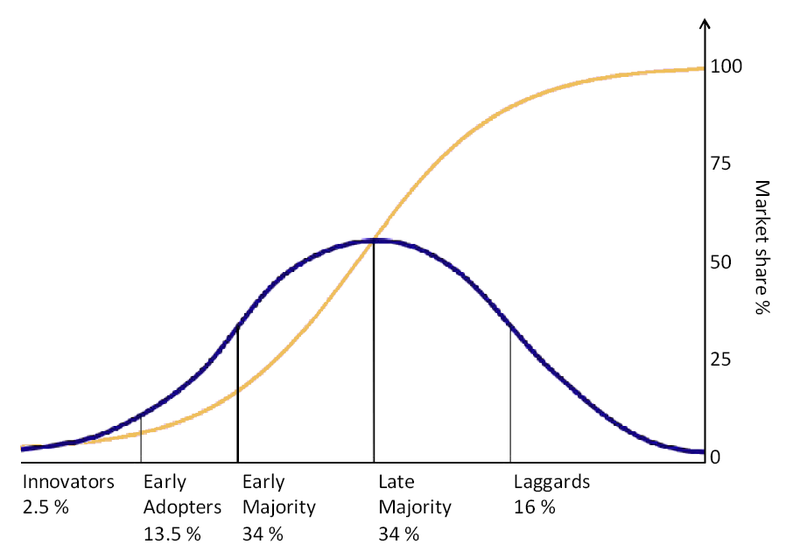
This continual rise in per-person wealth, standard of living and productivity has come from a succession of technological innovations that have permeated society. Although, from an historical distance, the long term growth trend of a country looks pretty smooth, innovation uptake by members of a society tends to following a wave of adoption. Very gradual at first, rapid as it gains widespread popularity, but then perhaps never quite reaching *everyone*.
There are only a discrete few innovations that are such majorly influential improvements to life as to have become ubiquitous (for example: mains electricity, automobiles, the internet), so they are spaced along our past. Each major innovation stimulated frenzied economic activity, indeed much employment was necessary to build, from nothing, massive infrastructure or industry (e.g. the railway/motorway network, industrial revolution). Lulls occur after each wave of innovation (because science takes time and) because the start of a wave is dependant on the new environment created by the previous one. So one should expect GDP growth history to be a little lumpy; a series of economic revolutions.
Nikolai Kondratieff wrote of his observation of a long wave economic cycle, back in 1925. It earned him Soviet Gulag, death by Stalin, and title to this theory (respectively). He estimated a fixed period of 50-60 years per cycle of: expansion, stagnation, recession. Since then it has been more commonly split into 4 seasons or irruption, frenzy, synergy, maturity (or such like).
This mini-book appeals to me because it talks about economic progress/stagnation/crisis as primarily attributable to innovations. However, his surprisingly compelling idea, to account for our global economic finance bubble, seems to clash directly with Kurzweil's portrayal of miraculously smooth technological advance. (Although Ray does talk about an overall exponential composed from S-curves through successive paradigms.)
* The Book's Central Thesis in A Nutshell Painted by Me:
The natural course of technological innovation, following the tree of scientific discovery, yielded many 'low hanging fruit' from 1870-1970 that greatly benefited the whole of western society. Transport, communications, home conveniences, mass production, free fertile land for US settlers and perhaps cheap fossil fuels. These rapidly raised the standard of living for just about everyone (in America), doubling it ~ every 25 years, also creating universal employment.
However, in the the last 40 years there have been no innovations with the same level of wide ranging public utility. We, in the developed world reached a plateau of of technological productivity gains in the 1970s. Advances since then have been *marginal improvements* that have mostly benefited private consumers (to an extent dependant on wealth). The lack true economic growth was hidden by the uncertain value of growing government expenditure. [Perhaps outright "Pollyanna Creep" too (my thought, or rather Douglas Rushcoff's from "Life Inc.").] Markets and individuals, caught up in the endemic false expectation of continuously strong growth (from the previous period of reaping 'low hanging fruit') all simultaneously overstretched to the point of buckling.
The Internet is a sole exception of innovation, in that it has had a great qualitative benefit to peoples lives, for that part of society sufficiently educated to enjoy it's many wonders. However, it has not yet raised standards of living as ubiquitously as did electricity in homes. Furthermore, it contributes very scantly to employment and GDP. Computers do almost all the hard work, so massive companies (Google, Facebook) have few employees, hence (in part) the 'jobless recoveries' of the last 2 decades. Also, it's very difficult (or just plain unnecessary), to monetise most internet content. Time well spent on-line, for the individual, may well decrease spending elsewhere, hence reduce GDP and government tax income. The net is just too damn efficient!
Continued climate skepticism, international treaty failures and government spending malaise are still the state of play as far as renewable energy generation is concerned, right? The planet is already doomed to a 2-4deg.C rise, while home-owners bicker over new wind turbine locations... But forget all that!:
From the perspective of this BBC article, a clean energy boom is already well under way. Even the UK, with our apparently doddering government, was 3rd in the world for renewable investment (in 2009), not far behind the US in gross expenditure. Way out in the lead, in terms of investment, and soon installed capacity, is China. Yes, the nation getting the most international evils for it's ballooning coal addiction, will soon pass it's 2020 target of 30GW of renewables (when counting just its wind power), and it is the world leader in photovoltaic cell production.
While US investment fell 40% during the sub-prime mortgage crash, overall global investment has been buoyant. South Korea's capacity grew 250% in the last 5 years!
Greenpeace may be moaning about data center power use, but Google are already heavily reducing their carbon footprint, spurring the rest of the industry, and society as a whole to follow suit. Their roves are carpeted with solar PV and the Climate Savers Computing Initiative (CSCI circa 2007) they co-founded has pretty ambitious targets.




 Admittedly, the internet uses (very)