Sunday, 14 April 2024
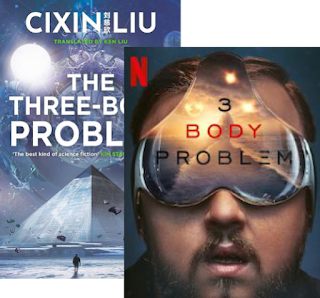
3 Body Problem - Series Review vs Book 1
Thursday, 16 February 2023
"Blindsight" & "Echopraxia" by Peter Watts - a qualified positive review, discussion and questions
► Review (light contextual & thematic spoilers):
| "Firefall" omnibus edition of both novels |
But the author also uses the context and diverse assortment of transhuman characters, in each book respectively, to explore themes of, first: neuroscience, abnormal psychology and consciousness. Then: genetic engineering, augmented intelligence, belief, identity, culpability and free will (or lack of).
Both books have an explicit discussion of concepts at the end, with over 100 references to science papers and other books, in each. This comprises a full 10% of Echopraxia's total length! In case readers had any doubts about just how thoroughly researched and insightful these works are.
There are certainly spaceships, action and a novel first contact situation. But the plot arks were somewhat arduous through long mid-sections, with lots of dialogue that dragged a little. Brooding suspense and flashbacks, in one. Voyage with sometimes grating protagonist interactions, in two.
Echopraxia doesn't really continue on from Blindsight directly. For me, it had somewhat of a feel like, for example, Prometheus (2012) continuing the Alien (1979) franchise. Although there is technically one recurring character. Book two reframes the first a little and is mostly a chance to explore additional futurism and dig more into his conception of a hyper-intelligent vampire.
Despite a promising first book opening, that name checked the (technological) singularity and Ray Kurzweil explicit, I never quite meshed with the feel of Peter Watts' philosophising. Throughout either book. I think, in part, he deliberately writes to make things uncomfortable. There's certainly no heart warming romance or nice happy endings.
But, more fundamentally, in the afterword of Echopraxia, he explicitly states that he doesn't support/believe in the concept of digital physics. I.e. the leitmotif of most of Greg Egan's works, and (implicitly) many works by other authors, which have sat more squarely with my own core beliefs and understanding of the universe.
The character arcs conclude properly, in my opinion. Although there seems to be deliberate ambiguity left for interpretation as to exactly what and why various things happened, big and small.
Sunday, 13 February 2022
"The Relentless Moon" by Mary Robinette Kowal (Lady Astronaut Universe Book 3)
Like books one and two, which I reviewed here, Kowal has very well written characters, with good narrative structure and pace. So "The Relentless Moon" is an easy reading page turner. Even though it's not my typical cup of tea: it is rigorously well researched hard sci-fi, but relatively low concept, big picture wise.
Set in an alternative 1960s where severe climates change, caused by a large asteroid a decade hence, is spurring a much more ambitious manned (and womanned!) space exploration and colonisation program. To escape the inevitable runaway greenhouse effect.
| [Goodreads] |
We ride inside the mind of Nicole Wargin, while our previous protagonist, Elmer York, is on her way to Mars; this is a spin-off plot, running in parallel to the second half of book 2. We met Wargin before: one of the first batch of (lady) astronauts. The wife of a senator, who is now angling to run for president of the US.
Sunday, 12 January 2020
"The Calculating Stars" & "The Fated Sky" by Mary Robinette Kowal
Two fairly short, well paced sci-fi novels that tell of an an alternate history branching from 1952, when the Eastern seaboard of the USA is hit by a large meteorite.

The story follows a female protagonist who is a scientist, 'computer' and ace pilot, as she, and her refreshingly supportive lead space engineer husband, face the trials and tribulations of fast tracking a space program to ensure against the consequences of this catastrophic event.
The first novel of this duology could stand entirely on its own, but I enjoyed it enough to buy into the continuation and be entirely please I read them both. Even though it's not the kind of hard sci-fi I'd generally go for. There's great technical adherence to the practical realities of spaceflight (and American life) in that era. But no attempt at predicting on technological or societal changes in our own future. And its not really a space opera in the usual sense.
In shines in its feminist tilt, looking at struggles against counterproductive sexism, and racism, in the space program setting. From the perspective of an unlikely heroine, who's main problem is crippling physiological anxiety stemming from physiological mistreatment by the male establishment. Rather than the rigours of spaceflight itself.
The main male characters are interesting constructions, too. The husband appears to be almost an idealised reference for how a feminist might specify best practice male behaviour (towards women). Perhaps a little artificial, but refreshingly non 'rough around the edges'/interestingly imperfect. I found their, more subtly written, physical romance scenes heart warming.
The most interesting character arc is that of a more senior male antagonist. He's initially a somewhat 2D male chauvinist, borderline(?) rapist, who our protagonist is forced to deal with and get to know better, in halting steps forwards and back. Ultimately not ending up going quite where I expected.
Issues [Spoilers]: