Showing posts with label space opera. Show all posts

Tuesday, 22 April 2025

Black Mirror Season 7 review - Good to excellent Sci-fi TV!

These are very quickly bashed out over/reviews. Please excuse missed details, etc. But new Black Mirror is something specially to be noted down! The episode order was certainly cathartic, making us work through the rough to finish with the fun...

1 - Common People - Depressing satire of predatory subscription models. Like, "Brain River" maybe a reference to Microsoft's digital river (torrenting Windows updates between users to save on server cost, etc). Also degenerate live streaming taken to a depressing low of basically crowd sourcing self torture porn. Talking to extreme the unhealthy practices of being a 'channel', eg multi-day 'subathons' that Twitch game streamers run, at the shallow end.

Some on r/cfs (Reddit) said they were somewhat triggered by the portrayal of the wife, choosing to end her life due to being exhausted all the time, with long unrefreshing sleep and continually loosing bodily control (with forced adverts channelled *through* her). Given that this depressing quality-of-life is still better than theirs, with this living torture disease.

2 - Beté Noir - A dark side of multiverse transitioning, a bit like "Everything Everywhere All at Once". The ultimate for revenge manipulation and gaslighting. Of course, they transition through a lot of impossible universe spaces and make no attempt to explain why their minds transfer over. 'Quantum Compiler' magic.

Sunday, 14 April 2024

3 Body Problem - Series Review vs Book 1

I read the first book of Liu Cixin's trilogy (translated from Chinese by Ken Liu) in 2016. So, fittingly, just about enough time has passed for a radio transmission to reach and return from the Proxima Centauri system... Also, more than enough time for me to forget many of the details! So I was not overly focused on expected plot waypoints, or any finer details, in the new Netflix series.

This streaming adaptation is by Benioff & Weiss, of Game of Thrones infamy, plus Alexander Woo (True Blood writer, apparently). Thankfully, they won't have to make up their own ending from scratch, this time. But given that the books reportedly get increasingly grand in cosmological scope and concept, we'll have to see what they make of the rest, come season 2. Hopefully not too far off!

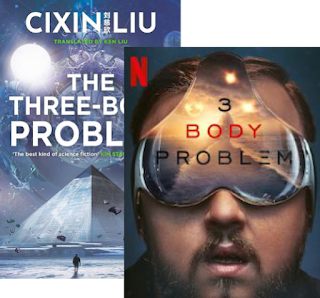
Book 1 (left). Netflix series thumbnail (right).

► My Initial Impressions of the Show [Low Spoiler]: the pacing was good and quick, despite the 1 hour episodes. So some of the many hard sci-fi concepts were shaved down to "blink and you'll miss it". Some things maybe discarded from the plot a little too soon. There was a frustrating lack of discussion of major events, following on from the big dramatic episode endings. 

But they managed to include a surprisingly large amount of the original material and feel, while finding a better compromise for retaining audience attention. Better than the somewhat laboured tour of scientific history, etc, in the first book. I was still surprised to see the show reach the main plot culmination of book one by the end of of the Ep 5. With 3 left to go! Apparently, they linearized the trilogy timeline, including a lot from Dark Forest and even some from Death's End.

I was a little disappointed how almost all the contemporary (2024) setting of the show was plonked down in London. Deploying a distracting remobilisation of GoT resources, with a far more 'international' cast than the books. White-washed vs the novels? Perhaps. But it worked well; the main characters were utterly remixed into an original ensemble, with more compelling personalities and social relationships. 

And there's already been a 30 episode (!) Chinese TV series adaptation, released in early 2023, with all Chinese cast. Apparently it drags badly, literally converting almost everything from the books. *Except* for the Netflix series' brutal opening scene, in the Chinese Cultural Revolution. The Chinese audience gets historical censorship, while we get soft power propaganda, only seeing the horribly outdated worse of China's tumultuous political neurosis and industrial devastation of nature.

Tuesday, 28 February 2023

"Valuable Humans in Transit" by Qntm - short story anthology summary and review

Having read all commercially published works by this relatively new author, of hard sci-fi on stilts, I felt I can to snaffle up this collection of short stories too. Bite size, even for me, so I read and summarised one per day, between dinners. Keeping the old noggin active.

They are all revisions of existing short stories he previous posted for free on his website, which are linked here, as well as purchase options. 

► Lena - Cautionary tale of the first human brain upload being duplicated, incidentally tortured (for compliance) hundreds of millions of times in increasingly numerous parallel simulations, to use him as a cheap information processing commodity.

Qntm preciously threw this into Fine Structure Constant, in passing. It's a sobering thought for extropians like myself, intent on digital reincarnation with indefinite lifespan. But, I feel like ChatGPT and other generative AI are already making redundant this idea of simulating brain Uploads for such utilitarian purposes. It's gonna be many orders of magnitude less efficient and probably less reliable.

Thursday, 16 February 2023

"Blindsight" & "Echopraxia" by Peter Watts - a qualified positive review, discussion and questions

 ► Review (light contextual & thematic spoilers):

"Firefall" omnibus edition of both novels
These two hard sci-fi novels are ostensibly space operas, set near the end of this century. They depart from a world where base humanity is struggling for relevance, half choosing to live in virtual reality heaven. While technology has resurrected once extinct vampires.

But the author also uses the context and diverse assortment of transhuman characters, in each book respectively, to explore themes of, first: neuroscience, abnormal psychology and consciousness. Then: genetic engineering, augmented intelligence, belief, identity, culpability and free will (or lack of).

Both books have an explicit discussion of concepts at the end, with over 100 references to science papers and other books, in each. This comprises a full 10% of Echopraxia's total length! In case readers had any doubts about just how thoroughly researched and insightful these works are.

There are certainly spaceships, action and a novel first contact situation. But the plot arks were somewhat arduous through long mid-sections, with lots of dialogue that dragged a little. Brooding suspense and flashbacks, in one. Voyage with sometimes grating protagonist interactions, in two.

Echopraxia doesn't really continue on from Blindsight directly. For me, it had somewhat of a feel like, for example, Prometheus (2012) continuing the Alien (1979) franchise. Although there is technically one recurring character. Book two reframes the first a little and is mostly a chance to explore additional futurism and dig more into his conception of a hyper-intelligent vampire.

Despite a promising first book opening, that name checked the (technological) singularity and Ray Kurzweil explicit, I never quite meshed with the feel of Peter Watts' philosophising. Throughout either book. I think, in part, he deliberately writes to make things uncomfortable. There's certainly no heart warming romance or nice happy endings.

But, more fundamentally, in the afterword of Echopraxia, he explicitly states that he doesn't support/believe in the concept of digital physics. I.e. the leitmotif of most of Greg Egan's works, and (implicitly) many works by other authors, which have sat more squarely with my own core beliefs and understanding of the universe.

The character arcs conclude properly, in my opinion. Although there seems to be deliberate ambiguity left for interpretation as to exactly what and why various things happened, big and small.

Sunday, 19 June 2022

"Ra" by qntm - Book Review

I enjoyed this book. It had immediate personal relevance, kicking off in my old-university city of Nottingham! In the 90s, a little while before the time I was there studying physics. With its central female protagonist called Laura (weirdly also the name of a girlfriend I had there), its brief summary of her mundanely relatable romance spoke truth to me, too. Anyway... 

"Ra" initially presents as a kind of alternate history, where magic exists as a new kind of science. Only recently taught to undergraduates, in either applied or theoretical courses. Described as esoteric and remote, for the majority of the population. Much like quantum physics in the real world. In both cases, they've been quietly revolutionary for civilisation. 


Our protagonist makes the exception to this, with ostentatious, hyper-competent implementation of its possibilities. Magic is cast by speaking a kind of programmer pseudo-code, with an ancient Samarian (or some such) flavour. While simultaneously holding complex concepts in mind.


It's no coincidence there's an echo of "The Laundry Files" mathematical demonology, here; qntm has clearly been strongly influenced by several of my favourite sci-fi authors, including Charles Stross, who's tweet put me onto them in the first place.

Tuesday, 13 July 2021

"Ancillary Justice" trilogy by Ann Leckie - positive review and discussion

"Ancillary Justice" (book 1 - 2013), "Ancillary Sword" (book 2 - 2014), "Ancillary Mercy" (book 3 -2015).

►Review:

"Ancillary Justice" is the first in the highly acclaimed, multi-award winning "Imperial Radch" series, from a debut female author [Wikipedia, Goodreads]. It felt very different from most of the sci-fi that I've read and loved, in not being primarily about a technologically exciting setting, cosmologically consequential events, or near future insights. It's overwhelmingly character driven, with an extreme focus on their development and back story.

Consequently, I was not utterly riveted by the first book, coming to it a couple years late, with a gap of a few more years before recently returning to finish the arc. But the story really grew on me; I can understand why this caused a splash.

I'd describe the core (feel good) hook of these books as ethics competency porn. The central character, Breq, always seems to hit the nail on the head, in terms of picking the most righteous course of action. Even in thorny situations, sticking it to the callous powers that be, etc. In a similar way to how Iain M Bank's Culture novels have a kind of ship mind competency porn, where it may come down to the last breath, but they clutch it out somehow, against all odds. More on the link between these authors, later.

Much has been made of Leckie's unique take on gender [e.g. Slate]. With Breq's biological sex never explicitly confirmed. Equality and gender neutral pronouns are one progressive aspect of the deeply flawed Imperial Radch empire. Feminine pronouns are always the default: she/her. Breq struggling to accurately gender some of the people they meet is certainly a cute device to accentuate this point. But it made less sense to me by the end of the series; when she was the troop carrying spaceship "Justice of Torren", she will have been intimately involved in matchmaking and interpersonal harmony between the many officers of her crew.

See, Breq is the last surviving fragment of a millennia old ship AI. Out, from the start, for revenge against the tyrant who murdered the rest of her. In the first novel, the story and meaning behind that unfolds in flashbacks interwoven with her travails on this quest. It's built up in a way to really put the reader into the shoes of this perpetually angry but compassionate intellect. Dealing with loss of function, identity and purpose. Redefining herself as she unexpectedly builds up a new life, sweeping through the whole arc to a satisfying conclusion.

The prose is well written and paced, with the occasional song lyric snippets included, that didn't make me turn off or really cringe; songs and their collection is a core personality trait of our protagonist. The latter two books are essentially linear, by comparison. And set in roughly the same place; this isn't a romp around the galaxy. Instead we explore in more depth, as events develop and unlock new possibilities.

There's certainly exciting build-ups and some interesting action. But generally it's more low key and human scale - tactical and psychological. Perhaps more of a stereotypically female thinking approach to things, overall, with tensions bubbling under the surface of outward civility. A lot of weight placed into subtle details and even menial activities, that, on paper I wouldn't have expected to get on board with. But fell into an easy rhythm.

I was really glad I read the whole of this trilogy, by the end. Hitting a very satisfactory conclusions via an often unexpectedly understated route. Although I wonder if it will be less memorable for me, in not hitting the more physical/technological notes that usually excite my interest. This trilogy might be good for fiction readers who don't normally go for sci-fi; maybe genre gateway books. 


► Discussion with SPOILERS!: much of the text below is content summary, as I struggled a little to pick many outright faults or failings. Nor interpret meanings too far beyond some fairly direct, probable and some (perhaps) wishful thinking references.

Monday, 28 June 2021

Prey (PC Game) Review and Sci-Tech References Explored

► Contents:
• Steam review (copied with added screenshots). 


Prey is quite reminiscent of Bioshock 1. So presumably System Shock, too? (I've never got around to it.) With a hack mini-game, for one thing. Also, the post disaster exploration of an Island of Doctor Moreau super-science setting. This time, a near future massive space station in lunar orbit. Realised due to an alternate history where President Kennedy lives to 100 and there’s cooperation with the soviet space, etc. As discovered by in-game background materials, of which there’s a good amount.

The game’s promotional material had put me off for a couple years, with an apparent emphasis on psychological and body horror (the eye injections). But I was glad that this wasn’t really representative. There were no jump scares, and none of the squalor or wildly demented characters of Bioshock. 

Sunday, 25 September 2016

On: "Knights of Sidonia" Anime (and Related Current Affairs)

"Knights of Sidonia" totes plenty of whizz-bang space battles with giant mecha suits piloted by teenagers repeatedly fighting incomprehensible space monstrosities that attempt to tentacle humanity to death.... But! Push past the facade of these overused anime tropes and be rewarded by a rich, engaging space opera.


Summary - Components of This Well Assembled Pastiche:

There's a strong 'hard sci-fi' undercurrent carrying the story along and underpinning a decent amount of attention to detail.

Then there's teenage awkwardness, of course, and tensions in a kind of high school-ish setting (of the pilot academy). The socially inept protagonist, chosen-one (Nagate), who alone can pull the joysticks of the legendary armour suit to it's full potential... But thankfully it's never as paralytically morose as NGE (Neon Genesis Evangelion).

It is respectably gritty, but not like the gratuitous gore of Akira. It has decent depictions of the brutal suddenness of war. This is brought home via the perspective of sympathetic characters, mostly very young, like the unlucky soldiers of real wars. But, of course, the fantastical space setting and perversely monstrous threats make it psychologically gentler (safer) for an audience to engage with emotionally.
Yuhata Midorikawa's different faces.

It also avoids being too bleak via juxtaposing the relatively low key social tribulations of the pilots, burgeoning on adulthood. Prime example of this is Yuhata. She swings between command responsibilities, gambling everyone's lives, to then be the star-struck, boy obsessed, teen girl. (Also gluing together geeky toy models kits in her spare time.)

There's a definite 'harem' sub-genre element running throughout, adding lighter notes, with support character developement and romantic intrigue. With three main contenders for Nagate's attention, there are few other females encountered who don't also make a play at some point, brood over him or have a twinkle of possible interest. These are mostly relatively subtle, making sense in context, since our protagonist is deliberately set up to be an inspirational hero who necessarily appeared mysteriously from no-where. An attractive combination, I suppose. But then this blank slate POV character with an open selection box of different flavoured lovers meshes rather neatly with the psyche of the core young-ish male demographic. Who would not love to imagine themselves as an overlooked darkhorse hero themselves? (If only they had their moment to shine or step out of themselves!)

Residential interior of Sidonia - caricature of the 
dense, hilly urbanisation of 'spaceship Japan'?
The flip side of all these female characters is that there are a whole lot of complex, strong female characters. In fact, they run the ship, from captain to XO, to commander, chief engineer, dorm mother, genius doctor/scientist. So, I suppose that even if this is basically down to the Manga artist/author enjoying drawing the female form more, then so be it. The result is good overall, although the bias towards showing only female communal 'photosynthesis' room scenes feels a little exploitative.

Also thrown into the pot are the unavoidably ubiquitous anime tropes of instant karma for (accidental) male lechery, always receiving a bloody nose, usually quite directly off a fiery female. Plus an alpha dog bully antagonist with long, grey/white hair and a massive family inheritance. But even he has an interesting story arc.

Finally, the art style is seamless 3D CGI. It's more noticeable in the space action scenes, when things look a little bit Tron - monochrome with neon highlights. But then it blends into a more rustic feel while inside sidonia's city spaces, with familiar cartoon stylings. The characters faces generally appear unnoticeably traditional. There's a retro aesthetic flavour, too, with the uniform outfits: almost storm trooper-esq, with stuffed up gear. There's some disconcertingly high flung, pointy boobage going on, but we'll put down to genetic engineering and/or reduced gravity, and move swiftly on...

The marriage of high tech space mecha, moving city(ies) of giant rusty pipes and cthulhu-ish space monsters is similar to, though far less gordy than, 2013's "Gargantia on the Verdurous Planet".


Original Manga vs Anime:

The anime appears to follow the original manga (comic) publications very closely. Almost shot for shot, with only some minor sequence juggling and tweaks here and there. So while I'm talking about the Knights of Sidonia (KoS) anime here, most comments apply to both.

Given that the manga has concluded already, it's a little tempting now, after watching season 2, to just read the final third (volumes 44-78, or thereabouts), rather than wait while the animation studio is apparently finishing up with a different project. It would save totally forgetting the plot details a second time.

But the video format is more compelling and I often struggle more to figure out what's supposed to be happening in the strips. It's a far more mentally tiring and different experience. At only 20 minutes per episode and a dozen per season, it's probably almost as quick for me to watch as read and digest the corresponding 20 odd manga volumes with 30 or so pages a piece. Plus you get to hear the cute Japanese voices and groovy theme tunes.

Wednesday, 22 October 2014

ScarJo for GITS? Alternative Actresses (Image Montages) & Thoughts on the Remake

Recoloured sketch augment by me (2009)
'News' of the possible casting for Ghost in the Shell seemed rife the other night (Guardian, io9, IGN, etc, etc). Probably because Facebook's algorithm can clearly see that I've LIKED the GITS film and SAC pages. Dipping briefly into the milieu of rabid fan comments, some alternative names cropped up that sparked me to think I might feasibly use this topic to squeeze a few film reviews into a single post (but then time and length over-ran, so they got their own posts).

Firstly, let me apologise for abbreviating Miss Johansson's name in the title, since she's reported as stating that the contraction "...sounds tacky... lazy and flippant... violent...[and]...insulting..."; a press convention designed to diminish women. This according to The Atlantic on "Scarlett Johansson's [Subversive] Vanishing Act" Note the partially redacted title! lol.

I would actually be fairly pleased with this casting choice in general. I have been pretty impressed with the direction she's taken with her acting roles (aside from the big Marvel money makers): oozing charisma through voice alone in "her", then reversing that completely with the disturbingly cold, emotional sparsity of "Under the Skin" (both 2013). The latter film could be taken quite literally as a metaphor for how the media industry feed on male weakness, using up successive starlets; all lust with no real intimacy pay-off.
Scarlett Johansson's shown she has the intensity. (Left: Under the Skin. Right: GITS 1995)
Whether she's deliberately challenging herself or even being a feminist heroine via clever casting choices is debatable. Obviously her sexuality never goes unnoticed, or uncommented. Supposedly it is flaunted in "Lucy" (2014 - though I've yet to watch it), in which her character uses "looks... as a utilitarian instrument of revenge" [Atlantic]. Obviously these 'looks' also woo a certain audience segment, too. This sounds just fine for Motoko's role, in certain respects. If this live action film leans towards the more overtly sexualised Major of the TV series (even more so the original manga...), then Johansson's reputation may be even more fitting (for better or worst).
http://lewyland.blogspot.com/2014/10/on-her-2013.html

My enthusiastic review extended into a whole blog post.
My concerns with Scarlet are more on how convincing fight scenes might look; I remember Scarlet's secret agent action role in "Iron Man 2" broke the 4th wall for me, in terms of believability for the physical capabilities of her body shape. Actually not so terrible, reviewing that scene. But the major generally goes toe to toe, rather than mauling opponents like a demented, Kung Fu squirrel. Maybe this inflexibility is a sexist failing on my part; "refus[ing] to embrace women in their entireties." [Atlantic].

Emily Blunt - has greater stature and already filed a military command role as Rita Vrataski (image above). She also has under her belt (the pretty decent) sci-fi action "Looper" (2012), with "Adjustment Bureau" (2011 - blogged here) rounding out the A-list of male action stars shes played support to. She actually turned down the 'Black Widow' role that now lets Johansson net serious money as an establish action star ($10M on the table for GITS). So if the current casting falls through (again), maybe history will be mirrored.

My blog post with analysis and criticism.
Blunt reminds me strongly of Keeley Hawes (in Ashes to Ashes): aside from being somewhat identical, both are type cast as indomitably assertive women with posh English accents. Which is all good. But I've yet to see Blunt in a lead role, and she seems to have a tendency towards hanging slightly agape, rather than tight lipped, steely determination.

Rinko Kikuchi - you might have hoped, would be more of an obvious choice, given that she's a japanese actress who has starred in a number of (English language) action blockbusters, (including 'Mako Mori' in the terrible Pacific Rim, see linked post below). Sadly, I think her accent is too strong to deliver the necessary philosophising with any serious weight (in a language I can comprehend, anyway).