Showing posts with label economics. Show all posts

Saturday, 18 April 2020

Covid-19 (Part 3) - Life under lockdown

Out for our 3rd weekly shop.
Exploring the pandemic situation, continuing from:
• "Covid-19: a deadly wake-up call to exponential growth?"
• "Covid-19 (Part 2) - Daily Updates"

Index:

• 2020-04-18 Sat - Misplaced Animosity
• 2020-04-19 Sun - Divided States
• 2020-04-20 Mon - Food Shortages?
• 2020-04-21 Tue - Through the floor!
• 2020-04-22 Wed - Perspective
• 2020-04-23 Thur - More Science Sumaries


► 2020-04-18 - Misplaced Animosity:

[Daily Mail]
• I've been somewhat horrified at the general appetite (seen in posts from of some of my old Facebook friends) for martial law and/or capital punishment, effectively. I.e. marking anyone taking an unnecessary walk in a park as "not for treatment", in the case they ever get infected. Punishment fits the crime grim poetry.

That last coming from one of the most caring individuals I know, in response (I believe) to a litany of pictures like this one (right), from the [Daily Mail]. Flattened, zoomed in perspectives making everyone look far closer together. Seemingly just trying to stir up resentment and outrage, for viewership and quite possibly to undermine public solidarity and help usher in crony capitalist friendly authoritarianism (for the papers owners).


Above is closer to the real story of public spaces - drone footage of Birmingham city centre on a sunny Saturday afternoon. It's usually heaving with crowds, but is now deserted! [Twitter Video]


It also looks like over 90% of rail travel is gone, 80% of London bus trips and 65% of other road travel too (right). [BBC]


78% of people self isolating, as of the beginning of April [Ipsos MORI]. Pretty impressive adherence to measures (and an unprecedented economic change).

Despite all this, UK public is still being focused on the rare black sheep amongst us, and bad optics in occasional photos and videos. It's our 10'000 year (or so) old memetic predilection for social scandal, coupled with a cognitive incomprehension for relative scale and rarity.

Sunday, 29 March 2020

Covid-19 (Part 2) - Daily Updates

SARS-COV-2 - lipid bilayer with
ACE2 binding s protein spikes.
... Continuing on from my previous mega-post: "Covid-19: a deadly wake-up call to exponential growth?".

It seems the future is currently flying at us on a daily basis, so I'm still finding it hard not to hyper-focus on events and feel I may as well use this blog for catharsis.

I've ended up spending quite a lot of time talking about the antics of politicians, which I'd normal tell others to ignore, but in this instance the situation is so heavily dependant upon exactly what measures are announced, when and how the public reacts.

Index:
2020-03-29 Sun - Pointing Fingers
2020-03-30 Mon - Missing reports, farm labour, excess oil, Korean expert
2020-04-02 Thur - Symptoms, Vit treatment, Exit strategy
2020-04-03 Fri - Developments (under-reporting deaths in Europe vs China)
2020-04-04 Sat - Followup
2020-04-05 Sun - Science - GAVI, CRISPR, summer reprieve?
2020-04-06 Mon - Science 2 - ICU survival rates, Bio-molecular basis of virus
2020-04-07 Tue - Science 3 - BP med danger? Bio-molecular simulation explain all?
2020-04-08 Wed - Unintended Consequences (Advertising apocalypse, BoJo in ICU, etc)
2020-04-10 Fri - Unequal impact (racial, economic and geographic inequities)
2020-04-12 Sat - Dissecting government decision making, cats & dogs and creativity


► 2020-03-29 - Pointing Fingers:

• The domestic coronavirus outbreak seems to have given Boris Johnson (and other incumbent leaders around the world) political invincibility. The 'rally around the flag' effect has him up at a 73% approval rating, the highest for any conservative government since such metric began in 1943 [Bloomberg].

Which makes sense during a crisis or war, generally. This certainly fits with the vibe I get when talking to most of my friends (those who aren't politically polarised already). Although I saw one post hinting that there may also have been some astroturfing, with copy-pasted supportive sentiments on social media [Twitter]. (Probably insignificant in this context.)


• That record polling was even unaffected by the announcement of his infection (and both health secretaries, etc). Which The Daily Mail has attempted to pin on the EU, via chief negotiator Michel Barnier, who was also diagnosed a while before [The New European]:


It's laughably implausible, given Barnier's not even been to the UK recently, so it would have to have passed via an intermediary politician. Prince Charles or Nadine Dorries far more likely. The very risibility of this nonsense claim is probably the reason I saw it plastered all over my Twitter time-line. Again, right wing intimations going viral, for free spread of their repulsive rhetoric. Including me posting it here, to illustrate the point...

Wednesday, 11 March 2020

Covid-19: a deadly wake-up call to exponential growth?

With wall-to-wall coronovirus news now impossible to miss, I wanted to do a bit of a brain dump of my thoughts on and around this scary issue. For personal catharsis and reference, as much as to inform the few others who might read it. I think this will likely turn out to be the most significant event in my living memory, so far.😨


On the Curve: 

My perspective with this blog was very much underpinned by extropianism and the inevitability of exponential technological advances most famously expounded by Ray Kurzweil. So of course I've often been aware of how typical human thinking and expectations is unable to grasp exponential changes. E.g. how solar PV is due to come from seemingly nowhere to suddenly be providing abundant clean electricity for most of the globe.

I'm wondering if the exponential spread of the Covid-19/SARS-Cov-2 virus will be a turning point in public awareness for the power and immediate relevance of such non-linear growth rates. Certainly the initial spread appeared to follow an exponential curve [YouTube]:


China's figures now claim the rate of infection spread has peaked after their impressively agile response [Twitter thread]. Throwing up entire new hospitals in a couple weeks, switching (free!) healthcare provision and interaction to be more online, bringing in hospital staff from all over and locking down entire regions with high compliance.

It's great news, if accurate, given how much of the world's goods are supplied by China. There was much reporting (in Western media) of initial infection whistle-blowers being silenced/punished for descent against the state, perhaps frustrating potential for early containment (we don't know, and might not). But the virus was recognised pretty early and sequenced in record time. However, the heroic containment efforts [NY Times] may have only bought the rest of the world a few precious weeks to start preparing...


Epidemic Response: 

There's very good reason to be scared for a worst case scenario outbreak in the US, where testing has been abysmally lacking. Tests alone have been costing individuals thousands of dollars out of pocket and there's no protection for many workers to take sick leave (let alone as a precaution). Pretty strong incentives not to act responsibly.

Also, the Trump administration dismantled the pandemic response team, back in 2018, at the time of an Ebola outbreak [Independent, FP]. He put openly anti-science Vice President Pence in charge of the coronavirus response and Trump himself has been lying that the spread has been "stopped" [Independent].

A very similar situation in the UK, where Tory government has been defunding the NHS for a decade, purging international staff and heath workers with Brexit xenophobia and now with an untouchable majority PM Johnson is making terrifying babbling noises about the UK just "taking it on the chin" [Twitter Video] and allowing the infection to spread, effectively... 😱

The WHO's (arguably belated) declaration of a global Covid-19 pandemic, today (2020-03-11) sounds like a direct dig at these attitudes: "we were deeply concerned, both by the alarming spread and severity and by the alarming levels of inaction"! Complacency and lack of fear is arguably more scary than a little panic (although calm assertive action is the call of the day, now).

Thursday, 18 June 2015

Audacity of Yanis Varoufakis - Understanding Global Macroeconomic Stability and the Greek Financial Crisis

Rough Contents Overview:
  • Varoufakis, a quick profile.
  • Global Minotaur book/concept.
  • Exchange rates, trade surplus issues and history.
  • China, 'Chimerica' & Niall Ferguson, currency wars.
  • Greece - historical context, specific precipitating factors.
  • IMF's ills.
  • Bitcoin and Max Keiser.
  • Piketty, inequality and Gates.
  • Referendum result and Resignation.
[2015-06-18] The ongoing Greek financial crisis dedlock has been continually misreported as if it is a simple, political tug of war: little Greece trying to barter an arbitrarily better deal from big EU lending countries. But this narrative excludes essential dimensions which have massive implications for the entire world! The bulk of this can, I think, be covered by talking about this chap's writings and hopeful approach...

He's the finance minister for Greece's latest Government, Syriza - a rainbow coalition of small, 'radical left' leaning parties. I almost wish this political agglomeration would inspire something similar in the UK, to tackle the insurmountable FPTP electoral system. Syriza united behind a popular mandate to begin rolling back half a decade of failed austerity measures, privatisations and restructuring forced upon Greece by the 'Troika'. This triumvirate comprising the IMF, EU and ECB, imposed these conditions in exchange for further, massive, unpayable debts.

Varoufakis is no career politician. Brought in by Prime Minister Alexis Tsipras, he's not even a party member, persay, more like a passionate consultant. A globetrotting, professional economist, no less, who has continued his blogging despite his new post. We should be so lucky! After graduate and masters studies in the UK, he fled Thatcher's 3rd term for 12 years tenure in an Australian university and a year in Texas. He recently advised Valve on growing their Steam platform globally before being drawn back to Athens and his home land. [Wikipedia-1]

With looks that wouldn't be out of place in a Bond villain, and a mellifluous cadence, he meticulously and gracefully answers any and all questions with carefully selected metaphors and examples. He is a formidable speaker in English, and someone to whom Joseph Stiglitz (Nobel economist and ex World Bank chief) pretty much defers to [New Economic Thinking Video]. In fact, Varoufakis' government position has been described as analogous to Obama appointing the well known Keynesian, Paul Krugman, or the aforementioned, world famous inequality expert, Stigltz [NYtimes via twitter].

With a father who fought on the communist side of Greece's civil war (1946–49) and having set up local (PASOK) youth movement, Yanis describes himself as an 'erratic Marxist' and preaches 'pragmatic egalitarianism'. A term I much like. With contributions to the field of game theory research, and the build of a rugby player, he must truly be an intimidating prospect for the European bureaucrats with whom he has been tasked to negotiate. So its of little surprise that he's had to, cooly and calmly as always, belay the repeated claims from 'leaks' and attacks on him via the (dodgy Greek) press, and distorting, confrontational lens of the international coverage.
The audacious part is that he appears to be out to apply his key macro-economic insights directly to where they could have the biggest, widest reaching beneficial effects on the composition of the entire Eurozone (and beyond)! A step up from the radical academics in fiction: Indiana jones or Tom Mason. I'd go as far as to hold him up besides world super-hero Elon Musk, if he succeeds at all.

Physicists - Yanis' initial interest in this degree subject, before switching to an economics degree (the lingua franca of political discourse) [1], leads me to feel an affinity with him and his approach. It was my first degree, which I chose because it seemed seem to contain the most fundamental factors for understanding everything (and for engineering the biggest changes to the universe).

Elon Musk was also a physicists, dropping out days into a PhD to make his millions on the dot com boom. He's famously talked about the subject's necessary thinking style of "first principles reasoning", "a framework of thinking that would allow understanding counterintuitive elements of reality" [BuinessInsider], that seems obvious to us scientist/engineer types, but seems regarded as a magical secret sauce by standard business types. I've already sung Musk's praises in my hyperloop post.

I hope(d against hope) that the Eurocrats can bring themselves to pay him serious attention, because he's not out to win as much ground for team-Greece as possible. The repayment postponements have been aimed at creating time for constructive dialogue. He's consistently projected far more hopefulness than the prevailing media narrative of political conflict we've heard, which has a perversely myopic focus, seemingly intent on self-fulfilling a doomsday scenario.

He's been penning, and repeatedly revising since 2010, a pragmatic "modest proposal" (with expert co-authors) that would quickly resolve the situation. It uses only existing institutions, without call for fanciful systemic overhaul. Yanis understands the hope and expectations riding on Syriza (and himself), and talk about the opportunity for Europe to "reboot". But has also stated that "we are not interested in imposing our views monolithically on the rest of Europe [Greece] is too tiny and too bankrupt to do that" [at 12:18 in this radio interview].

His ambition is to lay matters bare. Obviously he's been seen by some as rude and too strident, and I'm not sure his core ideas have even been listened to, let alone seriously considered. It feels like it may be a case like a expert employee trying to get their boss, with only qualifications in business management, to understand a fundamental technical limitation or requirement in their business, but the one in charge is blind to any reality beyond their costings spreadsheet. Does not compute and they probably even resent the impudence of their lesser rank knowing more than them. And that's before considering any influence of powerful figures who stand to profit from disaster and failures, via whatever arcane financial mechanisms they've cooked up.

Since starting this piece (several weeks back) a deal has been seeming decreasingly likely [BBC]. It was always going be a last minute compromise, at best, but it does feel increasingly like that may have been unrealistic. Despite haing to work up the details of the exit plan, Yanis is still pushing hard to be heard and save the day (as of 2015-06-19). But with talk of an all out run on their banks this weekend it sounds pretty much like game over [ZeroHedge].

Edited book cover image (from Yanis' blog).
Anyway. Varoufakis' big insight is "The Global Minotaur" - a beastly financial aspect of the United States that has stabilized the world economically (and therefore politically) via its huge, brutal consumption. More specifically, the state of affairs that existed since 1971, when America's world dominating, post world war trade surplus inverted. Instead of re-balancing, Nixon's Government decided to actively feed the country's trade and budget deficits to the max, shooting the moon. They relied instead upon attracted their exported dollars for re-investment in the American pie, vacuuming them back up via the wonders of international investments in Wall Street!

This one-sided flow of capital (goods and investment) was so powerful a sink of capitals as to neutralise the effects of national trade surpluses all around the entire world. It maintained a somewhat grim, global stability. This is comparable to the ancient regional stability fostered by the tyranny of feeding King Minos's labyrinthine bound, hybrid monster of Greek legend; a probable mirror of a real historical situation of lavish (human and economic) tributes proffered to Crete, in subordination to its dominance.

Tuesday, 20 August 2013

The non-paradox of "The non-paradox of choice".

About this article: "More Is More: Why the Paradox of Choice Might Be a Myth" on The Atlantic.

I don't see the contradiction here between:
  • Too many choices being bad - overwhelming customers.
  • And too few choices being bad - choice always needs to be discernibly relative. 
Most of the time, those doing the 'choosing' are actually just searching for what they already had in mind: there's not time in the world to analyse the relative merits of each type of milk, butter, bread, jam, etc, for each range of items in your grocery shop, every time you shop (even if you could erase your memories and start from scratch each time). There seems to have been a pretty strong evolutionary bias against such strategies, hinting at the expense of this type of critical thinking.

Scheibehenne, et-al
2010
So there should be a bell curve, with an optimum number of product options peaking in the middle somewhere. Exactly where that sweet spot lies will depend on each individual: domain naive persons benefit from simplicity, while connoisseurs generally think at a finer level of specificity, dependant upon past explorations.

The meta-study (Scheibehenne, et-al - 2010), to which the article presumably refers, appears to have been rather dumb: simply averaging the outcomes of the ~60 studies done in this area, selected from the previous decade, so that the two separate effects cancel each other out. In fact, the spread of study results lean pretty equally in either direction (picture, right). So the Atlantic article misleads by pitting a single, famous (Jam) study against "...10 different experiments... finding very little evidence that variety caused any problems,..".

Of course I didn't read the whole study paper, and might well not appreciate the intricacies of statistical significance, even if I had. But then I've not read Barry Schwart's book either, so this is just the ignorant rumblings of some guy on the internet who's read an article and watched a snack-sized pop-lecture (quite a while ago):


Conclusion: there's probably no marketing research shortcut here; you need to understand your customer's motivations, and the demographics there-of, to provide the optimum dispersal of product options for their satisfaction, and your sales.

What's doesn't seem to have been studied is the cultural phenomenon of spawning entirely new product markets, by gradually expanding established ranges. I strongly suspect that new economic ecosystems will monopolise a greater percentage of customer's attention and therefore spending resources. Promoting choice inflation (via biased reporting, for example) could be seen as a kind of capitalist control conspiracy: keeping a populace busy working all hours to buy more s...stuff, they don't really need. But I'd lay the blame squarely at the door of humanities's slavery to memes.

Monday, 17 October 2011

Why Wealth Inequality is *Actually* Bad

After putting all moralistic ideals to one side for a moment, income/wealth inequality is still fundamentally bad for a society. (I'll come back to ethics later, along with the Occupy movement and much more besides.)

The monetary system is immensely complex these days, so as a thought experiment I like to imagine money away: ignore it altogether as it has no intrinsic utility itself. It merely directs the allocation of man power and resources, as a dictator might. But hopefully our system has more effective priorities: promoting the spread of useful innovations and keeping society healthy.
Moai - 'Easter Island Heads' are misnamed,
 they've been buried to their shoulders by time. 

A conservative/neo-liberal might argue that rich people are no problem because they spend more, putting money back into the economy via the people they pay for products and services. However, I think the real problem is with the specific things they spend their enhanced incomes on.

Someone with 100 times more money than the average Joe doesn't buy 100 reasonably priced cars. Maybe they buy twice as many cars, but each one costs 50 times as much. It's actually quite difficult to spend that much money, so they will tend to purchase luxury items across the board, either impractically expensive versions of everyday goods or totally exclusive items like super-yachts.

Gucci handbags, jewel encrusted gold watches, $200M private yachts, giant mansions, hand made super-cars and fancy soirées are all about as useful at stimulating an increase in societal productivity as were the standing stones of Easter Island. For those unfamiliar: Moai (right) were erected all over the small Island as an expression of ancestor worship by clans. Making the statues took a heavy toll; there was total deforestation and ecosystem collapse. The isolated population of islanders had plunged from 15000 to 3000 by the time Europeans arrived in 1722. A 500% decrease, in under a century, with cannibalism. Shortly thereafter the 900 statues were toppled.
The monolith erecting game is taxing indeed for the people of Nias Island, Indonesia, 1915.
Back to the present day, the other thing wealthy people tend to use much of their money for is gaining *more* wealth. So, in a laissez-faire economy, an ever greater percentage of societal effort tends to be directed towards useless extravagances for an elite. Whether or not the top percent or two *deserve* extravagant pay for their services/resources is irrelevant, left unchecked this wealth concentration will destroy society. And in retrospect we will look every bit as dumb as those who built 10 meter tall maoi when all that was left to eat was each other.

Wednesday, 5 October 2011

Kondratieff Waves... Crashed Our Economy!

This article presents a divergent hypothesis from Tyler Cowen's lack of 'low hanging fruit' hypothesis for the current Stagnation (discussed in my previous post).

I was going to make one quick mention of a pure economics based thought that might have contributed to our current depression but it was based on an understanding inversion (see tiny writing below):

The 1970s switch of Government policy away from Keynesian practises towards monetary policies that buffered the economy from depressions and recessions may have precipitated the financial crisis by their very success: economic fluctuations shake the wastage out of the system, forcing inefficient businesses to shut down, reform or lay off unproductive staff. Keeping things steady just allowed more detritus to accumulate on the buckaroo donkey, saving all the pain for one big, inevitable mess... Well, actually that's complete nonsense!; It was *Keynesianism* that involved strong state intervention (like The New Deal). The 70s and 80s saw the rise of neo-liberalist policies promoting deregulated, free markets and privatisation. So, if anything one would have to blame *over* optimisation for the crash. 


+ Introducing Kondratieff waves:

To say that (inter)national economies are complex things is a blatant understatement. Many factors can effect a short term change in GDP growth rate; changes in: money supply, taxation, national interest rate, financial/business regulations (or removal of), public sector redundancies, etcetera. These have each caused quick and apparently large fluctuations in the past, but ultimately such disturbances only manifest for a couple of years at most before return to equilibrium. No amount of fiddling with these factors can stimulate sustained economic growth. Period. Yet on aggregate, since records began, the world GDP has *always* grown, year on year, even during the great depression, world wars and right now.
US GDP per person - "The Singularity is Near"
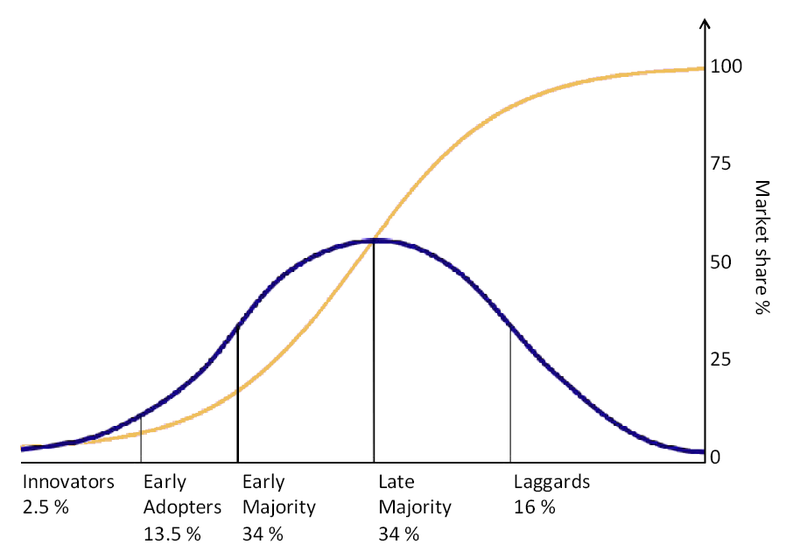
This continual rise in per-person wealth, standard of living and productivity has come from a succession of  technological innovations that have permeated society. Although, from an historical distance, the long term growth trend of a country looks pretty smooth, innovation uptake by members of a society tends to following a wave of adoption. Very gradual at first, rapid as it gains widespread popularity, but then perhaps never quite reaching *everyone*.
Wikipedia - Diffusion of innovations
There are only a discrete few innovations that are such majorly influential improvements to life as to have become ubiquitous (for example: mains electricity, automobiles, the internet), so they are spaced along our past. Each major innovation stimulated frenzied economic activity, indeed much employment was necessary to build, from nothing, massive infrastructure or industry (e.g. the railway/motorway network, industrial revolution). Lulls occur after each wave of innovation (because science takes time and) because the start of a wave is dependant on the new environment created by the previous one. So one should expect GDP growth history to be a little lumpy; a series of economic revolutions.

Nikolai Kondratieff wrote of his observation of a long wave economic cycle, back in 1925. It earned him Soviet Gulag, death by Stalin, and title to this theory (respectively). He estimated a fixed period of 50-60 years per cycle of: expansion, stagnation, recession. Since then it has been more commonly split into 4 seasons or irruption, frenzy, synergy, maturity (or such like).

Saturday, 1 October 2011

The Great Stagnation(?) by Tyler Cowen:

This mini-book appeals to me because it talks about economic progress/stagnation/crisis as primarily attributable to innovations. However, his surprisingly compelling idea, to account for our global economic finance bubble, seems to clash directly with Kurzweil's portrayal of miraculously smooth technological advance. (Although Ray does talk about an overall exponential composed from S-curves through successive paradigms.)

I came upon this (£2 Kindle app special) book via a link to this blog post considering stagnation vs relocation (of the world's economic centre to China).

* The Book's Central Thesis in A Nutshell Painted by Me:

The natural course of technological innovation, following the tree of scientific discovery, yielded many 'low hanging fruit' from 1870-1970 that greatly benefited the whole of western society. Transport, communications, home conveniences, mass production, free fertile land for US settlers and perhaps cheap fossil fuels. These rapidly raised the standard of living for just about everyone (in America), doubling it ~ every 25 years, also creating universal employment.

However, in the the last 40 years there have been no innovations with the same level of wide ranging public utility. We, in the developed world reached a plateau of of technological productivity gains in the 1970s. Advances since then have been *marginal improvements* that have mostly benefited private consumers (to an extent dependant on wealth). The lack true economic growth was hidden by the uncertain value of growing government expenditure. [Perhaps outright "Pollyanna Creep" too (my thought, or rather Douglas Rushcoff's from "Life Inc.").] Markets and individuals, caught up in the endemic false expectation of continuously strong growth (from the previous period of reaping 'low hanging fruit') all simultaneously overstretched to the point of buckling.

The Internet is a sole exception of innovation, in that it has had a great qualitative benefit to peoples lives, for that part of society sufficiently educated to enjoy it's many wonders. However, it has not yet raised standards of living as ubiquitously as did electricity in homes. Furthermore, it contributes very scantly to employment and GDP. Computers do almost all the hard work, so massive companies (Google, Facebook) have few employees, hence (in part) the 'jobless recoveries' of the last 2 decades. Also, it's very difficult (or just plain unnecessary), to monetise most internet content. Time well spent on-line, for the individual, may well decrease spending elsewhere, hence reduce GDP and government tax income. The net is just too damn efficient!

Saturday, 3 April 2010

Utility of the Green Energy Bubble

Continued climate skepticism, international treaty failures and government spending malaise are still the state of play as far as renewable energy generation is concerned, right? The planet is already doomed to a 2-4deg.C rise, while home-owners bicker over new wind turbine locations... But forget all that!:

"China steams ahead on clean energy"

From the perspective of this BBC article, a clean energy boom is already well under way. Even the UK, with our apparently doddering government, was 3rd in the world for renewable investment (in 2009), not far behind the US in gross expenditure. Way out in the lead, in terms of investment, and soon installed capacity, is China. Yes, the nation getting the most international evils for it's ballooning coal addiction, will soon pass it's 2020 target of 30GW of renewables (when counting just its wind power), and it is the world leader in photovoltaic cell production.

While US investment fell 40% during the sub-prime mortgage crash, overall global investment has been buoyant. South Korea's capacity grew 250% in the last 5 years!

Greenpeace may be moaning about data center power use, but Google are already heavily reducing their carbon footprint, spurring the rest of the industry, and society as a whole to follow suit. Their roves are carpeted with solar PV and the Climate Savers Computing Initiative (CSCI circa 2007) they co-founded has pretty ambitious targets.

Admittedly, the internet uses (very) roughly 5% of global power (and rising). I consider this should be

Thursday, 16 November 2006

Post Singularity Social Simulation

Second Life is getting BIG, and keeps having various interesting problems: e.g. homogenising swarms of self replicators (akin to a risk of advanced nano-tech) and recently this mini debacle (after a online 'business' in second life shut down due to all it's products presumably being copied and freely distributed by some helpful citizen with a 'copybot').
This is entirely reminiscent of the situation in Charles Stross's "Singularity sky" when a technologically repressed society suddenly gains the ability to transcend an economy of scarcity (i.e. they get replicator factories). It is also a very pertinent simulation for big issues of change in the real world. Showing the possible dangers of self replicating technology, especially seeing as we can't restart reality after editing certain annoyances out of existence!

The big issue here though is IP (Intellectual Property). Certainly the thorniest issue of this decade in my opinion (and likely a few to come). What's happening in second life spells out exactly the situation we will be in 40 years from now; you just can't own information! The transition to this state is already well under way. Record companies, movie big wigs and the like, having a hard time accepting this, will have to bite the bullet soon and find a way to make money in a new style market, or face seriously humiliating closure (like the second life start up).

Monday, 30 October 2006

Climate Economics

As I'd expected, it's taken a realistic long term economic forecast for the UK government to start taking a serious stance against climate change. This was provided by Sir Nicholas Stern in a big ole report suggesting that a single stitch today could save between 5 and 20 in the coming century (so to speak)... reported at BBC & Slashdot

I distinctly remember the Blairster casually laughing off a suggestion of fuel taxes on aviation fuel/airplanes (on some documentary or other) as not being in the interests of the country's economy. Irritating as it is and was clear that the continued growth of fossil fuel power flight clearly needs to be curved to even stabilise GHG emissions and this can only be done by increasing it's cost.

Even though I do largely agree with weighting all decisions of a capitalist government heavily on what will achieve the most economic growth (leading to prosperity) politicians have long maintained a facade of smug ignorance to the realistic cost/impact of human contributed climate change.

As usual, the people at the top are several steps behind on what's best to do: after letting ailing nuclear power stations, well, ail for decades, too afraid of the bad PR a pro nuclear stance would have, they're finally coming round to the idea of using nuclear as a power source with no atmospheric detriment: the lesser of 2 evils. This comes now that I’m convinced that the Lib Dem approach of: no fission as the only option (their only policy i used to disagree with on grounds of practicality) now make more sense to me. Typical.

The approach the enlightened German governance currently seems to be taking would be the way to go: big state investment in renewable energy technology (mainly solar - photovoltaic) to reduce manufacturing costs and make renewables outright competitive on the energy market. It wouldn't even take a supper-scale multi billion pound engineering project like a tidal damned estuary! (even though one on the seven estuary would provide 1/4 of the nations electricity!).

Sigh...


PS: Guardian Article tells of the UK recruiting Al Gore in an attempt to lobby the US to take said report seriously. No chance of anything happening before the Bush ousting of full elections in 2008.