Showing posts with label Book Review. Show all posts

Sunday, 14 April 2024

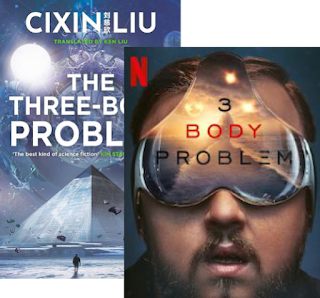
3 Body Problem - Series Review vs Book 1

I read the first book of Liu Cixin's trilogy (translated from Chinese by Ken Liu) in 2016. So, fittingly, just about enough time has passed for a radio transmission to reach and return from the Proxima Centauri system... Also, more than enough time for me to forget many of the details! So I was not overly focused on expected plot waypoints, or any finer details, in the new Netflix series.

This streaming adaptation is by Benioff & Weiss, of Game of Thrones infamy, plus Alexander Woo (True Blood writer, apparently). Thankfully, they won't have to make up their own ending from scratch, this time. But given that the books reportedly get increasingly grand in cosmological scope and concept, we'll have to see what they make of the rest, come season 2. Hopefully not too far off!

Book 1 (left). Netflix series thumbnail (right).

► My Initial Impressions of the Show [Low Spoiler]: the pacing was good and quick, despite the 1 hour episodes. So some of the many hard sci-fi concepts were shaved down to "blink and you'll miss it". Some things maybe discarded from the plot a little too soon. There was a frustrating lack of discussion of major events, following on from the big dramatic episode endings. 

But they managed to include a surprisingly large amount of the original material and feel, while finding a better compromise for retaining audience attention. Better than the somewhat laboured tour of scientific history, etc, in the first book. I was still surprised to see the show reach the main plot culmination of book one by the end of of the Ep 5. With 3 left to go! Apparently, they linearized the trilogy timeline, including a lot from Dark Forest and even some from Death's End.

I was a little disappointed how almost all the contemporary (2024) setting of the show was plonked down in London. Deploying a distracting remobilisation of GoT resources, with a far more 'international' cast than the books. White-washed vs the novels? Perhaps. But it worked well; the main characters were utterly remixed into an original ensemble, with more compelling personalities and social relationships. 

And there's already been a 30 episode (!) Chinese TV series adaptation, released in early 2023, with all Chinese cast. Apparently it drags badly, literally converting almost everything from the books. *Except* for the Netflix series' brutal opening scene, in the Chinese Cultural Revolution. The Chinese audience gets historical censorship, while we get soft power propaganda, only seeing the horribly outdated worse of China's tumultuous political neurosis and industrial devastation of nature.

Monday, 17 July 2023

"Scale" by Greg Egan - review and critique

► Review: I struggled to complete Scale; not up to the standard I expected from reading Schild's Ladder and Permutation City.

The concept is cool, if ambitious to reconcile in the messy details. But I was continually frustrated that Egan gave so few descriptive details of the different perspectives of physics, in daily life experience for the smaller scales. He glossed over a very major plot detail and entirely ignored the issues of eg shared air. I think because it (and other things) were too implausible.

Scale on Greg Egan's website.

It's mostly written as a straight detective mystery, from 3 main character perspectives. Which plays to his weakness of flat characters. Then, as politics becomes a major theme, that feels naïve, as if seen from space. And the bits of action aren't very thrilling.

I'd have preferred to see more of his usual trick, of skipping ahead through time periods and settings. Thus exploring more of the technological changes, and timescale divergence, in this wild little civilisation. Perhaps he knew it couldn't hold together.

Overall, I think this concept could have worked as a cheeky short story. Padding it out with human intrigue didn't work for me. I didn't care about Cara.

Tuesday, 28 February 2023

"Valuable Humans in Transit" by Qntm - short story anthology summary and review

Having read all commercially published works by this relatively new author, of hard sci-fi on stilts, I felt I can to snaffle up this collection of short stories too. Bite size, even for me, so I read and summarised one per day, between dinners. Keeping the old noggin active.

They are all revisions of existing short stories he previous posted for free on his website, which are linked here, as well as purchase options. 

► Lena - Cautionary tale of the first human brain upload being duplicated, incidentally tortured (for compliance) hundreds of millions of times in increasingly numerous parallel simulations, to use him as a cheap information processing commodity.

Qntm preciously threw this into Fine Structure Constant, in passing. It's a sobering thought for extropians like myself, intent on digital reincarnation with indefinite lifespan. But, I feel like ChatGPT and other generative AI are already making redundant this idea of simulating brain Uploads for such utilitarian purposes. It's gonna be many orders of magnitude less efficient and probably less reliable.

Thursday, 16 February 2023

"Blindsight" & "Echopraxia" by Peter Watts - a qualified positive review, discussion and questions

 ► Review (light contextual & thematic spoilers):

"Firefall" omnibus edition of both novels
These two hard sci-fi novels are ostensibly space operas, set near the end of this century. They depart from a world where base humanity is struggling for relevance, half choosing to live in virtual reality heaven. While technology has resurrected once extinct vampires.

But the author also uses the context and diverse assortment of transhuman characters, in each book respectively, to explore themes of, first: neuroscience, abnormal psychology and consciousness. Then: genetic engineering, augmented intelligence, belief, identity, culpability and free will (or lack of).

Both books have an explicit discussion of concepts at the end, with over 100 references to science papers and other books, in each. This comprises a full 10% of Echopraxia's total length! In case readers had any doubts about just how thoroughly researched and insightful these works are.

There are certainly spaceships, action and a novel first contact situation. But the plot arks were somewhat arduous through long mid-sections, with lots of dialogue that dragged a little. Brooding suspense and flashbacks, in one. Voyage with sometimes grating protagonist interactions, in two.

Echopraxia doesn't really continue on from Blindsight directly. For me, it had somewhat of a feel like, for example, Prometheus (2012) continuing the Alien (1979) franchise. Although there is technically one recurring character. Book two reframes the first a little and is mostly a chance to explore additional futurism and dig more into his conception of a hyper-intelligent vampire.

Despite a promising first book opening, that name checked the (technological) singularity and Ray Kurzweil explicit, I never quite meshed with the feel of Peter Watts' philosophising. Throughout either book. I think, in part, he deliberately writes to make things uncomfortable. There's certainly no heart warming romance or nice happy endings.

But, more fundamentally, in the afterword of Echopraxia, he explicitly states that he doesn't support/believe in the concept of digital physics. I.e. the leitmotif of most of Greg Egan's works, and (implicitly) many works by other authors, which have sat more squarely with my own core beliefs and understanding of the universe.

The character arcs conclude properly, in my opinion. Although there seems to be deliberate ambiguity left for interpretation as to exactly what and why various things happened, big and small.

Sunday, 19 June 2022

"Ra" by qntm - Book Review

I enjoyed this book. It had immediate personal relevance, kicking off in my old-university city of Nottingham! In the 90s, a little while before the time I was there studying physics. With its central female protagonist called Laura (weirdly also the name of a girlfriend I had there), its brief summary of her mundanely relatable romance spoke truth to me, too. Anyway... 

"Ra" initially presents as a kind of alternate history, where magic exists as a new kind of science. Only recently taught to undergraduates, in either applied or theoretical courses. Described as esoteric and remote, for the majority of the population. Much like quantum physics in the real world. In both cases, they've been quietly revolutionary for civilisation. 


Our protagonist makes the exception to this, with ostentatious, hyper-competent implementation of its possibilities. Magic is cast by speaking a kind of programmer pseudo-code, with an ancient Samarian (or some such) flavour. While simultaneously holding complex concepts in mind.


It's no coincidence there's an echo of "The Laundry Files" mathematical demonology, here; qntm has clearly been strongly influenced by several of my favourite sci-fi authors, including Charles Stross, who's tweet put me onto them in the first place.

Tuesday, 10 May 2022

"Left Hand of Darkness" by Ursula K. Le Guin - A Tepid Review

I picked up this novel because Ursula K Le Guin is often cited as an underappreciated sci-fi master and I've not read anything of hers. I started with Left Hand of Darkness because it was one of the top recommended, e.g. on the printSF Reddit.

I skipped over the two(!) additional introductions by contemporary authors, for fear of major spoilers I’ve had in the past. In her intro, she states: "Science fiction is not predictive; it is descriptive." Which is always somewhat true; dressing up contemporary issues in strange clothes to better understand them. 


Just as much a fantasy writer, apparently, this perspective makes sense. But not entirely so, to me. No prediction at all, would fly in the face of what I like most about my go-to fiction genre: exploring possible effects of future technological change.


She also seemed to say there was an unreliable narrator, telling some of this story..? But, even primed, I spotted no contradictory versions of events. [Edit: I don't know where I got this idea from, after re-reading her (1976) foreword. Kindle UK version.]


For a book published in 1969, it has largely dodged feeling entirely dated, courtesy of mostly avoiding high technology. The plot is grounded entirely on a somewhat backwards world (or at least, one that’s in no hurry to fully modernise). So the setting is very vaguely reminiscent, for me, of say "Inversions" by Iain M Banks.


Non-plot spoilers - In the rare appearance of a spaceship, it does sound like a stereotypically antiquated shiny silver rocket. While their FTL communications are basically a pager. Which, I guess, is still ahead of her time…? They have universally electric vehicles too. (I guess that transition is long overdue, for us.)

Saturday, 7 May 2022

"Kaiju Preservation Society" by John Scalzi - Review

An impulse buy, for me, when needing a new book to read on my Kindle. Kaiju Preservation Society is a quick, easy to read sci-fi novel by John Scalzi. I'd agree with his post-script, that it's the literary equivalent of a pop song.

It currently feels extra relevant, kicking off at the start of the Covid pandemic, in New York. Our protagonist's working for an UberEats competitor, seeing an uptick in demand. And there's an explicit reference to the opening of the genre cult classic "Snow Crash". Which comes up again as a bit of a running joke. So too, a couple more pop sci-fi references.


The story soon escapes miserable reality. I thought, at first, that we were going to taken on an interesting deconstruction of monster movie tropes. Focusing on more realist management banalities and such. But it only goes half way…


On one hand: the crew studying (and aiming to protect) the giant monsters are, realistically, almost all scientists with a complementary array of doctorates. They run through why such massive animals are physically impossible. Then proffer some bio-eco-physio-logical embellishments that might help realise this trope.

Sunday, 13 February 2022

"The Relentless Moon" by Mary Robinette Kowal (Lady Astronaut Universe Book 3)

Like books one and two, which I reviewed here, Kowal has very well written characters, with good narrative structure and pace. So "The Relentless Moon" is an easy reading page turner. Even though it's not my typical cup of tea: it is rigorously well researched hard sci-fi, but relatively low concept, big picture wise. 

Set in an alternative 1960s where severe climates change, caused by a large asteroid a decade hence, is spurring a much more ambitious manned (and womanned!) space exploration and colonisation program. To escape the inevitable runaway greenhouse effect.

[Goodreads]

We ride inside the mind of Nicole Wargin, while our previous protagonist, Elmer York, is on her way to Mars; this is a spin-off plot, running in parallel to the second half of book 2. We met Wargin before: one of the first batch of (lady) astronauts. The wife of a senator, who is now angling to run for president of the US.

Saturday, 17 July 2021

"Permutation City" by Greg Egan - Review & Discussion

Egan is famous for his very high concept hard sci-fi fiction that leverages his academic background in mathematics plus deep knowledge of quantum physics and computer science. Permutation City is no exception, exploring an even broader scope of fascinating concepts than Schild's Ladder, which I'd read years ago.

It's one in a set of 3 novels, by him, grouped together as "subjective cosmology". But they're not linked in any way besides this categorisation of theme.

It pushes far beyond hand waving philosophy, weaving in some solid technical references, as it explores concepts of: continuity of identity, simulation of consciousness, extreme transhumanist mind modification, subjective reality, artificial life within deterministic systems, computability, parasitic computation and "dust theory". Many ideas I consider important to at least be vaguely aware of.

His characters are adequately believable and his writing style reasonably sophisticated. Although my attention/motivation struggles a little, these days, with this kind of classic novel structure: alternating chapters between several characters, telling a story largely in parallel.

Tuesday, 13 July 2021

"Ancillary Justice" trilogy by Ann Leckie - positive review and discussion

"Ancillary Justice" (book 1 - 2013), "Ancillary Sword" (book 2 - 2014), "Ancillary Mercy" (book 3 -2015).

►Review:

"Ancillary Justice" is the first in the highly acclaimed, multi-award winning "Imperial Radch" series, from a debut female author [Wikipedia, Goodreads]. It felt very different from most of the sci-fi that I've read and loved, in not being primarily about a technologically exciting setting, cosmologically consequential events, or near future insights. It's overwhelmingly character driven, with an extreme focus on their development and back story.

Consequently, I was not utterly riveted by the first book, coming to it a couple years late, with a gap of a few more years before recently returning to finish the arc. But the story really grew on me; I can understand why this caused a splash.

I'd describe the core (feel good) hook of these books as ethics competency porn. The central character, Breq, always seems to hit the nail on the head, in terms of picking the most righteous course of action. Even in thorny situations, sticking it to the callous powers that be, etc. In a similar way to how Iain M Bank's Culture novels have a kind of ship mind competency porn, where it may come down to the last breath, but they clutch it out somehow, against all odds. More on the link between these authors, later.

Much has been made of Leckie's unique take on gender [e.g. Slate]. With Breq's biological sex never explicitly confirmed. Equality and gender neutral pronouns are one progressive aspect of the deeply flawed Imperial Radch empire. Feminine pronouns are always the default: she/her. Breq struggling to accurately gender some of the people they meet is certainly a cute device to accentuate this point. But it made less sense to me by the end of the series; when she was the troop carrying spaceship "Justice of Torren", she will have been intimately involved in matchmaking and interpersonal harmony between the many officers of her crew.

See, Breq is the last surviving fragment of a millennia old ship AI. Out, from the start, for revenge against the tyrant who murdered the rest of her. In the first novel, the story and meaning behind that unfolds in flashbacks interwoven with her travails on this quest. It's built up in a way to really put the reader into the shoes of this perpetually angry but compassionate intellect. Dealing with loss of function, identity and purpose. Redefining herself as she unexpectedly builds up a new life, sweeping through the whole arc to a satisfying conclusion.

The prose is well written and paced, with the occasional song lyric snippets included, that didn't make me turn off or really cringe; songs and their collection is a core personality trait of our protagonist. The latter two books are essentially linear, by comparison. And set in roughly the same place; this isn't a romp around the galaxy. Instead we explore in more depth, as events develop and unlock new possibilities.

There's certainly exciting build-ups and some interesting action. But generally it's more low key and human scale - tactical and psychological. Perhaps more of a stereotypically female thinking approach to things, overall, with tensions bubbling under the surface of outward civility. A lot of weight placed into subtle details and even menial activities, that, on paper I wouldn't have expected to get on board with. But fell into an easy rhythm.

I was really glad I read the whole of this trilogy, by the end. Hitting a very satisfactory conclusions via an often unexpectedly understated route. Although I wonder if it will be less memorable for me, in not hitting the more physical/technological notes that usually excite my interest. This trilogy might be good for fiction readers who don't normally go for sci-fi; maybe genre gateway books. 


► Discussion with SPOILERS!: much of the text below is content summary, as I struggled a little to pick many outright faults or failings. Nor interpret meanings too far beyond some fairly direct, probable and some (perhaps) wishful thinking references.

Tuesday, 6 July 2021

"Bobiverse" trilogy by Dennis E. Taylor - Criticisms

We are Legion (book 1), For We Are Many (book 2), All The Worlds (book 3).

► Overview Review:

These were easy reading sci-fi and they can't have been that bad, given that I read all three consecutively. I know there's now a forth book in the series, "Heaven's River". But I'm going to treat the first 3 as a stand alone trilogy, seeing as they round off the plot arcs at the end of the third. Also, I don't have the interest to read any more, for the reasons below...

Thursday, 16 January 2020

"Autonomous" by Annalee Newitz

Review:

A pretty straight forwards and compelling sci-fi read that I liked. I enjoyed the female central protagonist - James Bond age, scarred and entering a tryst with a hapless but permissive younger man, along the way. And the high (i.e. balanced) number of other strong female characters. Perhaps merely realistic, given the bio-science setting.

Its 2144 setting seems extremely conservative, to someone like myself. Quite possibly aimed at a more mainstream audience - it was, indeed optioned by AMC for a TV adaptation (admittedly what brought it to be on my read list). In terms of personal freedoms and distopia it even seems a little quaint, naive, compared to the (rapidly deteriorating) contemporary political situations in many countries.

I didn't really feel like the cover tag-line was justified, calling it the Neuromancer of biotech and AI. But that William Gibbson story is a little over-hyped itself (and outdated, now). The fictional science and technology felt pretty prosaic - under-ambitious in scope and impact. Except for a use of viruses (at the end) that seemed to jump the shark in implausibility. The AI are all human equivalent robots, with no hint at the influence of trans-(or even sub-)human AI. Let alone why there's been no Singularity, etc.

Specifics [SPOILERS]:

Sunday, 12 January 2020

"The Calculating Stars" & "The Fated Sky" by Mary Robinette Kowal

Review:

Two fairly short, well paced sci-fi novels that tell of an an alternate history branching from 1952, when the Eastern seaboard of the USA is hit by a large meteorite.


The story follows a female protagonist who is a scientist, 'computer' and ace pilot, as she, and her refreshingly supportive lead space engineer husband, face the trials and tribulations of fast tracking a space program to ensure against the consequences of this catastrophic event.

The first novel of this duology could stand entirely on its own, but I enjoyed it enough to buy into the continuation and be entirely please I read them both. Even though it's not the kind of hard sci-fi I'd generally go for. There's great technical adherence to the practical realities of spaceflight (and American life) in that era. But no attempt at predicting on technological or societal changes in our own future. And its not really a space opera in the usual sense.

In shines in its feminist tilt, looking at struggles against counterproductive sexism, and racism, in the space program setting. From the perspective of an unlikely heroine, who's main problem is crippling physiological anxiety stemming from physiological mistreatment by the male establishment. Rather than the rigours of spaceflight itself.

The main male characters are interesting constructions, too. The husband appears to be almost an idealised reference for how a feminist might specify best practice male behaviour (towards women). Perhaps a little artificial, but refreshingly non 'rough around the edges'/interestingly imperfect. I found their, more subtly written, physical romance scenes heart warming.

The most interesting character arc is that of a more senior male antagonist. He's initially a somewhat 2D male chauvinist, borderline(?) rapist, who our protagonist is forced to deal with and get to know better, in halting steps forwards and back. Ultimately not ending up going quite where I expected.


Issues [Spoilers]:

Sunday, 5 August 2018

"Avogadro Corp" by William Hertling

From the cover's tag line "The Singularity is closer than it appears" I expected this book would be a bit pat - aimed perfectly at my interests, as per this blog's focus. It certainly was very pat. Entirely straight forwards and linear in it's plot structure, with overly plain language and cardboard characters prone to converse in totally unrealistic exposition.

This book is basically a long form best guess at how a very early technological Singularity might be kicked off, via the accidental creation of AI. "Avogadro" would probably have read "Google" if not for the trademark issue - that is literally the company described, in every detail. As such the story is unimaginative. Yet it is still unbelievable in the amount of contrivances it throws in, to start the plot rolling.

The behaviour of characters is often uncanny, too - although this may be down to writing for brevity, without the author having the deft wordsmith skills of the likes of Charles Stross (let alone Banks).

To be fair, it was easy reading, for me, with short chapters and good pacing - I actually finished it (first one this year!). I'm considering going forwards onto his sequels, except the first chapter excerpt name drops both "Gibson" and "Stross" (as future phone handset models). Ick; clearly the author's influences are near perfectly aligned with my own, here, but his hat  tips are ugly AF.

Sunday, 11 September 2016

On: Stephen Baxter's "Raft"

Trying to branch out to new authors, and potentially new series, Stephen Baxter was a name that has come up a fair bit and particularly his "Xeelee" universe novels. I took a chance, aiming to start back at the beginning, with "Raft", from 1991.

A quarter century old now, it shows it. Not so much via obsolete direct technological references, which are ducked via context. (Although there is one to a large IBM computer, which stood out). It's more the immaturity of the writing.

The setting is ludicrous in the details of it's physical infeasibility, but a fairly novel premise: what if the gravitational constant, in a parallel universe, was crazy strong, such that cosmology scaled right down to human sizes? Stars the width of towns, 'planets' a few dozen 'yards' across (not sure why he chooses imperial here). Throw a bunch of (former) space faring humans into the mix and what weird, appalling, structures might their descendants inhabit there...?

Friday, 16 October 2015

Hannu Rajaniemi's "Quantum Thief" Trilogy


Review:

The pinnacle of high-concept, hard sci-fi, space opera cyberpunk, seemingly packed with every single concept the author could find, and he's a very smart guy: physicist, mathematician, cosmologist, recently launched a synthetic DNA start-up (via his TEDx talk). Finnish, but writing while in Edinburgh, literally hanging out with Charlie Stross, it's no coincidence that he's taken up the baton of writing the most futurism-idea dense, fast-paced (show don't tell) space-romp fun. Think "Accelerando" with the breakneck pace of "Singularity Sky". Stross surpassed I.M.Banks for this crown (in my mind), with stories that made traditional (mainstream) spaceship fiction look like quaint period dramas, pootling about in sail ships.

Mind uploads, planet scale computronium and all types of Singularity as obvious givens for Hannu Rajaniemi. He imagines the consequences of massively duplicated and branched individuals, in a complex future where identity and memory are slippery constructs and inequality has been inflated to vertiginous levels. It is cyberpunk, spun out, with contemporary nationality wiped away by subcultural identities flung across the entire solar system.

References are littered everywhere, at every scale of the telling, from throw-away pop-culture name drops (of famous games, anime series, etc), to terms for Ukrainian governance sub-divisions, to politics, philosophy and the (centuries old) historical origins of transhumanism. The books are so thick with meaning that they're far bigger than themselves; overloaded; virtually all the names and terminology (while sounding awesomely fitting, also) link the reader out to explore countless Wikipedia articles and culture.

Each of the three books has it's own distinct flavour, thematic reflections: personal, social (structure), philosophical and particular literary influences. Each also converges on a different planet, so their sub-arks cohere well as separate books. But they undeniably form a very carefully pre-planned and crafted whole. Densely plotted, too: subtle elements of the very first chapter of the first book become key through to the last. So, although Rajaniemi weaves in little reminder snippets here and there, it's highly advisory to read these books consecutively, and even then it may be worth checking out glossaries and/or synopsis in between.

If you are reading my blog, then you may well be within the core audience for this story, too. It fits perfectly with everything I've aimed to write about here myself. Other reviewers have complained of these books flying over their heads. Certainly I've been compelled to re-read sections, research meaning, etc, and am still not certain of precisely what happens in the conclusion. It is, however, definitely wrapped up properly. And I've had a virtually parallel (although even less than mediocre) academic path through physics and computer science, with strikingly overlapping cultural influences to the author (being, myself, only a little younger).

So perched atop the shoulders of high-concept sci-fi past, I'd definitely not recommend this series to the genre naive! Something to build up to, even more so than advice for readers to get a feel for Culture novels before embarking upon "Excession" or "Use of Weapons". Even then, you'll probably have to just roll with punches and maybe go back to pick out more of the details later. But  worth the effort and it works on multiple levels anyway!

[1] Quantum Thief (332 pages):

The first and best of the three. There is just no way that the others could ever have competed with the addictive rush from the tidal wall of novelty this installment hits you with! Also, with so much still a mystery, the fictional solar system feels bigger and far more real; a story in a crazy place, rather than about the place itself (which is more the case as the books progress).

The main setting here is also the most compelling in its familiarity, being structured around extreme technologically enabled privacy, with surveillance and control through information, all pressing issues (much like our present). The morally ambiguous gentleman thief character archetype drops perfectly into this setting, initiating the serie's liet motif of examining imprisonment, imposed control, security, enforced uniqueness, versus theft, liberation, diversity, etc.

[2] Fractal Prince (331 pages):

Feels the most out of place with the city of "Sirr"; it's characters didn't quite fit for me, or at least they are less knotted up with the plot than most of the others (arbitrary and single use by comparison). Twaddud felt stilted. Also, my disbelief was stretched thinnest here, with a core plot mechanism that could be a satire of Hofstadter's "Strange Loop" concept.

It's probably the easiest book to get lost in, which is saying something, since there are glimpses of deeper meaning secreted in plain sight throughout the trilogy, like fractal detail to gaze upon during re-reading. But this novel's "Arabian Nights", story(s) within story(s), "Inception" like structure doesn't help, and the intermingled interludes and flashbacks gain more concrete context from reading the next installment.


[3] Causal Angel (303 pages):

Neatly ties together all the pieces, places and people previous covered. Yet it is slightly shorter than the previous two books and feels shorter still. The plot is more linear, like it is following the ballistic trajectory that was set in motion.

Perhaps it could have dwelt a little longer on certain places and people; maybe some of the developments risked feeling a little too emotionally gymnastic, or unremarked upon. Although the core characters were developed across the entire length of the ark.


Discussion (SPOILERS Ahead!):

Monday, 10 March 2014

Hydrogen Swan Song

This is a good novel. A good sci-fi novel by a great author. A great author who died last year, at an unfitting age, and will be fondly remembered by his body of fantastic works.
Photographed - Hydrogen Sonata. Front inset Iain M Banks. Rear inset Iain Banks.
It certainly held my attention, and looking back, the second 300 pages felt more like a last 3 chapters (in that the end of the story flew by far too soon). However, I didn't find it as exciting or stimulating as previous Culture books. Maybe I am just not as ravenously enthusiastic for this kind of material as I was previously; older and wise to these fantastic vistas. The concluding details didn't feel surprising, but it never really felt like they could have been; I was resigned to the plot arc being somewhat frustrating, inevitably stuck dancing around the familiar end of the rabbit hole (so to speak).

As I've said previously, there's no way to wrap up the Culture itself: they have been so well written as the epitome of a stable utopia: stubbornly determined to keep on partying forever, while making damn sure everyone else has as much fun as possible too! So I was hoping for a complete change of pace by having a prequel. There are teasers here, but little exploration of this direction. 

Monday, 27 January 2014

"Engineering Infinity" anthology summary/review.

I picked up this anthology of hard sci-fi (published 28 Dec 2010) from the library to see if it would inspire me to branch out to some new authors. Despite it's compact size it's taken me more than a couple months to nibble my way through at bed times, though I'm, not sure a compelling single span novel would have been consumed any quicker.

I've written a brief review of each story, marking the ones I found most notable with a *.  Those by Karl Schroeder, Hannu Rajaniemi, Charles Stross, John C. Wright and Gwyneth Jones (each for different reasons).

p13 "Malak" by Peter Watts:
From the perspective of an unmanned killer drone, "Azrael", that acquires a prosthetic conscious in the form of a collateral damage calculator. It only brings grief though, as it's aborts are always overruled by remote command. Pretty competently written, but unsurprising (with it's inevitably trite resolution); reminded me a lot of Stealth (2005), obviously. Formulaic.

p31 "Watching the Music Dance" by Kristine Kathryn Rusch:
A near future tragedy, when a family that loose everything after a mother becomes obsessed with molding her daughter into a musical prodigy. The (limited) genetic engineering, "enhancements" and "apps" (for the girl's Neuromancer style, behind-ear chip) come at great cost to the financially crippled family. Creatively constructed, from the perspective of the autistic sounding girl and the father (in the 1st and 3rd person respectively). Dealing more heavily with the personal and emotional context is a good way to avoid being too specific about future technology.

* p47 "Laika's Ghost" by Karl Schroeder:
I could have believed this was a Charles Stross near future thriller. A world-worn, free lance, nuclear decommissioning inspector, come minder, returns to his home land (Stepnogorsk, Kazakhstan - part of the setting for Stross's "Rule 34") with a young American under his wing, who's on the run from the CIA, the Union of Soviet Socialist Republics Online (based in Seattle) and Google. The world-wind adventure brandishes guns and hydroponics en-route to a slightly impractical conclusion that's nonetheless satisfactory, for such a short story.

Wednesday, 7 August 2013

A Run of Mediocre British Sci-fi?

Did I hit a somewhat unlucky run of reading or am I just bored of sci-fi?? To get these out the way, and out of mind ASAP, I'm going to try and round all 3 up together here.

I became page-jammed, with the top two books (as pictured) over a year ago, stuck mid chapter, a few dozen pages into each. With blog posts having dried up about the same time, that may have been down to a dip in cognitive function with most remaining resources sunk into co-leading an alliance to a #2 crown on World 75 of Lord of Ultima). But with miraculously improved health (more on that later), dust was blown off and determined reading resumed... and then continued on through another novel that had been entirely self-locked for years. Since I finisihed Reynolds just this morning, I'll start with him.

House of Suns (Alastair Reynolds):

By the numbers, hard sci-fi, space-opera, second star to the right and straight on until morning. That is to say, it certainly wasn't unpleasant (in the way that Divergence had me staring at the page in aggrieved disbelief, sometimes), but there was little omph. No real surprises...
[But still, spoilers after the page-break are greyed out (please highligh to read easily).]

Friday, 3 June 2011

'Recursion' by Tony Ballantyne

From a distance this novel should be right up my street, with a plot about self replicating machines that eat up entire planets. But his visions of the future are generally uninspired and wholly lackluster, mired in the clunky, Simple-English-Wikipedia of his prose.

+ Criticism:

It may be Ballantyne's 2004 debut, but it looks certain that his later work will never progress beyond amateur hour in comparison to (for example) Ian M Bank's fecundly imaginative narrative, or Reynold's brooding atmospherics. The scant few unfamiliar technologies presented in Recursion are named entirely literally, like the pivotal "Von Neumann machines" (or "VNMs"), for example. The number of raw ideas in Recurusion would barely sustain a couple of chapters of a Stross book. Also, either of my aforementioned favourite writers usually leave me with a post-it note full of fun new vocabulary that required Googling (if I'm in a literary mood), I almost feel I might have done a better job myself.

The 2051 (chronologically earliest) storyline was the most compelling in terms of character, and managed to build tension, terminating with a modicum of surprise (although it may as well have been set in 2020 in terms of future-fantastic).

The spy thriller thread (in 2119) was unconvincing and the coherence of the protagonists falters badly when he tries to write a frantic fleeing scene, that incidentally felt like it owed much to 'Eternal sunshine of the spotless mind'. In fact the cumbersome way details are often spelled out, some needlessly arbitrary events and the odd gaping continuity hole leave the whole thing feeling like the synopsis for a Hollywood movie. Which seems to be where much of the author's inspiration comes from.

My impression from the opening page, with 'Herb' in 2210, is that it could have been written in 1964, not 2004. Incidentally, his impression of a black skinned antagonist in this opening chapter left me somewhat uncomfortable (embarrassed on the author's behalf). Herb is the least believable character, supposedly smart (for a human) he is made to act overly retarded, attempting to paint the robot character as implacably smart, and allow many details to be spelled out to the reader through dialogue.

+ Nuts, bolts and spoilers: